
We are very pleased to bring you a new sound offering in honor of this particularly auspicious full moon. Through these songs, we strive to bring together Pagan voices from all over the world, spreading a network of support, positivity, and spiritual action. We would like to thank Desert Rose Arts, Marble Mountain Woodworks, and Dodssang Tempel for their excellent vocal contributions. Other voices have asked to remain anonymous. This track is meant for quick practice as opposed to our longer version of the Elder Futhark. By listening to this brief galdr, one can quickly memorize the names and order of the Elder Futhark runes with ease; solidifying them internally for use at any moment of need. The Ansuz Society family tree is growing. With deep roots, we stretch towards the sky. May all sentient beings thrive under the guidance of the ancient runes.
yoga
Tantra, Practice, Experience
In science, one applies approved methods to achieve a certain outcome. If one wants to develop new methods, they experiment until they find what works, then relay the information to others.
Tantra is an identical process, although it works on the plane that science struggles to grasp, the spiritual or metaphysical plane of conscious beings.
If you practice a certain tantric technique in the correct way, you will generally be able to achieve the results that the tantra describes, as long as you understand and have crossed the thresholds present in any preliminary practices.
In this way, one doesn’t usually follow the path out of blind faith, but rather, does so because of the direct experience of that which the tantra describes. Without putting the methods into practice and without direct experience, there can be no hope of achieving the described outcome of a tantric text or teaching.
No matter how much one reads about a topic of activity like meditation or tantra, if the material is not practiced and experienced, it will remain a distant, exotic fancy for one to flirt with.
May all sentient beings look inward and experience mind in its raw state.
Hailaz / Namaste
-Ansuz Society
Non-Profit Approval
Last year, during the time between Samhain and the November Full Moon, we carried out a 9 day ritual which covered many different aspects of reverence and renewal.
On the evening of the full moon, we concluded ritual operations by dropping off our letter for non profit approval at the local post office. Since then, we have been waiting patiently for the process to unfold.
Today, we finally found out that we are indeed approved by the state of New York to operate as a not-for-profit corporation. This opens up many doors for the future and will give us the opportunity to put together more events to benefit all.
Our purpose and dream for this project since the beginning was to create a space for all beings to practice on this path; a spiritual center that can be a source of refuge whether one is near or far. Whether Pagan, Hindu, Buddhist, or nondenominational, we aim to create a Sangha of practicing individuals with mutual respect and understanding for one another.
We are very happy to share this news with you.
May all beings thrive.
Hailaz / Namaste
-Ansuz Society
Information for Summer 2023
Shrines, altars, trails, and meditation areas are open to visitors daily by request. If you want to visit the grounds, please feel free to reach out.
This project is aimed at giving individuals the space and environment necessary to develop themselves spiritually. This is something we feel is desperately needed in our society, as people are usually unable to practice in any meaningful way due to their living circumstances.
In the past, we’ve been fortunate enough to frequent other places dedicated to the development of human beings on a spiritual level, such as Self Realization centers, Vedanta Societies, Meditation Centers, Monasteries, and Pagan holy grounds.
Because of these places dedicating themselves to the benefit of others, countless individuals are given innumerable opportunities to grow, learn ways to cultivate feelings of well being, and overcome negative tendencies. We feel all sentient beings must have space for this.
We’ll be setting up a membership program this summer for folks who want to consistently be a part of things here. This is to form a family of people who feel passionately about assisting in the creation of space for this purpose. Eventually, we want the Ansuz Society to be a family with similar values, driven by the inspiration of those involved in its’ efforts.
Regarding personal interaction with shrines and altars:
We encourage you to practice as you feel appropriate. Personal offerings to deities and natural sites are absolutely acceptable, we just ask you to please not take anything off of the shrines or altars.
May all beings thrive.
Hailaz / Namaste
-Ansuz Society
Awareness, Samsara, and Meditation
The fact that there will always exist a present moment is a point of permanence one can take solace in.
Past and future are littered with attachments and desires, polluted by expectations and other products of our ignorance like fear, anxiety, etc.
Whether we know it or not, these afflictions are the causes of our suffering, keeping us “fettered” in a state of constant flux, away from the present moment.
Although this is the case, it isn’t something that we need to be upset about. This is just the nature of living within the confines of endless change, the endless spinning of Samsara that all beings are subject to.
One thing that doesn’t change in our experience, however, is the primordial state of awareness regarding the here and now. Minds natural state of naked clarity. Like the center of a wheel, true nature of mind is fixed in place no matter how fast the rest of its parts may be going.
When one can reach this realization and become familiar with it, they can observe their minds’ habits and patterns more easily, removing obstacles, worries, and distractions with consistent practice. One can begin to sever problems from their roots.
This is a method to liberate one from Samsara and achieve a state of samadhi, free of time and space. A tiny glimpse of this pure “enlightenment” is enough to shatter our many delusions and make us strive to practice with more vigor and dedication.
To reach that place within that doesn’t change, is to escape the motion that the “Wheel of Life/Wheel of Becoming” represents, giving one a sense of peace that doesn’t exist in any materially found means.
If we can learn to rest in this experience of present awareness, we can observe all phenomenon that arise in our experience without attaching ourselves to them, giving us a a sense of well-being, freedom and love.
May all sentient beings find a place of unchanging peace within.

Om Namo Bhagavate Rudraya
When meditating on Shiva/Rudra, it is important not to confuse the deity with ego. We should never impose our current (lower) self on the visualization that we create/invoke during deity yoga. If one already thinks they are perfect, what’s the point in trying to change, grow, or spiritually develop?
The point of forming/inviting the deity during meditation is to purify or destroy obstacles within one’s mind, receive blessings or protection, or to approach the deity as one would approach a mother, father, or guru for advice, confession, and guidance.
This process is to be visualized within the practitioner’s mind, requiring immense focus and discipline to construct more elaborate images of our deity in focus, allowing for further symbolic potency and generation of enlightened activity. It is important to pay attention to visions or details that arise and meditate on them further later.
Because visions and epiphanies can be hard to analyze on our own in the preliminary stages of practice, it is recommended to seek a teacher when practicing deeper levels of tantra in order to maintain correct interpretation and application of the results of the practice, as it is a much “riskier” system of training than non-tantric forms of meditation.
Mistreating tantric practices or using them only for personal gain is a sure way to send oneself into lower states of being, and further, into rebirths of great suffering. It is much easier to get oneself lost in these “darker” areas than those who wander the “lighter”, more trodden paths.
In conclusion, the point here is to focus all awareness on the deity or guru, allowing a stream of communication to form between yourself and the deity. One practices this “external” type of visualization until one is ready to move to the next step, which is absorbing the deity in ones being, essentially replacing the tainted properties of our unawakened state with the higher qualities of either deity, guru, or yidam.
This is a basic summary of introductory deity/guru yoga practice.
May all beings benefit.
Hailaz / Namaste
Cernunnos
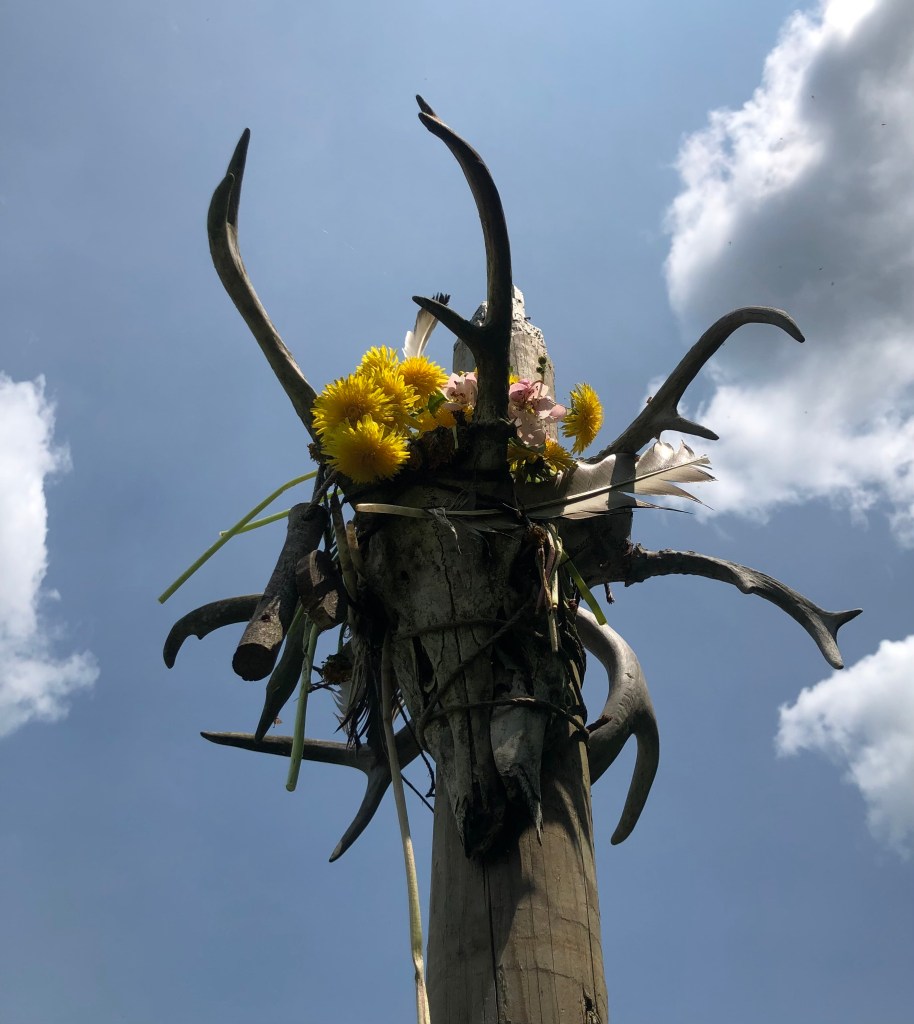
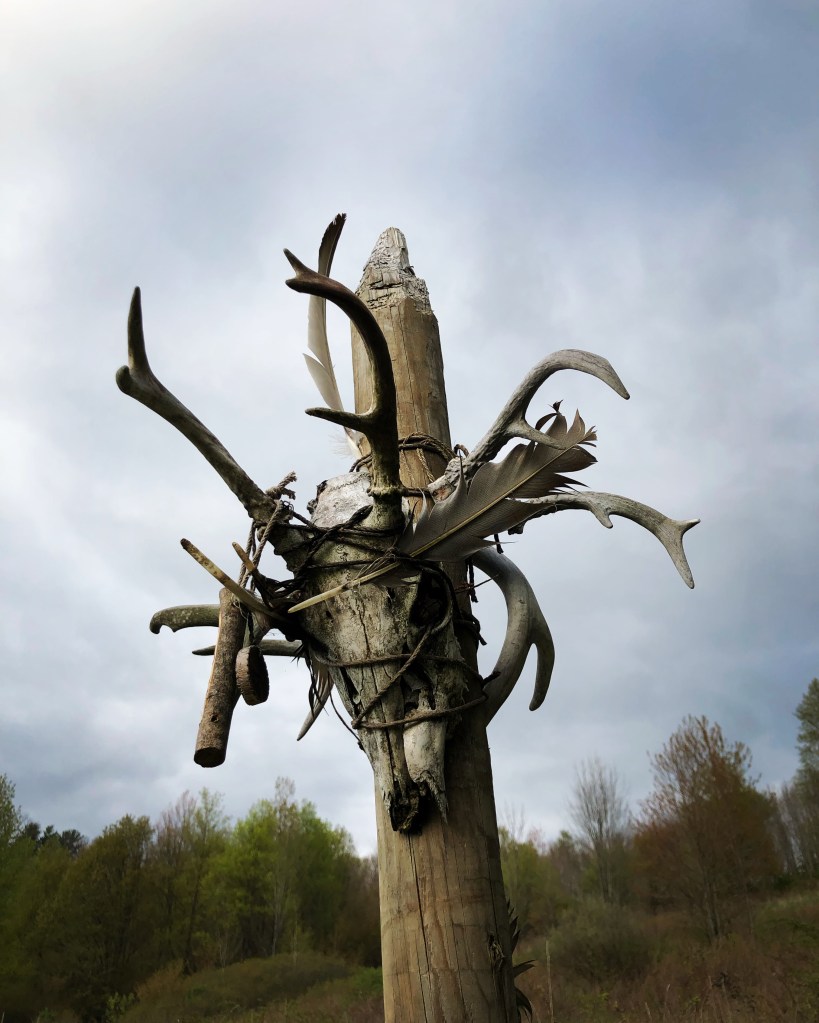
Cernunnos/Hurnaz represents the spirit, soul, or incarnation of the forest itself. Unlike most gods, which fill an archetypal form congruent to their other roles, Cernunnos isn’t necessarily one that the practitioner aspires to be(come), but rather, a spirit one asks for protection, aid, and blessings from. Our idol stands at the edge of our property where things are considered “ordered,” representing the liminal space between the safety of the homestead and the inherent dangers of the wilderness. With this in mind, and within a Germanic context, we see Cernunnos representing an older, ancient, natural “Jotun” or “Wight” type of spirit; one that we must form a relationship with if we want to have a completely unified connection and understanding of the forest and all of its life forms.
It is here we bring the dead we find and offer fruits and other foods for the wildlife, the children (and embodiment) of the forest. Cernunnos represents all landavetter and spirits residing in the mysterious woods.
This god, as all others, has many different venerative systems, especially based on where it is you are practicing. If in a more urban setting, one might view this god as the Roman’s or civilized Gaul’s did, as a fertility and commerce god. If in the rural or farther reaches of society, one might have a more direct relationship with this god as the embodiment of the forest, as one by the sea would visualize the entirety of the ocean as Poseidon or Njord. Likewise, many cultures practiced this type of veneration in association with their geographical surroundings. Volcanoes, mountains, forests, lakes, oceans, etc., all embodied a certain god form inherent within them. This is where polytheism and animism overlap, forming the mindset of many of our ancestors prior to Christianity.
May we all venerate the great spirits of nature.
Goþa Fara (Spring Equinox 2023)
We are happy to bring you this new song “Goþa Fara” on this beautiful and auspicious Spring Equinox.
‘Goþa Fara’ is a Gothic phrase meaning, “have a good journey,” and is meant here as a blessing to all beings embarking on new journeys, whether in life or in death.
This song, in particular, is dedicated to my Grandfather, who passed away this month at 94 years old, still standing tall.
May his travels be light and swift.
To all those who are honoring the Dawn goddess today, may these words bring benefit:
Hailaz Austrō, great goddess of Spring,
Lady of light, and slayer of darkness.
May our offerings encourage your loving guidance,
On this equal day and equal night;
Your affluent heat, and cosmic glow,
The gifts of prosperity, among us all.
We give to you, this song of praise,
Exchange our devotion for longer days.
Hailaz / Namaste
-Ansuz Society
Lord of the Wind
We’ve added a new song to the channel titled “Lord of the Wind.”
This is a devotional song to the All-Father, Odin.
“…Holding wisdom old as time,
Elder god of masks and rhymes,
Flames rise to lick the sky,
Send our gifts to those on high…”
May all beings benefit.
Hailaz / Namaste
-Ansuz Society
Jaya Shiva Shankara
We are very happy to bring you this new mantra in 108 repetitions.
Use as needed.
May all your doubts and worries be destroyed by unwavering faith.
Om Namah Shivaya
Hailaz / Namaste
 Ansuz Society