
Subscribe to continue reading
Subscribe to get access to the rest of this post and other subscriber-only content.

Subscribe to get access to the rest of this post and other subscriber-only content.
Subscribe to get access to the rest of this post and other subscriber-only content.
Subscribe to get access to the rest of this post and other subscriber-only content.
Stanza 23 of The Hávamál reads:
“The witless man is awake all night,
Thinking of many things;
Care-worn he is when the morning comes,
And his woe is just as it was.”
This stanza offers timeless insight into the nature of worry and sleeplessness. It warns against the unproductive torment of overthinking, something that transcends time, culture, and language.
Insomnia and nighttime rumination are now well documented features of anxiety and depression. The pre-dawn hours, when the world is still and our thoughts are loudest, can feel especially oppressive.
Odin’s advice urges wisdom through healthy and proactive emotional moderation. He implies that constant brooding leads us nowhere. A sleepless night of rumination changes nothing and only compounds one’s suffering. This is the product of avoiding one’s anxieties during waking hours. We cannot hide from these things.
This emotional state also appears in Anglo-Saxon poetry, such as in The Wanderer. The speaker describes his lonely morning sorrows: “Often I must bewail my sorrows alone every morning: none is now alive to whom I dare plainly speak my mind”.
Interestingly, a similar concept is found in the Old English word uhtceare, which roughly translates as “pre-dawn anxiety” or “the sorrow before dawn.” It refers to the experience of lying awake in the early hours, consumed by worry. The word is formed from uhta, meaning the time just before daybreak, and cearu, meaning care, grief, or anxiety.
The fact that both Norse and Anglo-Saxon traditions preserved and named this specific experience speaks to how universally felt it was throughout the Germanic world.
Yet, perhaps there is comfort to be found in this. The ancients wrestled with the same restlessness that plagues us today. If even the Allfather himself thought it important enough to caution against, then perhaps it’s a reminder that we’re not alone in our struggles. And that, in itself, may offer some solace.

The Sanskrit Triratna (Triple Gem/Three Gems) mantra is a universal refuge prayer for all Buddhists, sung in all schools of Buddhism from the Theravada to the Mahayana and Vajrayana. The mantra proclaims the following:
“I go for refuge to the Buddha,
I go for refuge to the Dharma,
I go for refuge to the Sangha.”
Refuge in the Buddha means to acknowledge the omniscient and unshakable nature that the Buddha represents, and to aspire to acquire that state. Refuge in the Dharma means to accept the authority of the teachings and to follow them diligently as a road map to enlightenment. Refuge in the Sangha means to find solace and inspiration in spiritual friends, teachers, and community.
This is a basic interpretation of the mantra as generally understood by most practicing Buddhists. However, as one gains deeper meditative insight, one’s guru will reveal further interpretation, depending on the school one involves themselves in.
Sanskrit:
Buddhaṃ śaraṇaṃ gacchāmi.
Dharmaṃ śaraṇaṃ gacchāmi.
Saṃghaṃ śaraṇaṃ gacchāmi
Pali:
Buddham saraṇaṁ gacchāmi
Dhammaṁ saraṇaṁ gacchāmi
Saṅghaṁ saraṇaṁ gacchāmi
Image link: https://www.himalayanart.org/items/61240
#buddhism #triratna #refuge #dharma
Padmasambhava, also known as Guru Rinpoche, was a legendary tantric Yogi and the founder of Vajrayana Buddhism in Tibet, bringing the religion from India around the 8th century and establishing the first Tibetan sect now known as the Nyingma (Old School). He is considered by many to be the second Buddha, foretold by Shakyamuni (Gautama Buddha) to reveal the tantric/esoteric (Vajrayana) teachings and to propel and protect Buddhism in the degenerate age (Kali Yuga).
Jigme Khyentse writes in the book “White Lotus,”
“Before he [Shakyamuni] passed into mahaparinirvana, the Buddha prophesized that his activities would be prolonged and his teachings propagated and protected by Padmasambhava, whom Tibetan Buddhists frequently refer to as Guru Rinpoche, the Precious Master.”
Vajrayana is an outgrowth of Mahayana Buddhism and involves a wide collection of practices aimed at providing liberation (nirvana) in a single lifetime, hence its name meaning “Thunderbolt Vehicle.” This differs from the Mahayana (Great Vehicle) path where it can take an untold number of lives (incarnations) to accomplish complete liberation. Because of this difference in philosophy, the indigenous Tibetan and Himalayan peoples could only be persuaded by the infinite power of the Vajrayana and were quite reluctant to adopt Buddhism prior to Padmasambhava’s arrival.
Through various trials and tribulations, Padmasambhava was able to subdue the powerful gods and beings who inhabited the region of Tibet. In doing so, he gained their favor and service in return, incorporating them into the Buddhist religion as protectors and stewards of the Dharma. This is why we see numerous gods from other pantheons mentioned in the rituals and myths of tantric Buddhism, as Vajrayana practitioners of all nationalities seem to include their own ancestral deities into their practice. This is easily observed in the Tibetan, Japanese, Chinese, and Mongolian variants of Vajrayana, where each culture has created a syncretic and unique flavor of religious practice, not completely removed from its source but rather philosophically reformed and reworked.
The mantra of Padmasambhava OM AH HUM VAJRA GURU PADMA SIDDHI HUM is one of the most popular and powerful mantras used in Tibetan Buddhism, recited often to instantly evoke the Guru, gain enlightenment, and achieve siddhi (occult power). It can be translated in many ways and has various levels of meaning, but a general interpretation of the syllables would be:
OM AH HUM – Purifies body, speech, and mind.
VAJRA GURU – Perfect Teacher.
PADMA – Lotus, synonymous with nature of mind.
SIDDHI – Occult power, success in practice, accomplishment.
HUM – The syllable of enlightenment, the unshakable nature of ultimate truth.
Padmasambhava permeates everything and exists everywhere, nestled into the very fabric of space and time. At the time of his death (parinirvana), he achieved “Rainbow Body,” dissolving into light and leaving behind nothing but hair, nails, and clothing. He is known also as Padmakara (Lotus-Born), meaning he is born in our minds, existing eternally in the unstained regions of our consciousness, quickly summoned by this sacred formula. This mantra should be recited as often as needed, whether for guidance, protection, clarity, wisdom, or any other purpose.
OM AH HUM VAJRA GURU PADMA SIDDHI HUM
Subscribe to get access to the rest of this post and other subscriber-only content.
This process is something that is done differently by almost everyone, as there has never existed a pan-Pagan dogma regarding this type of activity. However, most would agree that when constructing an altar in the Germanic fashion, there are 4 main pieces to consider. These 4 pieces we will cover here along with other ideas for what one can add to their setup. Having an altar dedicated to spiritual activity is important, as it gives one a place to conduct work that is vital to the human experience.
First, one must find a location that one is drawn to, perhaps isolated in the forest at the foot of a particularly powerful tree, a secret natural site, or inside one’s home in a secluded area. Second, it is recommended that an organic “table” be present in the location to conduct exchanges and make offerings, such as a stump or flat stone. If there is not, one should build something for this purpose. This can be a simple platform, or it can be an entire temple, this all depends on the person’s means and dedication. Third, the deity with which one wishes to communicate (in this case Odin) needs a home or place to inhabit on the altar. This can take the form of a special tree, stone, idol, statue, image, or in some cases, the skull of an animal or human. Generally, the deity is thought to reside in this location indefinitely, although, some will argue that they are only meant as temporary dwellings for the gods and spirits to reside in while the operant conducts their business. The fourth piece, especially important in the case of Odin (but also relevant to any Pagan altar), would be the drinking vessel in which we offer libations.
Once one has completed these 4 tasks, the altar is ready to be blessed and put into immediate use. Blessings include fumigation, galdr, and various invocations to protect the space. Some other things to consider placing on the altar are offering bowls, incense vessels, candles, a set of runes, and a place to leave meat or gifts intended for Odin’s ravens and wolves. Aside from these things, it is up to one’s discretion what they choose to exchange with the High One. When it comes to maintaining this space, one must keep things fairly organized and clean. This shows respect to the deity and helps one stay disciplined.
Strive to replace the rune set every year, if made of wood. If the runes are made of stone, they should be washed, cleansed and re-consecrated through galdr and one’s own blood. Last, libations should be made according to your means, but it is recommended to refresh the drinking vessel either every 3 days, 9 days, 45 days, and/or on full Moons. When throwing out the old libation, it should be offered to a tree or local spirit, never put into the drain or trash.
May this be of use to new and current practitioners.
Hailaz!
ᚲ / C / K
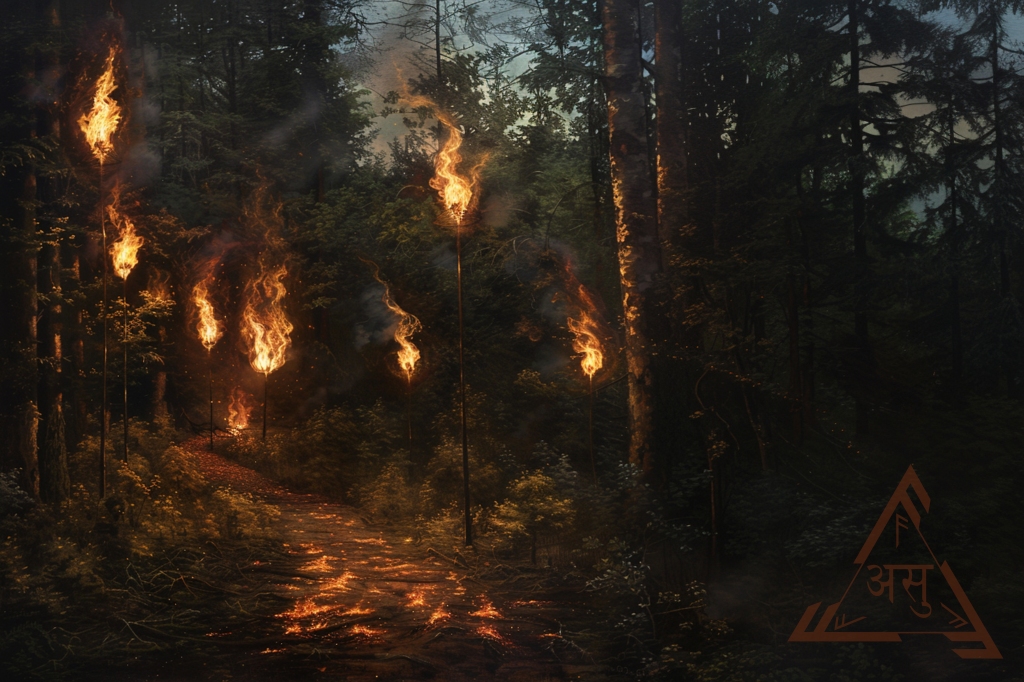
Kenaz is a particular rune, changing dramatically in context from Elder to Younger runes. The continental Germans seemed to hold this rune in a more positive light than their Scandinavian neighbors in the North. Kenaz is a reconstructed word from Proto-Germanic meaning “torch,” associated with creative fire, skills, knowledge, and teaching. The torch is that which illuminates the darkness, showing us the way in places unknown. This has been equated with an internal creative “spark” as well, which I think is reflected in the hard “k” sound represented by this rune. If we look to the Gothic language, we find evidence for this theory in the kindred word kōnja which refers to pine sap. This must be directly related to the torch, as pine/spruce has long been a favored wood for this use.
The Gothic name for this rune is kosma/kusma, stemming from kunnan meaning “to be able, to know how,” referring to one’s inner abilities and skills. This word travels through time and tribe almost unchanged in sound and meaning, showing up in modern English in the words know and keen. In my opinion, the best example of this concept is crystallized in the Swedish word konst, meaning “art, knowledge, science, magic, secret,” and in the cognate German word kunst meaning “skill, craft, ability, magic.” This internal power of knowledge, associated with a craft or specific artistic focus, is the secret “light” side of the Kenaz rune, symbolizing our ability to make things known, to teach them, and to exhibit mastery in arts, crafts, intellectual or occult matters.
When looking for clues in the rune poems, the only evidence we find in relation to a “torch” is from the ‘Old English Rune Poem,’ where it states:
“Torch is known by each of the living through its fire
-bright and blazing- it burns oftest
Where the athelings are at ease indoors.”
Here it is clear that the word “torch” is denoting skill as a display of one’s “inner fire.” This is something (as a torch in the dark) that all can witness. “Bright and blazing” is the external effect of mastery and true skill in craft, as creation is a bright and blazing power. The last line denotes a sense of peace inherent in the “athelings,” which means “nobles, lords, heroes.” This clearly reminds an English reader of the word athlete, which signifies “those competing to win a prize.” I believe this relates to the calm felt within an extremely wise, skilled, or focused group; where everyone’s flame is burning bright and clear, all can feel a sense of ease and comfort. We get another look at this concept with the Old English word kennan which means “to make known, declare” but also “to bring forth, produce.” This is essential to the function of a craftsmen, artist, musician, or anyone who actively works with creative energies and systems.
In Old Norse, this rune is represented in the word kaun, meaning “sore, ulcer, boil,” and carries a much more sinister and harmful aspect associated with it. In most old poetry and analysis, it seems this rune was more of a curse or fetter than something used for anything “positive.” Although, in some Freemason rites, it has been shown that the Younger rune (ᚴ) is still in effect as a “torch,” as it mimics the man holding his sword (torch) at this angle during initiation rituals. As one walks through this “tunnel of torches,” he is “illuminated/initiated” into a new reality.
In the ‘Old Norwegian Rune Rhyme” it is said:
“A sore is a curse for children;
Bale makes a man pale.”
Likewise, in the “Old Icelandic Rune Poem” it is said:
“A boil is bale for bairns, and a scourgeful spot,
And a home for flesh-rot.”
Here we see how our Scandinavian ancestors viewed this rune, as a much darker and fearful tone is taken with it. They viewed this rune in the context of evil and pain, without any allusions to a “lighter” aspect within the poetry. However, all these physical ailments have in common the sensation of “burning” within those experiencing it. This gives us insight into the deeper layers of the rune, where “fire” is still present, albeit in a new form. This rune was probably used strictly as a curse unless by the most skilled of sorcerers, who may have been able to turn this internal strife and struggle into acts of creation or transcendence. If looking at the Younger Futhorc as a whole, we see Kaun landing next to another very sorcerous and powerful rune, Hagal, the hail stone of transformation. Seeing these very destructive and feared runes side by side, as fire and ice respectively, shows a sort of miniature Ragnarök within the cycle of the Futhorc, enhancing the importance of viewing them in their respective “aetts” or groups, as here we end the first and begin the second. This is something I plan to venture into with more thought later…
To conclude, Kenaz is a rune steeped in much power and is tied together throughout all linguistic changes in the concept of an internal “fire” or a “burning” sensation. We have the older associations with torches, knowledge, creation and skill; being associated with teachers, students, craftsmen, and artistic masters. We also have the concept of “keenness” tied in, being exceptionally skilled and knowledgeable, “sharp” of mind and highly productive. In the North, this rune carried a more malicious nature, representing sickness, pain, and struggle. When approaching this rune from all the previous angles, we see a very wide range of meanings one can attribute to this rune, depending mostly on which system of runes one is working with. If using the Elder or Anglo-Saxon runes, this rune is viewed in relation to the torch. If using the Younger runes, it is likely you will associate this rune with pain or sickness.
Taken from the book “Wandering the Runic Path: Esoteric Analysis of the Germanic Runes” by Hrukjan.
A short section from the new book “Wandering the Runic Path: Esoteric Analysis of the Germanic Runes” regarding the Kenaz (ᚲ) rune.
“Kenaz is a particular rune, changing dramatically in context from Elder to Younger runes. The continental Germans seemed to hold this rune in a more positive light than their Scandinavian neighbors in the North. Kenaz is a reconstructed word from Proto-Germanic meaning “torch”, associated with creative fire, skills, knowledge, and teaching. The torch is that which illuminates the darkness, showing us the way in places unknown. This has been equated with an internal creative “spark” as well, which I think is reflected in the hard “k” sound represented by this rune. If we look to the Gothic language, we find evidence for this theory in the kindred word kōnja which refers to pine sap. This must be directly related to the torch, as pine/spruce has long been a favored wood for this use.
The Gothic name for this rune is kosma/kusma, stemming from kunnan meaning “to be able, to know how,” referring to one’s inner abilities and skills. This word travels through time and tribe almost unchanged in sound and meaning, showing up in modern English in the words know and keen. In my opinion, the best example of this concept is crystallized in the Swedish word konst, meaning “art, knowledge, science, magic, secret,” and in the cognate German word kunst meaning “skill, craft, ability, magic.” This internal power of knowledge, associated with a craft or specific artistic focus, is the secret “light” side of the Kenaz rune, symbolizing our ability to make things known, to teach them, and to exhibit mastery in arts, crafts, intellectual or occult matters.”
May all sentient beings realize this rune within themselves.
Hailaz / Namaste

 Ansuz Society