Solstice hails!
May blessings of prosperity, good health, and strength reign!
May the gods and spirits be satisfied!
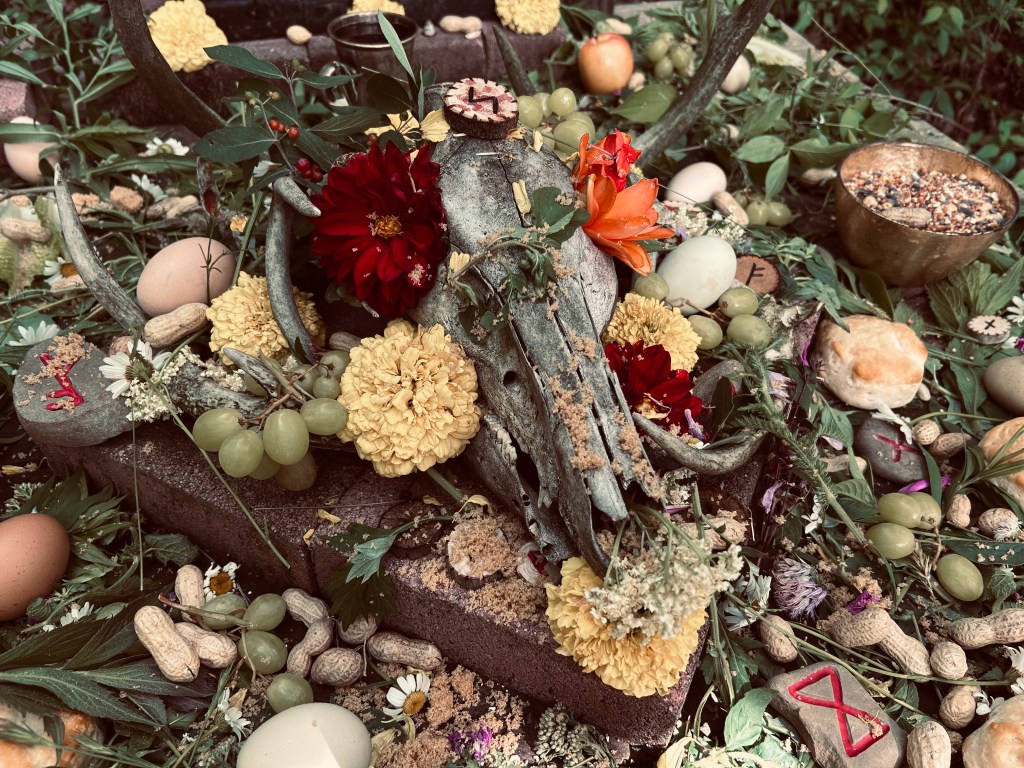

Solstice hails!
May blessings of prosperity, good health, and strength reign!
May the gods and spirits be satisfied!
Ingwaz is the rune of the great god Ing/Yngvi/Freyr. Like Freyr, Ingwaz represents peace, growth, and prosperity of the land. In shape, it is reminiscent of a seed, that which gestates, cultivates life, and stores energy until ready to be released. Ingwaz also represents the Earth, as the Earth gestates and stores life within it, recycling and regenerating constantly. Ingwaz, like the stirring seed, represents patience, strength, internalized energy, and focus. Ingwaz is closed space for sacred creation, something that can be mimicked in a ritual setting. The diamond represents small, protected enclosures, but also, infinite potential within. In this way, one can incorporate this rune into their arsenal of protective symbols, deterring outside influence from tainting one’s internal and/or ritual space.
Ingwaz is a rune of harmony and protection. This closed or “fenced in” area is represented by the household, homestead, farm, and entirety of one’s community or village. In Old English, ing means “meadow,” enforcing this connection to farms, pastures, and crops. Ingwaz is the sowing and cultivating of agricultural resources, the growing and planning stages of all actions. As we have explored in other runes, the concept of meadows and Heaven are commonly linked. This gives Ingwaz a particular “heavenly” aspect, that being the heavenly realm of Alfheim/Álfheimr, meaning “Land of the (Light) Elves,” where Freyr is said to reside. Elves have long been associated with the dead and especially dead ancestors, so this could very well represent a more “Vanic” outlook of the afterlife. In Proto-Germanic, we have the related word angijō, which means “a low-lying meadow in a valley or near a river.” It can be speculated that the valley/meadow atmosphere was mirrored in this divine power that represented the fertility of these landscapes, and further, the power of the god Freyr.
In reference to shape, Ingwaz resembles an unbroken Jera rune, Jera representing the harvest of energies and endeavors. In this way, we can view Ingwaz as the space where energy is cultivated and Jera as the reaping or release of that energy. Ingwaz, as a closed space, can represent deep concentration and meditation. During meditation, one can invoke the shape of Ingwaz to isolate one’s mind from distraction. This power is different from the focused meditation represented by Isa, as it develops the Earthly elements within and helps fuel our growing development. Ingwaz is a reminder that we must focus our energy inward to fully develop enough “pressure” to release it, as shown by the Jera rune. This applies to our ideas, business plans, projects, and overall goals in life. Things must be internalized first, to a certain extent, as to not diffuse our energy by talking about it too much. When we do this, we fall victim to procrastination, or worse, complete abandonment of projects.
The “Old English Rune Poem” gives us the only glimpse into this rune’s meaning, as it is absent from the Younger Futhorc of Scandinavia. It states:
“Ing was first among the East-Danes
witnessed by warriors, until he eastward
wandered over the waves; his wain ran after;
thus the bold ones named the hero.”
This poem addresses a great hero of the “East-Danes,” or Goths, who came West and committed many marvelous deeds. He returned home, across the waves, with his “wain,” or wagon. This refers to the god Ingwaz/Yngvi/Fraujaz/Freyr. Many tribes claim to be descendants of Ingwaz/Yngvi, such as the Ingaevones and Ynglings. Ingwaz is one of the three sons of Mannus, the progenitor of the Germanic tribes. The worship of this god is very ancient, reaching as far back as the Goths, as we see in the “Ring of Pietroassa” inscription found in present day Romania. One interpretation has been said to read “[to] Ingwin of the Goths. Holy.” This Ingwin is none other than Yngvi-Freyr. This translation, however, is still widely debated and no definitive transcription has been given.
In the Gylfaginning, it is said:
“Freyr is the most glorious of the Aesir. He is the ruler of rain and sunshine and thus of the produce of the earth, and it is good to pray to him for prosperity and peace.”
Freyr, symbolized by the Ingwaz rune, represents all things prosperous, abundant, and beautiful. Ingwaz symbolizes times of peace, growth, and good weather; wealth and life protected within a diamond. Ingwaz is a rune of kings, farmers, nobility, and those who are responsible for the prosperity of the land and its people. Ingwaz is a sacred space where nature and man may live in unity.
One connection I find interesting, although not linguistically associated, are the Sanskrit words ish and Ishvara. Ish means “to possess, own, rule over, be master of” and Ishvara means “husband, God, Supreme Being.” This is also another title for the god Shiva. Of the tribes that predominantly worshipped Freyr, we can assume that his role mimicked an all-encompassing form similar to Shiva, as indeed, both gods are known for their auspiciousness. Not only in these words and gods, but in Freyr’s other rune, Fehu, we see echoes of this adjective ish, as Fehu and ish refer to possessions, ownership, material wealth, and governorship.
Do I believe that Freyr and Shiva (as divinities) are closely connected? Not necessarily. As stated, I can see how a Germanic tribe worshipping Freyr as head of the pantheon could see him in the same way certain Vedic and Hindu tribes have viewed Shiva in the past. The point here is to see the connection between Yngvi-Freyr, (Ish)vara, kingship, and the relationship between Freyr’s two runes; Fehu and Ingwaz. Freyr is the great Vanic King who presides over the “ing” and its people, known for gifts of peace and prosperity. This ing and ish seem to hold similar origins in Indo-European thought.
In conclusion, the Ingwaz rune, like the god it represents, is extremely broad in meaning, form, and function. Some things, however, we can feel certain in attributing to this rune. First, the shape of Ingwaz invokes ideas of a seed, Earth, egg, or general enclosed space. This “enclosed” space has an added divine aspect to it, as Ingwaz resides over this type of biosphere, the meadow or ing. These environments are places of fertility, sowing, growing, and patience. In this way, Ingwaz represents farms, villages, and general spaces that exist separately from the wilderness. These are inhabitable, domesticable environments where humans can thrive, another aspect of Freyr’s attributes. Last, we can see this rune in a “tantric” sense, using it in meditation to protect ourselves from distractions and help us focus on our practice. Ingwaz is one of the most important runes to develop a relationship with if one wants to master patience, prosperity, and development.
-Wandering the Runic Path: Esoteric Analysis of the Germanic Runes

Subscribe to get access to the rest of this post and other subscriber-only content.
Subscribe to get access to the rest of this post and other subscriber-only content.
Subscribe to get access to the rest of this post and other subscriber-only content.
Subscribe to get access to the rest of this post and other subscriber-only content.
Samhain is a time when the spirits of nature, the dead, and the gods are most likely to emerge to interact with the living. During these days, when daylight becomes shorter and shorter, nature around us seems to die and shed its vitality, leaving stalks, trunks and branches barren, resembling bones protruding from the soil. This is a time when we are meant to shift our focus from outdoors to indoors and shed our dead weight from the previous year, like the trees shed their leaves. By doing this, we are mirroring the process of nature and turning our energy inward. With Samhain come the final harvests, meaning that soon the workload will be drastically cut down and many daily activities will change. This time is to now be replaced with indoor tasks such as tending to animal pens, preserving food, repairing tools, spiritual practice, and performing various crafts such as woodworking, writing, or blacksmithing.
It is customary to make offerings to the deities, ancestors, and wandering spirits during this time in order to receive their favors, blessings, and good luck. We please the spirits to avoid their wrath. We offer to the ancestors to uphold family honor. We give our veneration to the gods to gain their power and visage. By performing rituals during this particular time of year, one enables themselves to better access various forces and gain insight into the past, future, and matters regarding cause and effect within the present which will aid one’s progress moving forward.
In “A History of Pagan Europe” by Jones & Pennick, they write:
“Samhain (1 November). This was the most important festival of the year, showing the pastoralist, rather than agricultural, origin of the calendar. Samhain was the end of the grazing season, when flocks and herds were collected together, and only the breeding stock set aside from slaughter. It was a time of gathering-together of the tribe at their ritual centre for rituals of death and renewal, dedicated to the union of the tribal god (in Ireland, the Daghda) with a goddess of sovereignty, the Morrigan, or, more localised, Boann, deity of the River Boyne.”
As the last of the great harvests, Samhain brings reward and celebration, the end of one year and the transition into the next. According to many European tribes, Samhain marked the turning point between the years and represented the New Year celebration of their cultures. With Samhain we descend into “night,” resembling the womb of the goddess or the abode in which she resides. The goddess reigning over this time of year was almost always in the form of a grim, fate-controlling hag or crone, such as Hel, Frau Holle, or the Morrigan.
In “Celtic Mythology and Religion,” Macbain writes:
“Equal to Beltane in importance was the solemnity of Hallowe’en, known in Gaelic as Samhuinn or ‘summerend.’ Like Beltane it was sacred to the gods of light and of earth; Ceres, Apollo, and Dis also, must have been the deities whose worship was honoured. The earth goddess was celebrated for the ingathering of the fruits; Apollo or Belinus and Proserpine were bewailed for their disappearing from earth, and Dis, who was god of death and winter’s cold, and who was especially worshipped by the Celts, as Caesar says, was implored for mercy, and his subjects, the manes of the dead, had special worship directed to them. It was, indeed, a great festival—the festival of fire, fruits, and death.”
In reference to Norse and Germanic paganism, we see the worship of elves and land spirits was also common during this time. In modern Germanic paganism, many people celebrate Samhain under the name Álfablót (Elf Sacrifice), which is when harvests are reaped and sacrifices are made to the elves and gods. Elves and the dead are strongly connected to the ancient burial mounds of the Pagans, therefore, much of the activity surrounding this festival would have likely involved distributing offerings to the gods and conducting sacrifices directly upon the mound (or grave) of the dead. This is where the elves were thought to reside.
In our own Samhain/Álfablót practice, the fair-weather god Freyr, king of the elves, is given one last celebration of reverence, being the center focus of the rites and rituals of the two-day celebration. He is invoked and offered substantial food and drink, as well as prayers and songs, showing devotion and thanks to the spirits and deities of abundance and prosperity. The event begins on the last day of October (Halloween) and ends the night of November 1st, when Freyr is returned to his resting place until the first of May. This cycle is reflected in “Myths and Symbols in Pagan Europe,” where Davidson writes:
“He [Freyr] is said to have brought good seasons and prosperity to the land, and so when he died the Swedes brought great offerings to his mound, and believed that he remained alive and potent in the earth. The connection which seems to exist between Freyr and the elves and land-spirits thus provides an additional reason to associate them with the dead in their graves.”
Because of these associations, we place the death and rebirth of Freyr (the power of good weather and abundance) within this span of time (Nov 1-May 1). However, this is not the only way to do things nor is it recommended to everyone, as how one celebrates these sacred events revolves much around one’s lifestyle, geography, deity devotion, and overall means. For us in Western New York, this timeline coincides seamlessly with the natural cycle of the weather, and therefore is easy to follow. For those in a different climate or location, this may not make as much sense, and it is recommended to follow the patterns around you regarding these things.
In “Sorcery and Religion in Ancient Scandinavia,” Vikernes gives us further examples pertaining to the Nordic new year and pre-Christian Halloween customs. He writes:
“The first holiday of the year was New Year’s Day, better known in English as Halloween (“initiation evening”), and in Gaelic as Samhain (“summer’s end”). The sorcerers and later the gods (i, e. religious kings) and their challengers dressed up as different creatures with access to the realm of the dead. They fasted and hung their clothes in a tree or the gallows, to make it look as if they had hanged themselves. They wounded themselves with a spear, to bleed, smeared ash or white mud all over their bodies to look like the dead, they put on masks and sacrificed a cow or an ox on the grave mound, so that the blood poured down and into the grave underneath; into the realm of the dead. They then blew a horn, in the Bronze Age a lure, to open up the entrance to the realm of the dead. They then travelled into hollow trees, caves in the mountain, holes in the ground, or more commonly into the burial mounds. These were all seen as entrances to the realm of the dead. Inside, in the darkness of the grave, a woman was waiting for them, sprinkled in the sacrificed animal’s blood and dressed like the queen of death. They then took at least some of the objects their dead forebears had been buried with and brought them back out.”
As we can see, Samhain (or Álfablót) type celebrations were not only distinct to Celtic and Germanic culture, but rather appear as a pan-European tradition representing a celebration of the dead, the ancestors, and the final harvests of the year. It is clear that no matter which form of paganism(s) one practices, the celebration and event known to us now as Halloween is of very ancient and sacred importance. Not only as a transitional period between the seasons, but as a time when it was believed to be easiest to pierce the veil between dimensions and interact with beings outside of our normal cognition. It is because of the superstitions and Pagan worldviews of the past that we have many (if not all) of our current yearly celebrations in the West.

The Autumn Equinox is the turning point in the year when daylight and darkness become even once again, tipping the scales towards the darkest period of the year when the nights grow longer than the days and the weather gets colder. Traditionally, harvests would be reaped during this time and various rituals were conducted for the gods and spirits residing over abundance. Attention was given to the spirits and ancestors as it was believed that this time was liminal and other realms were accessible. At the cusp of the Equinox, the dark half of the year begins to slowly gain dominance once again.
Bonfires are especially common as well as sacrifices, whether physical or symbolic. People give thanks and ask for future abundant harvests, ensuring a healthy stock of goods for the upcoming Winter months. Much depended on this pivotal time of year and many rites were undertaken to guarantee success. Feasts would be widespread as well as games, echoing other Summer/Fall festivals in atmosphere. For us here in the Northeastern United States, many crops are ripening at this time, such as squash, tomatoes, and beans. With this comes canning and drying to stock pantries for the Winter.
In “Teutonic Mythology” by Grimm, it says:
“In some parts of northern England, in Yorkshire, especially Hallamshire, popular customs show remnants of the worship of Frieg. In the neighborhood of Dent, at certain seasons of the year, especially autumn, the country folk hold a procession and perform old dances, one called the giant’s dance: the leading giant they name Woden, and his wife Frigga, the principal action of the play consisting in two swords being swung and clashed together about the neck of a boy without hurting him.”
As seen above, many early English (and Germanic) peoples would honor the god/goddess Frieg (Frigga) and Woden (Odin) during this time. Woden/Wotan in early Germanic belief was sometimes associated with wheat fields, where offerings were left for his horse Sleipnir during pivotal moments of the year. Certain epithets of Odin give reason to believe that he has been worshipped as a benevolent god to some extent, reigning over wealth, fate, and general prosperity. Names like this include Farmatýr (Lord of Cargoes) and Óski (God of Wishes).
Regarding Odin and continental Pagan belief, Grimm also states:
“As these names [Woden/Mercury/Hermes], denoting the wagon and the mountain of the old god, have survived chiefly in Lower Germany, where heathenism maintained itself longest; a remarkable custom of the people in Lower Saxony at harvest-time points the same way. It is usual to leave a clump of standing corn in afield to Woden for his horse.”
Of all the ancient celebrations, the Autumn Equinox was the most difficult one to find any references for. My belief is that it was a lesser celebratory event and more centralized in each community, where the harvest would be brought in and the local spirits offered to. People were likely working hard and didn’t have time to prepare for anything large like they would have during the last harvest of Samhain, which certainly would have taken the forefront in terms of importance, at least to the Pagan Celts.
In “The One-Eyed God” by Kershaw, it says:
“These times of transition are strange times, whether the transition is from month to month, or season to season, or year to year; they are times which are not quite one thing or the other. They are like boundary lines, which are not quite my property or yours, or doorways, which are not quite inside or outside. As Eitrem said, it is at these dividing lines of time and space that the dead and Hermes are particularly active.”
It was common to not only focus on the harvest at this time, but to also give special attention to the dead and gods (or spirits) associated with death. The year was to start its final stages of descent into darkness and the deified Sun/Light was to begin the darkest part of its journey through the underworld. Because of this, symbolic bonfires are lit in order to emulate the Sun and prolong the light.
In “Sorcery and Religion in Ancient Scandinavia” by Vikernes, it says:
“Odinn placed his eye in the grave, in the well of the past, every year, in order to learn from the past. This might sound strange, but his eye was the Sun, Baldr, that lost its power every autumn and therefore had to spend the winter in the world of the dead. In other words, Odinn had one eye in the world of the living and one eye in the world of the dead.”
Aside from the various gods, goddesses, and spirits of prosperity, it is clear that Odin and Frigga took a central role in (Germanic) Equinox observances in pagan Europe. Odin (Woden) was recognized as a god of wishes, death, darkness, gifts, and clairvoyance, mirroring the exoteric liminality of the period between light and dark invoked by the Equinox. Frigga, on the other hand, represented the Earth, love, fertility, wisdom, strength, and magic. Essentially, Frigga is the symbol of Nature herself.
This celestial event is to also be reflected internally, as darkness begins to gain supremacy after this transition. We begin to look inward and conduct deeper spiritual work, creating light within to combat the impending darkness of Winter.
-The Celto-Germanic Wheel of the Year According to Past and Present Pagan Customs
Subscribe to get access to the rest of this post and other subscriber-only content.
Subscribe to get access to the rest of this post and other subscriber-only content.

