
Subscribe to continue reading
Subscribe to get access to the rest of this post and other subscriber-only content.

Subscribe to get access to the rest of this post and other subscriber-only content.
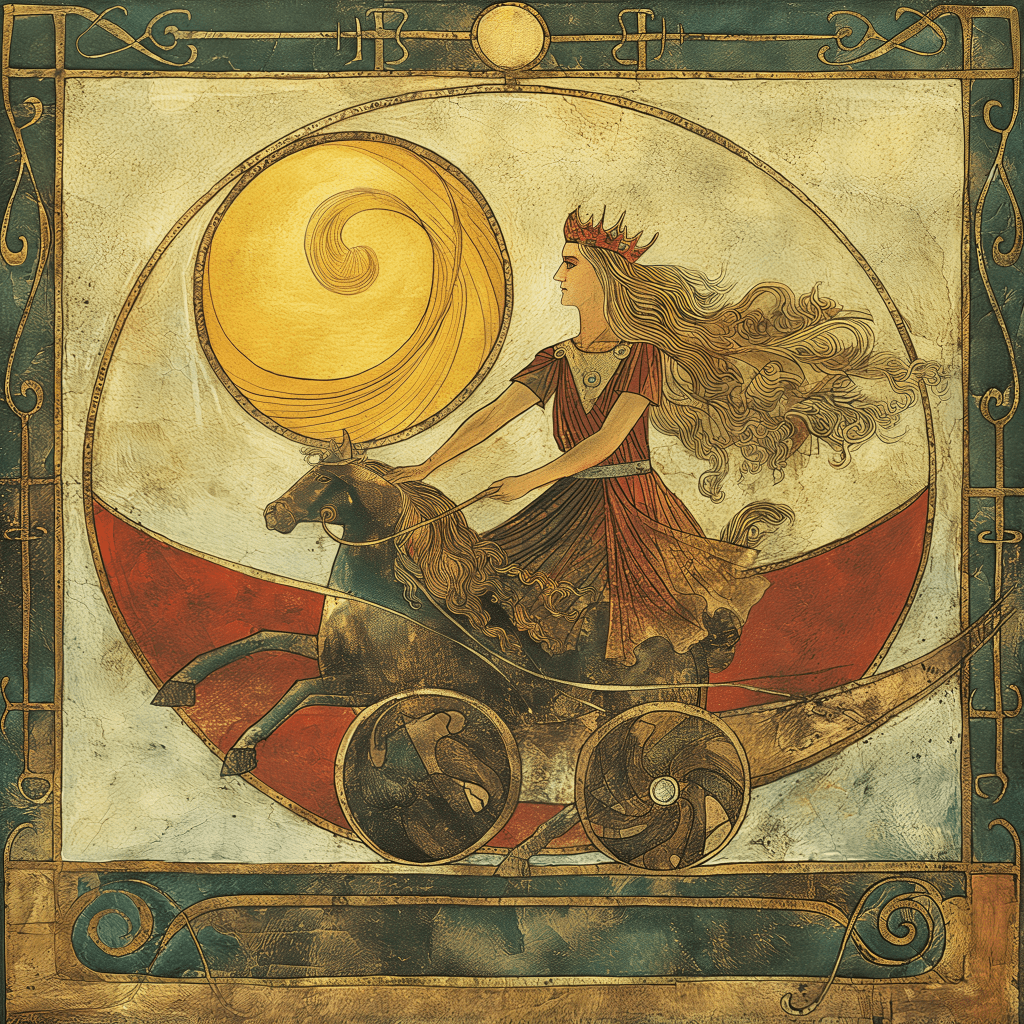
The Autumn Equinox is the turning point in the year when daylight and darkness become even once again, tipping the scales towards the darkest period of the year when the nights grow longer than the days and the weather gets colder. Traditionally, harvests would be reaped during this time and various rituals were conducted for the gods and spirits residing over abundance. Attention was given to the spirits and ancestors as it was believed that this time was liminal and other realms were accessible. At the cusp of the Equinox, the dark half of the year begins to slowly gain dominance once again.
Bonfires are especially common as well as sacrifices, whether physical or symbolic. People give thanks and ask for future abundant harvests, ensuring a healthy stock of goods for the upcoming Winter months. Much depended on this pivotal time of year and many rites were undertaken to guarantee success. Feasts would be widespread as well as games, echoing other Summer/Fall festivals in atmosphere. For us here in the Northeastern United States, many crops are ripening at this time, such as squash, tomatoes, and beans. With this comes canning and drying to stock pantries for the Winter.
In “Teutonic Mythology” by Grimm, it says:
“In some parts of northern England, in Yorkshire, especially Hallamshire, popular customs show remnants of the worship of Frieg. In the neighborhood of Dent, at certain seasons of the year, especially autumn, the country folk hold a procession and perform old dances, one called the giant’s dance: the leading giant they name Woden, and his wife Frigga, the principal action of the play consisting in two swords being swung and clashed together about the neck of a boy without hurting him.”
As seen above, many early English (and Germanic) peoples would honor the god/goddess Frieg (Frigga) and Woden (Odin) during this time. Woden/Wotan in early Germanic belief was sometimes associated with wheat fields, where offerings were left for his horse Sleipnir during pivotal moments of the year. Certain epithets of Odin give reason to believe that he has been worshipped as a benevolent god to some extent, reigning over wealth, fate, and general prosperity. Names like this include Farmatýr (Lord of Cargoes) and Óski (God of Wishes).
Regarding Odin and continental Pagan belief, Grimm also states:
“As these names [Woden/Mercury/Hermes], denoting the wagon and the mountain of the old god, have survived chiefly in Lower Germany, where heathenism maintained itself longest; a remarkable custom of the people in Lower Saxony at harvest-time points the same way. It is usual to leave a clump of standing corn in afield to Woden for his horse.”
Of all the ancient celebrations, the Autumn Equinox was the most difficult one to find any references for. My belief is that it was a lesser celebratory event and more centralized in each community, where the harvest would be brought in and the local spirits offered to. People were likely working hard and didn’t have time to prepare for anything large like they would have during the last harvest of Samhain, which certainly would have taken the forefront in terms of importance, at least to the Pagan Celts.
In “The One-Eyed God” by Kershaw, it says:
“These times of transition are strange times, whether the transition is from month to month, or season to season, or year to year; they are times which are not quite one thing or the other. They are like boundary lines, which are not quite my property or yours, or doorways, which are not quite inside or outside. As Eitrem said, it is at these dividing lines of time and space that the dead and Hermes are particularly active.”
It was common to not only focus on the harvest at this time, but to also give special attention to the dead and gods (or spirits) associated with death. The year was to start its final stages of descent into darkness and the deified Sun/Light was to begin the darkest part of its journey through the underworld. Because of this, symbolic bonfires are lit in order to emulate the Sun and prolong the light.
In “Sorcery and Religion in Ancient Scandinavia” by Vikernes, it says:
“Odinn placed his eye in the grave, in the well of the past, every year, in order to learn from the past. This might sound strange, but his eye was the Sun, Baldr, that lost its power every autumn and therefore had to spend the winter in the world of the dead. In other words, Odinn had one eye in the world of the living and one eye in the world of the dead.”
Aside from the various gods, goddesses, and spirits of prosperity, it is clear that Odin and Frigga took a central role in (Germanic) Equinox observances in pagan Europe. Odin (Woden) was recognized as a god of wishes, death, darkness, gifts, and clairvoyance, mirroring the exoteric liminality of the period between light and dark invoked by the Equinox. Frigga, on the other hand, represented the Earth, love, fertility, wisdom, strength, and magic. Essentially, Frigga is the symbol of Nature herself.
This celestial event is to also be reflected internally, as darkness begins to gain supremacy after this transition. We begin to look inward and conduct deeper spiritual work, creating light within to combat the impending darkness of Winter.
-The Celto-Germanic Wheel of the Year According to Past and Present Pagan Customs
Amitabha (Boundless/Infinite Light) is an important figure found in the Mahayana and Vajrayana schools of Buddhism, with his function varying differently between the two.
In the Mahayana schools, especially the Pure Land school, Amitabha is venerated as a fully enlightened Buddha and his realm Sukhavati (a place ideal to practice the Dharma) is aspired after death. This isn’t a permanent heaven, but rather a flawless realm for one to continue practice and achieve enlightenment in.
In Vajrayana, Amitabha is a Dhyani (meditation/wisdom) Buddha and is the head of the Lotus (Padma) family, associated with the direction of the West, the same direction of his heavenly realm Sukhavati. He is responsible for the transformation of desire and attachment into discerning wisdom. He is also invoked in the practice of Phowa meaning “transfer of consciousness.” However, when practiced in accordance with long-life rituals, he appears as Amitayus (Buddha of Infinite Life), a sambhogakaya (enjoyment body) form of Amitabha.
Amitabha usually appears as a red Buddha in meditation posture, adorned with Dharma robes and holding a begging bowl with both hands. The meditator is to visualize oneself as a bodhisattva, white in color, with Amitabha, the Bhagavat, in front. Through his sadhana, one eventually dissolves the barrier between Amitabha and oneself, becoming the very essence of “lucidity and emptiness.”
Om Ami Dewa Hri
Front Image Link: https://www.himalayanart.org/items/24733/images/primary#-617,-1000,1381,0
Back Image Link: https://www.himalayanart.org/items/77019/images/primary#-1434,-2204,2971,0
Subscribe to get access to the rest of this post and other subscriber-only content.
Kali is a wrathful emanation of the great Mother Durga and the consort of Lord Shiva.
Kali is destruction and time. She is representative of the cycles of samsara, specifically birth, death, and rebirth. Despite this association, she is also a symbol of moksha (liberation), as she encourages effort (shakti) and action in one’s life to overcome obstacles and suffering.
Kali is nature and matter, everything that changes in existence. She is that which primordial, unchanging consciousness (Shiva) is thrust into. This duality is the core of what we see in the famous image of Kali dancing on Shiva, as she is the play (dance) of nature and he rests motionless beneath her as the foundation of reality (consciousness/space).
Although Kali seems fearsome, this aspect of the goddess has immense motherly love for her devotees. She gladly removes tribulations and gives boons to her followers as long as they remain strong and diligent. Negative thoughts and emotions are offered to Kali who purifies them instantly. The mantra “Om Krim Kalikaye Namah” is an invocation and homage of the glorious goddess Kali Ma, who chooses carefully her disciples according to their endurance and diligence.
May all negativity and misery be abolished!
Jai Maa Kali!
Image link: https://www.clevelandart.org/art/1968.44
“The powerful black Hindu goddess Kali effortlessly slays an eight-armed spotted green demon with an impossibly long trident. His chariot horses and two minions lie incapacitated below. Kali’s tongue lolls out, indicating her ability to catch blood before it touches the ground: one of her demonic enemies has blood that generates another demon every time one drop comes in contact with the earth. The demon is a metaphor for wicked thoughts that give rise to more evil thoughts; Kali aids her followers in eradicating them all.”
Padmasambhava, also known as Guru Rinpoche, was a legendary tantric Yogi and the founder of Vajrayana Buddhism in Tibet, bringing the religion from India around the 8th century and establishing the first Tibetan sect now known as the Nyingma (Old School). He is considered by many to be the second Buddha, foretold by Shakyamuni (Gautama Buddha) to reveal the tantric/esoteric (Vajrayana) teachings and to propel and protect Buddhism in the degenerate age (Kali Yuga).
Jigme Khyentse writes in the book “White Lotus,”
“Before he [Shakyamuni] passed into mahaparinirvana, the Buddha prophesized that his activities would be prolonged and his teachings propagated and protected by Padmasambhava, whom Tibetan Buddhists frequently refer to as Guru Rinpoche, the Precious Master.”
Vajrayana is an outgrowth of Mahayana Buddhism and involves a wide collection of practices aimed at providing liberation (nirvana) in a single lifetime, hence its name meaning “Thunderbolt Vehicle.” This differs from the Mahayana (Great Vehicle) path where it can take an untold number of lives (incarnations) to accomplish complete liberation. Because of this difference in philosophy, the indigenous Tibetan and Himalayan peoples could only be persuaded by the infinite power of the Vajrayana and were quite reluctant to adopt Buddhism prior to Padmasambhava’s arrival.
Through various trials and tribulations, Padmasambhava was able to subdue the powerful gods and beings who inhabited the region of Tibet. In doing so, he gained their favor and service in return, incorporating them into the Buddhist religion as protectors and stewards of the Dharma. This is why we see numerous gods from other pantheons mentioned in the rituals and myths of tantric Buddhism, as Vajrayana practitioners of all nationalities seem to include their own ancestral deities into their practice. This is easily observed in the Tibetan, Japanese, Chinese, and Mongolian variants of Vajrayana, where each culture has created a syncretic and unique flavor of religious practice, not completely removed from its source but rather philosophically reformed and reworked.
The mantra of Padmasambhava OM AH HUM VAJRA GURU PADMA SIDDHI HUM is one of the most popular and powerful mantras used in Tibetan Buddhism, recited often to instantly evoke the Guru, gain enlightenment, and achieve siddhi (occult power). It can be translated in many ways and has various levels of meaning, but a general interpretation of the syllables would be:
OM AH HUM – Purifies body, speech, and mind.
VAJRA GURU – Perfect Teacher.
PADMA – Lotus, synonymous with nature of mind.
SIDDHI – Occult power, success in practice, accomplishment.
HUM – The syllable of enlightenment, the unshakable nature of ultimate truth.
Padmasambhava permeates everything and exists everywhere, nestled into the very fabric of space and time. At the time of his death (parinirvana), he achieved “Rainbow Body,” dissolving into light and leaving behind nothing but hair, nails, and clothing. He is known also as Padmakara (Lotus-Born), meaning he is born in our minds, existing eternally in the unstained regions of our consciousness, quickly summoned by this sacred formula. This mantra should be recited as often as needed, whether for guidance, protection, clarity, wisdom, or any other purpose.
OM AH HUM VAJRA GURU PADMA SIDDHI HUM
Subscribe to get access to the rest of this post and other subscriber-only content.
The Summer Solstice is the time of year when the daylight is longest, the power of the Sun is at its peak, and the solar cycle reaches its apex, tipping the scales towards the dark half of the year once again. After this turning point, the sunlight begins to wane, shortening the daylight minute by minute until the Winter Solstice. Typically, this was a time to celebrate the Sun, spend time outdoors, and enjoy the bliss of good weather. Mead, wine, and other beverages would be consumed, and great feasts would be enjoyed.
In “Teutonic Mythology” by Grimm, it is said:
“Twice in the year the sun changes his course, in summer to sink, in winter to rise. These turning-points of the sun were celebrated with great pomp in ancient times, and our St. John’s or Midsummer fires are a relic of the summer festival. The higher North, the stronger must have been the impression produced by either solstice, for at the time of the summer one there reigns almost perpetual day, and at the winter one perpetual night.”
Games and various competitions would be hosted along with other festivities such as dancing and music. Entertainment would be lively and abundant, encouraging joy and merriment among the community. In the Germanic context, many people honor the god Baldr during this time as a god of light and/or personification of the light of the Sun, which in a mythological context, “dies” and beings to decline after this time, mirrored by Baldr’s death and descent into Hel. Because of these connections, a common blot/ritual focus during the Summer Solstice is the death (or funeral) of Baldr, the god of light. Stone ships are erected, abundant offerings are made, and various sacrificial items are thrown into fire. These offerings are meant to aid Baldr in his journey on the long road of the underworld.
In “Celtic Mythology and Religion” by Macbain, he says:
“The midsummer festival, christianised into St John’s Eve and Day, for the celebration of the summer solstice, is not especially Celtic, as it is a Teutonic, feast. The wheels of wood, wrapped round with straw, set on fire, and sent rolling from a hillock summit, to end their course in some river or water, which thus typified the descending course of the sun onward till next solstice, is represented on Celtic ground by the occasional use of a wheel for producing the tinegin, but more especially by the custom in some districts of rolling the Beltane bannocks from the hill summit down its side. Shaw remarks – “They made the Deas-sail [at Midsummer] about their fields of corn with burning torches of wood in their hands, to obtain a blessing on their corn. This I have often seen, more, indeed, in the Lowlands than in the Highlands. On Midsummer Eve, they kindle fires near their cornfields, and walk round them with burning torches.” In Cornwall last century they used to perambulate the villages carrying lighted torches, and in Ireland the Eve of Midsummer was honoured with bonfires round which they carried torches.”
Large bonfires and “Sun-wheels” are made during this time, reflecting the power and glory of the Sun. Special attention was given to the goddess during this time as well, whether as a deification of the Sun itself, the Earth, the Mother, or a mix of the 3. Offerings such as flowers, cakes, milk, honey, and blood are given to the gods and spirits, a ritual exchange of abundance for abundance. As observed in the above quote, it was (and is) common practice to bring the energy of the Sun down to Earth in the form of a torch, then parade it through the fields, groves, or temples in order to bless them with this powerful energy.
In “A History of Pagan Europe” by Jones & Pennick, it says:
“…But the summer solstice, under its statutory date of 25 June, became a popular festivity early in Germanic history. The German word Sonnenwende always refers, in medieval texts, to the summer solstice, not to the winter solstice. At the end of the first century CE some German troops in the Roman army at Chesterholme listed their supplies for the celebration in a record which has come down to us. In the early seventh century, Bishop Eligius of Noyon in Flanders criticised the chants, carols and leaping practised by his flock on 24.”
Here we are given examples of some ancient Germanic practices revolving around the Summer Solstice. We are told of singing, chanting, and competitive games like “leaping”. Clearly, the Christian Romans were disturbed by this revelry, showing its clear Pagan origins. This turning point in the year was extremely important to observe, as it strikes a pivotal moment in the Sun’s lifecycle, affecting every aspect of our lives.
“Think of the simplest thing you do, such as making a cup of tea. You know that in order to do something as easy and simple as making a cup of tea, you must acquire all the necessary conditions and ingredients. You need a source of heat and you need a source of water. You need a container in which to boil the water, you need tea leaves, and you need a cup to drink the tea in. If you do not have those things, you cannot make tea. When it comes to making tea, we take all of these things for granted. We think of it as a very simple process. Yet somehow when it comes to the practice of Dharma, we are unwilling to go through the process of accumulating what is necessary.
Furthermore, when you make tea you have to know what your are doing. You have to know how to use the stove. If you do not know what you are doing, you are going to burn your house down. When it comes to practicing Dharma, you think that you do not need to know what you are doing; you do not need to know anything, and you do not need to study. This is incorrect.”
-MD Vol. 3 (The Dispelling of Impediments or Obstructions)
It is important that we approach our practice in this simple and straight forward way, making sure to acquire and assemble all of the ingredients of a practice (physically and mentally) before attempting to accomplish it. If we expect fruition of a practice without doing any preliminaries to ensure our accomplishment, we will likely fail and discontinue, or worse, lose our faith altogether. Be diligent and disciplined with your routine, take things step by step. Don’t be afraid to ask for help or advice from those who embody the qualities you want to develop or achieve. This is crucial on our path towards awakening.
May all beings be liberated.

Rune classes will resume this Fall/Winter both in person and online via zoom.
Classes will range from basic introduction to advanced theory and practice.
In person group classes will be limited to 3 people at a time to ensure each person is given proper attention.
More details will be posted next month.
If you have any questions, please feel free to reach out.
If you are interested in teaching a class either in person or online, let us know!
May all beings thrive.
Hailaz / Namaste

 Ansuz Society