
Subscribe to continue reading
Subscribe to get access to the rest of this post and other subscriber-only content.

Subscribe to get access to the rest of this post and other subscriber-only content.
Sowilo is the rune of the Sun. In nearly all Indo-European languages, you will find this word in some form, all originating from the Proto-Indo-European root sóh₂wl̥, meaning “Sun.” This cosmic body represents one of humanities oldest “gods” or divinities, being associated with power, glory, triumph, health, and life. In most Germanic cultures, the Sun was viewed as a goddess, while the Moon represented a god. In the North, this goddess went by the name of Sunna (Sun) and was drawn across the sky by a chariot, chased by the great wolf Sköll (treachery). In other cultures, such as Greek, the Sun was viewed as masculine, residing under the name Hḗlios, which means “Sun, east, day, and sunshine.”
In Latin and in Old Norse, the word for the Sun deified is sól/sōl. The difference is in gender association, as the Roman Sun-god was masculine and the Norse Sun-god(dess) was female in nature. In ancient Vedic, Persian, and Celtic culture, the Sun-god was revered as a masculine force under the various names of (Sanskrit) Surya, (Persian) Mithra, or (Celtic) Lugh. In the Baltic region, we find the Sun revered as goddess under the name Saule, representing the Sun, life and fertility.
When looking at the rune poems, we get a glimpse into common cross-cultural themes surrounding this rune. We see words like “hope, steer, light, holy, shield, and glory” arise, bestowing upon this rune many positive and powerful connotations. The “Old English Rune Poem”
“Sun for seamen is ever a source of hope,
When they ferry over the fish’s bath,
Until they steer their surf-steed to land.”
This poem alludes to sailors and the act of faring across the sea. Sun is “hope” on these voyages, guiding us across the seas as the ancient golden compass. In the gloomy North, they used mysterious “sun-stones” for guidance under the Icelandic name sólarsteinn. These were used for navigation and direction, as they were able to detect sunlight even through the clouds. This was their only means of navigation across the dark northern sea or landscape, pointing them in the right direction whether they could see the Sun or not. Until the voyage was complete, one relied on the sign of the Sun.
In reference to the word “sign,” we can look to another name for this rune in Old English, that being siġel, meaning “Sun.” This word would later evolve into our modern English word sigil, meaning “occult sign, seal, signature, pattern, symbol or design.” This, I believe, references the purely metaphysical and symbolic aspect of this rune, as the Sun is one of humanities oldest symbols, found cross culturally in the form of the wheel or swastika.
In the “Old Norwegian Rune Rhyme,” it is said:
“Sun is the lands’ light;
I bow to holy judgement.”
We see this poem take a more “terrestrial” tone, referring to the Sun more objectively as “land’s light.” The light-side of Sowilo is on the forefront here, echoed further in the second line, as one can clearly see the connotations held in the poem. The Sun is viewed as holy; a divine being able to bestow judgement upon man. This “bowing” to the Sun can be found in Armanen rune yoga and in varying names for the Sowilo rune in later Icelandic sources. One name is kné sýn, translating to “knee-sun,” referring to bowing or praying to the Sun.
The “Old Icelandic Rune Poem” states:
“Sun is the shield of the clouds, and gleaming glory,
And ice’s age-old anguish.”
This poem touches on many elements and aspects of life, the first being Sun as a “shield” to the clouds. This rings strangely, as the Sun resides over the clouds, giving insight into what the Pagan Icelanders thought they needed to be shielded from; perhaps enemies from above? Line two holds similar meaning to the other poems, linking the powers of glory to the Sun. The last line describes the destructive powers of the Sun, referencing it as the “age-old” anguish of ice, a nod to the myth of creation, where fire and ice collided to create the known universe.
In relation to Odin, this rune can be viewed as his “lighter” side, being attributed to his retained eye; the “solar” awareness. Evidence for this can be found in his epithet Báleygr, meaning “flaming eyed.” This type of philosophy can be found further in the Old Irish word súil, which means “eye, hope, expectation,” but also, is a reference to the Sun as well, as the Old Irish believed the Sun to be the “eye of the sky.” One last word-connection to Odin and the Sun is the word solitary, stemming from this sol- root, meaning “one who lives alone in solitude.” This can absolutely be attributed to the Sun, which is a solitary being, but also to Odin, as he is the solitary wanderer, ever-moving like the wind. Sowilo falls under the rule of “Odin’s 9” as well, having the same form whether upside down or right side up. I leave the reader to decide the importance of that connection.
This holy power of the Sun is one of healing, but also, as one can learn from the Thursatru tradition, is a power of cataclysmic destruction. In their tradition, Sowilo represents the fire-sword of Surt, guardian of Muspelheim: the primordial realm of fire. This force of fire is distinct in power when compared to the other fire rune, Kenaz. Sowilo is the ultimate force of cosmic fire and not the metaphysical, inner fires of creation. Sowilo is rather the inward and outward powers of destruction. This destructive energy does not necessarily carry negative connotations, but holy ones; the purifying and purging force of fire. At the end of Ragnarök, Surt will cover the earth in flames and all will be destroyed. However, the offspring of the gods return, Baldr at their helm, as a symbol of the reborn son/Sun. This cycle is mirrored in many traditions, as a constant flux and flow between creation and destruction.
To conclude, the Sowilo rune applies not only to the Sun, but also, conceptions of glory, guidance, sanctity, hope, and light. On a deeper level, it can be used to vanquish impurities and clean slates, representing a purifying, holy, cosmic fire or shield. The Sun and Moon have been viewed as gods for as long as mankind has been able to name them, representing core functions of not only the physical structure of the world, but the structure of sentient beings as well, being linked intrinsically to one another; the holy light of Heaven above and the holy light within man.
-Wandering the Runic Path: Esoteric Analysis of the Germanic Runes
The cult of Thor generally revolves around the community, fertility, farming, and the daily routine that most humans experience. Because of this, Thor was the most widely worshiped of the ancient gods and was the chief deity observed by the common folk. Thor protects man and the world from chaos, endowing power into our material forms. This force keeps man strong, driven, and determined, acting in accordance with honor, loyalty, and vitality. Thor represents the physical and temporal qualities of human life, things we can build, destroy, and manipulate in accordance with our will. Thor establishes order out of chaos, rhythm out of randomness. He represents the “tempo” of the seasons, symbolized by the wheel (or fylfot), and like the wheel, carries us forward safely through time and space.
May all revere the Thunder god.
“Reid is reins,
Reid is spokes,
Thor’s wagon,
Behind the goats.”
ᚱ : ᚱ : ᚱ : ᚱ
Hailaz
Isa is among the most powerful of runes, although, easily overlooked due to its simple form. On the outside, this rune represents ice and the powers inherent within “frozen” states of being; nearly removed from the degradation of time. When looking for etymological clues during the research of this rune, I was unable to break free from the “ice,” so to speak. No matter where I searched, there wasn’t much material stretching this rune out. So, most of what we can say about Isa is largely subjective, although, some basic core concepts have been generally accepted as interpretations, such as focus, patience, and stillness. These ideas we will explore more as we dive further into this mysterious rune.
Isa is a word that hasn’t changed much since its’ theoretical use in Iron Age Germania. We still see it quite clearly in the English word ice and German eis, even loaning itself to Japanese in the form of aisu. At the root of Isa is the Proto-Indo-European h₁eyH- meaning “ice, hoarfrost, rime,” most likely referring to the icy residue left upon sprawling steppe landscape in cold months. Later, this would evolve into the Old Norse íss, which also means “ice.” This word, likewise, is used as a kenning or poetic reference to a sword, which clearly resembles the long, sharp icicles that hang from roofs and rafters in the winter.
The “Old English Rune Poem” gives us a beautiful description of this rune, stating:
“Ice is extra cold and immensely slick,
It glistens clear as glass, most gemlike,
A frost-wrought floor, fair to behold.”
The first line seems to have a precautionary feeling to it, expressing the obvious physical qualities of the rune. The second line starts to unfold the more metaphysical associations that the Anglo-Saxons attached to it, as ice can have a “mesmerizing” effect on the observer; clear like glass and mimicking the beauty of a fine gemstone. The final line shows that the ice was held in reverence by our ancestors, as the force held in Isa is one of beauty, radiance, and power. It is in this sense that we can attribute qualities like focus, stillness, and even a sense of “peace” to Isa.
Isa represents meditation, concentration, and patience. Isa is still and quiet, as one who is meditating. Isa is concentrated matter; power focused inward. Isa is a force of patience, taking long periods of “human time” to affect its surroundings. We can attribute a great energy and power to Isa, the same force inherent in continents of ice and gargantuan glaciers that carve the face of the Earth. This is an unseen and long-lasting power, extremely “dense” and focused; opposite to the quick and clearly observable power of fire which consumes all. It is with this evidence that we can grant this rune half of the powers fundamental in the Norse creation myth.
With Isa, we can invoke the now familiar concept of “Odin’s 9,” being a rune that is unchanged whether right side up or inverted. In relation to Odin, it is said that he is the offspring of the ice giant Bestla and the primordial being Borr, connecting him and the giants/jötunns directly to this rune. This evidence enforces theories about Isa regarding the past and its’ association with memory. Ice freezes and “locks” matter within it, encasing things and moments in a space beyond time. Essentially, ice holds the memories of the past within it. This has been further reinforced in modern science, as it has been proven that water can actually carry information within it. Isa slows and halts the forces of change.
This brings up the god/giant Mímir. Mímir translates to “memory” and further connects to Proto-Indo-European (s)mer- which means “to fall into thinking, remember, care for,” or essentially, meditation. This applies connection to Isa and to Odin, as meditation and the unlocking of “memories” is one of Odin’s most sought-after goals, consulting often the head of Mimir for advice and counsel. It is with this evidence that, I would argue, Isa is synonymous with the traditional symbol of the “crystal ball” that magicians, wizards, and various occultists have been said to consult throughout history. Mimir’s head could very well be associated with a large, clear gemstone or crystal, one which Odin uses for prophecy, wisdom, and focus.
Within Isa we also have a key to creation, as this rune represents a building block of design; the ancient and primordial ice that met with the all-encompassing “heat” or furious fire in the middle expanse of Ginnungagap (yawning abyss). With Isa we can see the ancient concept of Germanic “duality.” Not as one dealing necessarily with good and evil, but with “fire and ice”; chaos and order, change and stillness.
The ”Old Norwegian Rune Rhyme” gives us two rather obscure lines regarding Isa, stating :
“Ice we call a broad bridge;
A blind man needs to be led.”
Surely the Norwegians experienced a difference in form and force of ice than their ancestors from the steppe, as the first line alludes to massive and expansive “bridges” of ice. The second line seems to me to indicate that if one is “blind” or inexperienced that he will need to be led safely over these “bridges of ice.” Here we can see this rune is able to be applied to many circumstances in life where one is potentially “blind,” making this rune a more practically applicable concept.
Lastly, we will refer to the “Old Icelandic Rune Poem,” where it is said:
“Ice is the rind on a river, and a wave’s roof,
And a danger for doomed men.”
Here we have a more objective picture of this rune. We see its form as the “rind” or crust/peel of the river, referring to the layer of ice upon the top of bodies of water. We also have a reference to oceanic ice as the “wave’s roof,” something the Icelanders would have had an intimate relationship with. Lastly, the obvious is stated as a warning, that this rune is danger for men who are “doomed.” On land or sea, if you are unprepared for ice, indeed you will likely be doomed.
To conclude, it is without a doubt evident that Isa holds immeasurable power within it. Although it is arguably the “quietest” of all the runes, I think as with people, this is a sign of a different type of power; one that is slow, focused, precise, calm, and internalized. Cunningness as opposed to a purely aggressive, outward force. Isa is mastery over the forces within, a “silence” that is akin to serenity. With Isa we can associate deep and focused acts of meditation, a Shiva-like “stillness” that deeply reverberates within, radiating a crystal brilliance internally. This is the clear awareness of Odin; clear, bright, and entirely concentrated.
-Wandering the Runic Path: Esoteric Analysis of the Germanic Runes
Padmasambhava, also known as Guru Rinpoche, was a legendary tantric Yogi and the founder of Vajrayana Buddhism in Tibet, bringing the religion from India around the 8th century and establishing the first Tibetan sect now known as the Nyingma (Old School). He is considered by many to be the second Buddha, foretold by Shakyamuni (Gautama Buddha) to reveal the tantric/esoteric (Vajrayana) teachings and to propel and protect Buddhism in the degenerate age (Kali Yuga).
Jigme Khyentse writes in the book “White Lotus,”
“Before he [Shakyamuni] passed into mahaparinirvana, the Buddha prophesized that his activities would be prolonged and his teachings propagated and protected by Padmasambhava, whom Tibetan Buddhists frequently refer to as Guru Rinpoche, the Precious Master.”
Vajrayana is an outgrowth of Mahayana Buddhism and involves a wide collection of practices aimed at providing liberation (nirvana) in a single lifetime, hence its name meaning “Thunderbolt Vehicle.” This differs from the Mahayana (Great Vehicle) path where it can take an untold number of lives (incarnations) to accomplish complete liberation. Because of this difference in philosophy, the indigenous Tibetan and Himalayan peoples could only be persuaded by the infinite power of the Vajrayana and were quite reluctant to adopt Buddhism prior to Padmasambhava’s arrival.
Through various trials and tribulations, Padmasambhava was able to subdue the powerful gods and beings who inhabited the region of Tibet. In doing so, he gained their favor and service in return, incorporating them into the Buddhist religion as protectors and stewards of the Dharma. This is why we see numerous gods from other pantheons mentioned in the rituals and myths of tantric Buddhism, as Vajrayana practitioners of all nationalities seem to include their own ancestral deities into their practice. This is easily observed in the Tibetan, Japanese, Chinese, and Mongolian variants of Vajrayana, where each culture has created a syncretic and unique flavor of religious practice, not completely removed from its source but rather philosophically reformed and reworked.
The mantra of Padmasambhava OM AH HUM VAJRA GURU PADMA SIDDHI HUM is one of the most popular and powerful mantras used in Tibetan Buddhism, recited often to instantly evoke the Guru, gain enlightenment, and achieve siddhi (occult power). It can be translated in many ways and has various levels of meaning, but a general interpretation of the syllables would be:
OM AH HUM – Purifies body, speech, and mind.
VAJRA GURU – Perfect Teacher.
PADMA – Lotus, synonymous with nature of mind.
SIDDHI – Occult power, success in practice, accomplishment.
HUM – The syllable of enlightenment, the unshakable nature of ultimate truth.
Padmasambhava permeates everything and exists everywhere, nestled into the very fabric of space and time. At the time of his death (parinirvana), he achieved “Rainbow Body,” dissolving into light and leaving behind nothing but hair, nails, and clothing. He is known also as Padmakara (Lotus-Born), meaning he is born in our minds, existing eternally in the unstained regions of our consciousness, quickly summoned by this sacred formula. This mantra should be recited as often as needed, whether for guidance, protection, clarity, wisdom, or any other purpose.
OM AH HUM VAJRA GURU PADMA SIDDHI HUM
Subscribe to get access to the rest of this post and other subscriber-only content.
ᚲ / C / K
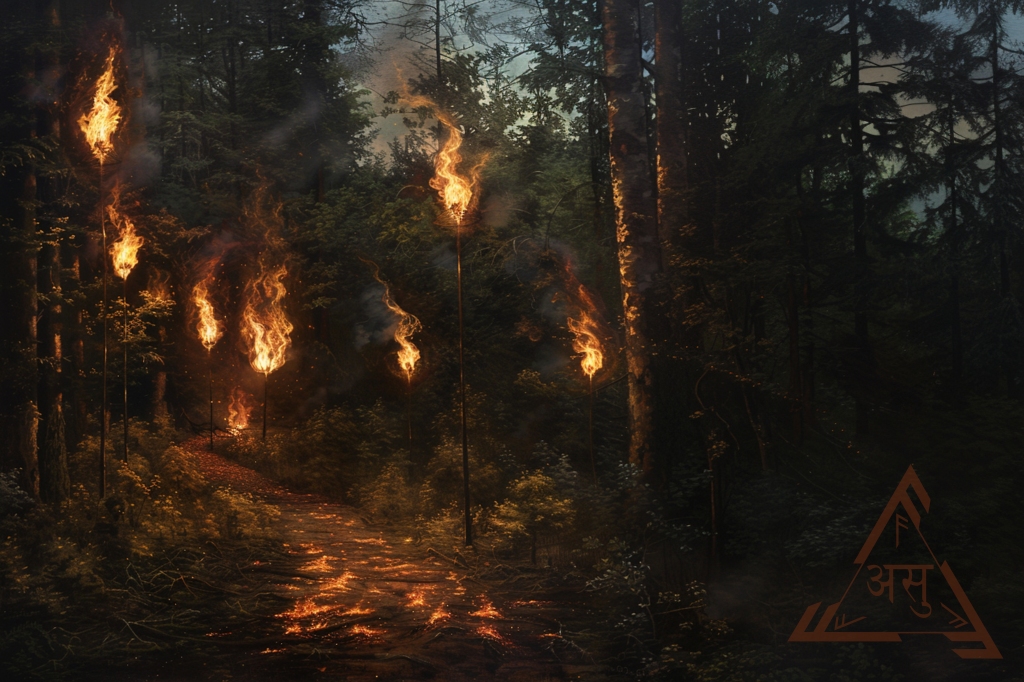
Kenaz is a particular rune, changing dramatically in context from Elder to Younger runes. The continental Germans seemed to hold this rune in a more positive light than their Scandinavian neighbors in the North. Kenaz is a reconstructed word from Proto-Germanic meaning “torch,” associated with creative fire, skills, knowledge, and teaching. The torch is that which illuminates the darkness, showing us the way in places unknown. This has been equated with an internal creative “spark” as well, which I think is reflected in the hard “k” sound represented by this rune. If we look to the Gothic language, we find evidence for this theory in the kindred word kōnja which refers to pine sap. This must be directly related to the torch, as pine/spruce has long been a favored wood for this use.
The Gothic name for this rune is kosma/kusma, stemming from kunnan meaning “to be able, to know how,” referring to one’s inner abilities and skills. This word travels through time and tribe almost unchanged in sound and meaning, showing up in modern English in the words know and keen. In my opinion, the best example of this concept is crystallized in the Swedish word konst, meaning “art, knowledge, science, magic, secret,” and in the cognate German word kunst meaning “skill, craft, ability, magic.” This internal power of knowledge, associated with a craft or specific artistic focus, is the secret “light” side of the Kenaz rune, symbolizing our ability to make things known, to teach them, and to exhibit mastery in arts, crafts, intellectual or occult matters.
When looking for clues in the rune poems, the only evidence we find in relation to a “torch” is from the ‘Old English Rune Poem,’ where it states:
“Torch is known by each of the living through its fire
-bright and blazing- it burns oftest
Where the athelings are at ease indoors.”
Here it is clear that the word “torch” is denoting skill as a display of one’s “inner fire.” This is something (as a torch in the dark) that all can witness. “Bright and blazing” is the external effect of mastery and true skill in craft, as creation is a bright and blazing power. The last line denotes a sense of peace inherent in the “athelings,” which means “nobles, lords, heroes.” This clearly reminds an English reader of the word athlete, which signifies “those competing to win a prize.” I believe this relates to the calm felt within an extremely wise, skilled, or focused group; where everyone’s flame is burning bright and clear, all can feel a sense of ease and comfort. We get another look at this concept with the Old English word kennan which means “to make known, declare” but also “to bring forth, produce.” This is essential to the function of a craftsmen, artist, musician, or anyone who actively works with creative energies and systems.
In Old Norse, this rune is represented in the word kaun, meaning “sore, ulcer, boil,” and carries a much more sinister and harmful aspect associated with it. In most old poetry and analysis, it seems this rune was more of a curse or fetter than something used for anything “positive.” Although, in some Freemason rites, it has been shown that the Younger rune (ᚴ) is still in effect as a “torch,” as it mimics the man holding his sword (torch) at this angle during initiation rituals. As one walks through this “tunnel of torches,” he is “illuminated/initiated” into a new reality.
In the ‘Old Norwegian Rune Rhyme” it is said:
“A sore is a curse for children;
Bale makes a man pale.”
Likewise, in the “Old Icelandic Rune Poem” it is said:
“A boil is bale for bairns, and a scourgeful spot,
And a home for flesh-rot.”
Here we see how our Scandinavian ancestors viewed this rune, as a much darker and fearful tone is taken with it. They viewed this rune in the context of evil and pain, without any allusions to a “lighter” aspect within the poetry. However, all these physical ailments have in common the sensation of “burning” within those experiencing it. This gives us insight into the deeper layers of the rune, where “fire” is still present, albeit in a new form. This rune was probably used strictly as a curse unless by the most skilled of sorcerers, who may have been able to turn this internal strife and struggle into acts of creation or transcendence. If looking at the Younger Futhorc as a whole, we see Kaun landing next to another very sorcerous and powerful rune, Hagal, the hail stone of transformation. Seeing these very destructive and feared runes side by side, as fire and ice respectively, shows a sort of miniature Ragnarök within the cycle of the Futhorc, enhancing the importance of viewing them in their respective “aetts” or groups, as here we end the first and begin the second. This is something I plan to venture into with more thought later…
To conclude, Kenaz is a rune steeped in much power and is tied together throughout all linguistic changes in the concept of an internal “fire” or a “burning” sensation. We have the older associations with torches, knowledge, creation and skill; being associated with teachers, students, craftsmen, and artistic masters. We also have the concept of “keenness” tied in, being exceptionally skilled and knowledgeable, “sharp” of mind and highly productive. In the North, this rune carried a more malicious nature, representing sickness, pain, and struggle. When approaching this rune from all the previous angles, we see a very wide range of meanings one can attribute to this rune, depending mostly on which system of runes one is working with. If using the Elder or Anglo-Saxon runes, this rune is viewed in relation to the torch. If using the Younger runes, it is likely you will associate this rune with pain or sickness.
Taken from the book “Wandering the Runic Path: Esoteric Analysis of the Germanic Runes” by Hrukjan.
 Ansuz Society