
Subscribe to continue reading
Subscribe to get access to the rest of this post and other subscriber-only content.

Subscribe to get access to the rest of this post and other subscriber-only content.
This process is something that is done differently by almost everyone, as there has never existed a pan-Pagan dogma regarding this type of activity. However, most would agree that when constructing an altar in the Germanic fashion, there are 4 main pieces to consider. These 4 pieces we will cover here along with other ideas for what one can add to their setup. Having an altar dedicated to spiritual activity is important, as it gives one a place to conduct work that is vital to the human experience.
First, one must find a location that one is drawn to, perhaps isolated in the forest at the foot of a particularly powerful tree, a secret natural site, or inside one’s home in a secluded area. Second, it is recommended that an organic “table” be present in the location to conduct exchanges and make offerings, such as a stump or flat stone. If there is not, one should build something for this purpose. This can be a simple platform, or it can be an entire temple, this all depends on the person’s means and dedication. Third, the deity with which one wishes to communicate (in this case Odin) needs a home or place to inhabit on the altar. This can take the form of a special tree, stone, idol, statue, image, or in some cases, the skull of an animal or human. Generally, the deity is thought to reside in this location indefinitely, although, some will argue that they are only meant as temporary dwellings for the gods and spirits to reside in while the operant conducts their business. The fourth piece, especially important in the case of Odin (but also relevant to any Pagan altar), would be the drinking vessel in which we offer libations.
Once one has completed these 4 tasks, the altar is ready to be blessed and put into immediate use. Blessings include fumigation, galdr, and various invocations to protect the space. Some other things to consider placing on the altar are offering bowls, incense vessels, candles, a set of runes, and a place to leave meat or gifts intended for Odin’s ravens and wolves. Aside from these things, it is up to one’s discretion what they choose to exchange with the High One. When it comes to maintaining this space, one must keep things fairly organized and clean. This shows respect to the deity and helps one stay disciplined.
Strive to replace the rune set every year, if made of wood. If the runes are made of stone, they should be washed, cleansed and re-consecrated through galdr and one’s own blood. Last, libations should be made according to your means, but it is recommended to refresh the drinking vessel either every 3 days, 9 days, 45 days, and/or on full Moons. When throwing out the old libation, it should be offered to a tree or local spirit, never put into the drain or trash.
May this be of use to new and current practitioners.
Hailaz!
The Chanterelle is an edible mushroom with medicinal perks.
You can find this golden treasure living in symbiosis with pine, spruce, oak and hornbeam.
They will reappear in the same places year after year so long as the mycelium in the soil is not disturbed. One patch can produce fungi for generations.
Some of the benefits of Chanterelles include:
• Rich source of several vitamins and minerals including vitamin D which supports bone health
• Known to help reduce inflammation
• Great immunity boosters
We like to pickle our excess Chanterelles for later use.
Let us know if you have any favorite Chanterelle recipes or other uses!

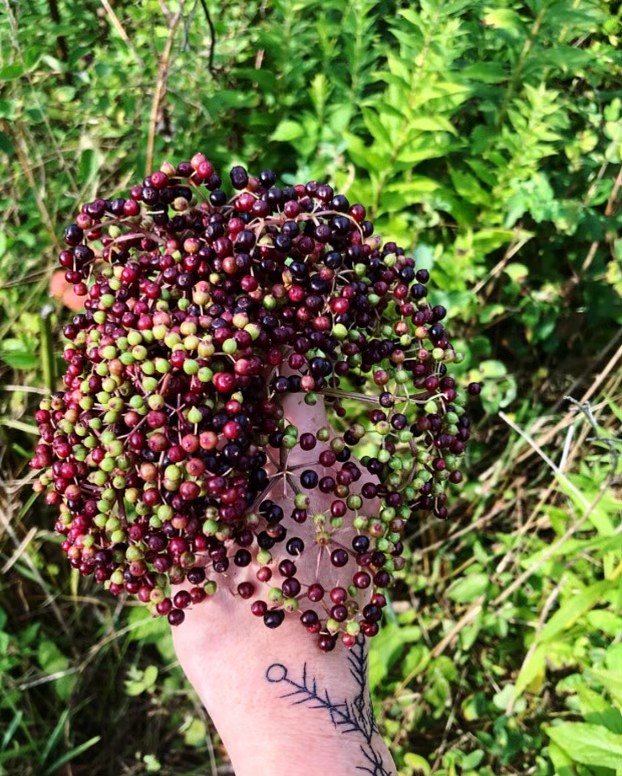
One could spend a lifetime soaking up Elderberry lore. Please, if we have missed something important, let us know!
Elder can be found most prominently in European history and mythos. Elderberry gets its name from the Old English aeld, which means “fire.” This association with fire comes from archeological evidence suggesting the use of its hollow branches to blow into fire to get it going.
In Celtic Ogham, the Ruis (ᚏ) symbol represents the Elder. In Old Irish, ruise means “red” or “redness”. This Ogham refers to blushing, intense emotions, shame, being red in the face and the glow of anger. It also refers to the practice of using Elderberries to redden one’s cheeks. Ruis shows sacrifice must be made in order to gain. We must face our failures and pain on our path to achievements.
Elder is sacred to many goddess-traditions and especially to the goddess Frau Holle. It is said that Frau Holle lived inside of the elder bush and she has been referred to as the Elder Mother. Frau Holle has been represented in various ways in several cultures and has gone by many names in Germanic mythology including Mother Earth, Perchta, Odin’s Wife, Frigg, Holda, and several more. She has many faces.
Frau Holle is alternately a hag and a nurturing mother, believed to be a bridge between life and death; communicating with and helping souls to pass over. She holds the power to unleash a variety of magicks on all beings and things in the world. Not one part of the Elderberry bush is to be cut or burnt without permission from her. If one does, you may experience her wrath.
In Danish, the Elder Mother is called Hyldemoer and is associated with Elves, commonly perceived as living within the roots of the Elder tree. Elder wood was considered dangerous to use when building cradles for fear that the Elder Mother could torment or steal the child away.
In an ancient Irish collection of stories known as “The Lays of Fionn Mac Cumhail”, there is a tale called “The Headless Phantoms”. In this tale, Fionn stays in a strange and otherworldly house where elder logs are burnt. He spends the evening being forced to face a myriad of horrible monsters.
The Romani were so fearful of the wrath of the Elder Mother that they would go through great lengths to inspect each bundle of firewood to be sure there was no Elder before casting it upon the fire. It is said that “should you doze off under an Elder bush, you may be taken away to the otherworld or you may never wake at all.
The Elder is known as a great protector and powerful ward against evil. Elderberries are still commonly planted in gardens to watch over the plants. Leaves of the bush were placed above doors to ward off witches. Elderberries on windowsills are supposed to keep vampires from entering. The vampire’s compulsive need to count all the berries would keep them occupied until dawn.
It has also been used in a variety of burial rituals. Green Elder branches were placed in fresh graves to protect the dead from evil spirits. Carrying or wearing any part of the Elder would protect you from harm. Elderberry oil (or water) has been used in blessing rituals. Among Christian traditions, the Elder was a fearful symbol of sorrow and death. In medieval times, some Europeans would tie Elderberry twig hoops to parts of the body that had rheumatism and believed that this would cure it. The Romans created hair color from the dark juice of the berries.
 Ansuz Society