The Younger Futhark (Futhorc) emerged around the 8th century C.E. in Scandinavia and is comprised of 16 runes. These runes were developed from the older 24 rune system we now call the Elder Futhark. Because of this reduction in symbols, some runes inevitably absorbed others in the process, making the system more cryptic. This also made reading and writing more complicated, as now some runes could supply a wider array of sounds. We see this for instance in the Tyr (ᛏ) rune, which indicates the “t” sound, now symbolizing the “d” sound as well, or in the Bjarkan (ᛒ) rune, which represents the “b” sound, now including the “p” sound as well. However, the rune with the most sounds is the Ur (ᚢ) rune, which includes over 5 different phonetic values such as U/W/V/Y/O.
This galdr track includes 16 repetitions of the Younger Futhorc, intended to help with meditation, memorization, and focus.
May it be of use to practitioners and anyone wanting to learn the runes.
Padmasambhava, also known as Guru Rinpoche, was a legendary tantric Yogi and the founder of Vajrayana Buddhism in Tibet, bringing the religion from India around the 8th century and establishing the first Tibetan sect now known as the Nyingma (Old School). He is considered by many to be the second Buddha, foretold by Shakyamuni (Gautama Buddha) to reveal the tantric/esoteric (Vajrayana) teachings and to propel and protect Buddhism in the degenerate age (Kali Yuga).
Jigme Khyentse writes in the book “White Lotus,”
“Before he [Shakyamuni] passed into mahaparinirvana, the Buddha prophesized that his activities would be prolonged and his teachings propagated and protected by Padmasambhava, whom Tibetan Buddhists frequently refer to as Guru Rinpoche, the Precious Master.”
Vajrayana is an outgrowth of Mahayana Buddhism and involves a wide collection of practices aimed at providing liberation (nirvana) in a single lifetime, hence its name meaning “Thunderbolt Vehicle.” This differs from the Mahayana (Great Vehicle) path where it can take an untold number of lives (incarnations) to accomplish complete liberation. Because of this difference in philosophy, the indigenous Tibetan and Himalayan peoples could only be persuaded by the infinite power of the Vajrayana and were quite reluctant to adopt Buddhism prior to Padmasambhava’s arrival.
Through various trials and tribulations, Padmasambhava was able to subdue the powerful gods and beings who inhabited the region of Tibet. In doing so, he gained their favor and service in return, incorporating them into the Buddhist religion as protectors and stewards of the Dharma. This is why we see numerous gods from other pantheons mentioned in the rituals and myths of tantric Buddhism, as Vajrayana practitioners of all nationalities seem to include their own ancestral deities into their practice. This is easily observed in the Tibetan, Japanese, Chinese, and Mongolian variants of Vajrayana, where each culture has created a syncretic and unique flavor of religious practice, not completely removed from its source but rather philosophically reformed and reworked.
The mantra of Padmasambhava OM AH HUM VAJRA GURU PADMA SIDDHI HUM is one of the most popular and powerful mantras used in Tibetan Buddhism, recited often to instantly evoke the Guru, gain enlightenment, and achieve siddhi (occult power). It can be translated in many ways and has various levels of meaning, but a general interpretation of the syllables would be:
OM AH HUM – Purifies body, speech, and mind.
VAJRA GURU – Perfect Teacher.
PADMA – Lotus, synonymous with nature of mind.
SIDDHI – Occult power, success in practice, accomplishment.
HUM – The syllable of enlightenment, the unshakable nature of ultimate truth.
Padmasambhava permeates everything and exists everywhere, nestled into the very fabric of space and time. At the time of his death (parinirvana), he achieved “Rainbow Body,” dissolving into light and leaving behind nothing but hair, nails, and clothing. He is known also as Padmakara (Lotus-Born), meaning he is born in our minds, existing eternally in the unstained regions of our consciousness, quickly summoned by this sacred formula. This mantra should be recited as often as needed, whether for guidance, protection, clarity, wisdom, or any other purpose.
Wunjo is the liberating power of bliss; the levity associated with fulfillment and satisfaction in one’s life and with one’s deeds. This blissful ecstasy can otherwise be associated with our concept of joy, happiness, and pleasure. We get a glimpse of this rune in the “Old English Rune Poem,” where it is said:
“Wynn is borne by him who knows little of woes,
Of soreness and sorrow, and himself has-
Bounty and bliss, and plenty of strongholds too!”
Throughout the poem, we see a clear picture of true contentedness; a metaphysical ease that embraces one whom has for themself created the circumstances for bliss; a momentary freeing of the soul from any bonds of anxiety, woe, or sorrow. One who has conquered their aspirations.
Wunjo also has a connection to wishes, in the sense that fulfilled wishes lead to these feelings of delight, enjoyment, ecstasy etc. Combined with the lessons of other runes, we know that our wishes must be paired with correct action in order for them to be fulfilled; runes like Raido (for control), Thurisaz (for willpower), and Ehwaz (for movement) come to mind here, among plenty of others.
Therefore, it is wise to not look at wishing as a mere fantasy or common prayer, but rather a goal or outcome we’d like to see accomplished; something we want to facilitate or create. Wunjo/Wunsch/Wish of the old Germanic peoples was a force (or deity/spirit) of inspiration; one knew their wishes would only be fulfilled by their actions in life, rather than in pure lip-service. This is how one honored the Wunsch/Wish deity, who bestowed blessings upon those who completed their goals. This god of the Wish has been equated to Odin, as Grimm states in Teutonic Mythology:
(Wuotan/Wunsch) is himself the bestower of all bliss.”
It is certain that this “face” of Odin was one of importance and great reverence, as we find reference to him in “Grímnismál” as Óski, meaning “God of Wishes, Wished For.” This wish granting, bliss bestowing deity is usually associated with a tool, weapon, or item that symbolizes and or directs the gifts towards those who have earned them. This is seen in the German wunschelris, meaning “wishing twig,” the predecessor to the English “magic wand.” We also have the “wishing hat” of Wuotan, the “Horn of Plenty” or “Wheel of Fortune” of Fortuna, which in Sanskrit translates to mano-ratha or “wheel of the mind.” This alludes to Wunjo as a needed force of momentum to keeping one’s “wheel” moving forward. Another Indo-European deity who functions in this way would be Kamaduh/Kamadhenu, the “wishing cow.”
Another concept that we can include here is that of the Old Norse fylgja, meaning “one who follows man, companionship” and is associated with a type of “guardian angel” spirit who attaches itself to those it chooses, bestowing them with luck, blessings, and bliss. Fairies, elves, and dwarves are also known to grant wishes, associating these beings with the Wunjo rune.
Wunjo is closely related to the feeling of love, whether intimate or familial. We see this is the Proto-Indo-European root word wenh₁-, which means “to love, win” and “to wish.” Many word offspring have come from this root and it seems this sound denotes a sort of happiness, kindness, and affection. We see another related word in the Latin venia meaning “kindness, mercy, grace” and in the modern English/Old French word venial meaning “able to be forgiven, worthy of forgiveness.” In both words we see connections associated with Wunjo, as during the process of forgiveness one shows great love. Some more words derived from these concepts are the Proto-Germanic word wanjaną which means “to make accustomed to,” indicating an act of extreme care and kindness to guests. Wunjo is this process, formula, and understanding; the living phenomenon of the Wish, of love, and kindness. Wunjo is the creation of bliss, joy, and satisfaction in life.
One more concept that could be drawn from this rune is that of indulgence or intoxication. Rather than embodying a stupefied version of these words, however, one is meant to reach states of ecstasy and spiritual dominance through these particular indulgences, using pleasure as a tool to create Wunjo, or bliss, associated with the divine; a piercing into the veil of reality. This can be seen in the Proto-Italic word wenjā meaning “indulgence.” The earlier visited Latin word venia also has a co-meaning of indulgence. In this respect, we can see a clear connection with pleasure and the realms of love and bliss.
It is acceptable to deduce that Wunjo is a symbolic representation of the sensation of love, satisfaction, and joy in life. This feeling has permeated man for thousands of years with a clear and definitive expression. We can see a direct development of sounds and words associated with Wunjo forming their own substratum of conceptual framework, all revolving around this original sound/word wenh₁-. To our linguistic forefathers, the Proto-Indo-Europeans, we can assert that the “W” sound carried a euphoric and ecstatic vibration for those who spoke it.
Fehu is a rune denoting possessions, wealth, and material resources. In the ancient German tongue, this word would have represented one’s livestock, particularly cattle or other large production animals. Fehu stems from the Proto-Indo-European word péḱu, which translates to “livestock.” Before the common man was able to call land his own, the only things he could really claim ownership of were his animals, assets, and family. This would evolve later into the English word fee, meaning “a right to the use of a superior’s land, inherited estate held of a lord, general property ownership, money paid or owned, payment for service, a prize or reward.” We see this same idea in the Old French word fief, meaning “an estate held by a person on condition of providing military service to a superior, something over which one has rights or exercises control, or an area of dominion.”
Another connection we find relating to the concept of land ownership is in the word feudalism, meaning “a social system based on personal ownership of resources and personal fealty between a lord and subject.” This word can be broken down into 3 parts as “fe-odal-ism,” which would imply the connection between the noble (odal) and the fee (fe) one pays to essentially sub-lease land from the noble. This fee would be in the form of food, money, or military service. We also can find further evidence in the word fealty, meaning “allegiance to an oath to one’s lord.”
This rune applies to all things monetary and material, whether in the form of the living flesh of animals or in the cold medium of actual money. Fehu, in this regard, can also be assigned powers of security, abundance, domestication, opportunity, and peace. Esoterically speaking, one could view Fehu as a fire rune, as one’s resources are a type of fuel/fire source, helping to propel us forward with more confidence, and ultimately, more focus towards our goals. Now that we’ve peeled away the outer layers of the Fehu rune, we can look deeper inside for further information.
Connections can be made to the twin Vanir gods Freyr and Freyja, as this stave belongs to their respective “aett” of runes. Frey(r) has long been known to reside over the homestead, fertility, and success of the farm. His powers are attributed to fair weather, peace, prosperity, and general safety within the “sacred” or enclosed space of the homestead/village. Freyja, on the other hand, represents fertility, lust, beauty, death, and the Earth. In the “Old English Rune Poem” it is said:
“Wealth is an ease to every man,
Though each should deal it out greatly
If he wishes to gain, before his Lord, an honored lot.”
At this point in history, the author would have been referring to the Christian God. Nonetheless, this could easily refer to Freyr as well, and in fact clearly alludes to him, as the very title of Freyr means “Lord.” This poem, and others, also indicate a certain antagonism of greed, saying one must “deal out” wealth as much as he can do so.
We see another connection to Fehu and Freyr in the word fairy, which is generally believed to be a being connected with the dead, magical powers, and the natural world. This word is cognate with the Latin Fata, who is the goddess of fate. We also have the English word fey, meaning “dying, dead, spellbound, doomed, or otherworldly.” Here, we can see remnants of powers inherent in the fairy, but also in Freyja, as she is a goddess residing over the dead alongside Odin. This could be insight into the overall order of the Futhark, as one could assume it resembles a Ragnarök-esque circle of events, symbolizing birth, death, and rebirth. Some refer to this as “the doom of the gods,” which could be a possible piece of evidence alluding to the Fehu rune representing doom or death, perhaps hinting at the resurrection of ones “Self” by means of retrieving material possessions from the burial mound; in turn beginning a new cycle, starting with one’s possessions.
Suggestion for this can be found in “Óláfs Saga Helga,” where King Olaf facilitates his resurrection through the prophetic dreams of Hrani, who takes the possessions of his (Olaf’s) mound to the wife of Herald the Greenlander. After this, she then gives birth to a son who is bestowed the name Olaf, ensuring another life according to their tradition. The new Olaf would later denounce this claim, as Christian ideals had become the norm by then and the concept of reincarnation was abolished in their religion aside from select, “underground” sects. Similarities can be seen in the way Tibetans choose the Dalai Lama; who is shown past possessions to pick from at a young age. If the child chooses the correct objects, he will be recognized as the reincarnated Holy Man.
Freyr has also been associated with the burial mound, the dead, and the cult of the ancestors. In “Ynglinga Saga” it is said that after Freyr had died, he was buried in a great mound with 3 holes bore into it. Each hole was offered a precious metal of either gold, silver, or copper to ensure good seasons and peace continued throughout the land. In connection with the dead, it is said that King Yngvi also used to perform “utisetta,” or Norse meditation, upon his dead queen’s burial mound.
One more piece of evidence I will add, in this regard, is the Irish word figh, meaning “to weave together, compose.” Here we see the idea of a new beginning, the “weaving” of a new story, connecting with the ideas we explored in relation to the goddess(es) of fate, who have long been associated with the “spinning” or weaving of the destinies of man and the cosmos. This further ties the rune to the goddess Freyja, who is known for teaching seiðr to Odin; a sorcery generally associated with a metaphysical “weaving, tying, or binding” of a specific target, the weather, or the forces of fate altogether.
Through this very material and resourceful rune we can form a more broad picture of how it may have been used as it moved through the ages. From a purely terrestrial concept revolving around possessions and livestock to the more metaphysical aspect of fire, energy, and prosperity within the Self and tribe. We are also given objective history into the idea of land ownership and how that system is constructed based on the notion of leasing out lands to those below you in caste. The king leases his land to nobles and the nobles, in turn, lease their land to the farmers/peasants.
In conclusion, we can be assured that the Fehu rune is a rune of one’s material possessions and that it is a rune of moveable wealth. Further, it can be attributed to gifts of abundance, prosperity, and fertility of the Earth. As this rune moves through the times, it reflects not only money, but the fuel-source it represents in respect to our desires and opportunities. We see esoteric connections to the dead, the burial mound, and the Heathen process of reincarnation associated with the retrieval of “past possessions,” similar to that of the Tibetan practice. These rather obscure connections, upon additional reflection, seem to hold more and more weight within them.
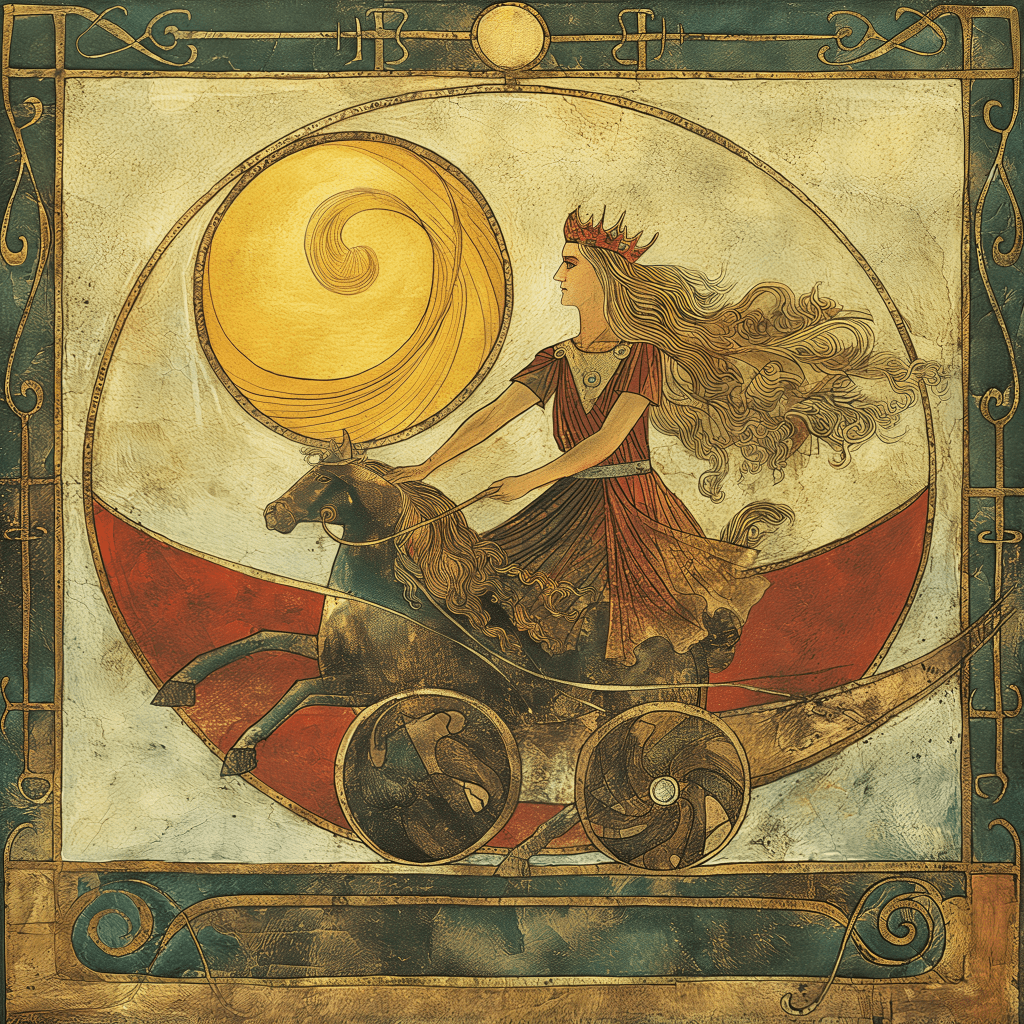
The Summer Solstice is the time of year when the daylight is longest, the power of the Sun is at its peak, and the solar cycle reaches its apex, tipping the scales towards the dark half of the year once again. After this turning point, the sunlight begins to wane, shortening the daylight minute by minute until the Winter Solstice. Typically, this was a time to celebrate the Sun, spend time outdoors, and enjoy the bliss of good weather. Mead, wine, and other beverages would be consumed, and great feasts would be enjoyed.
In “Teutonic Mythology” by Grimm, it is said:
“Twice in the year the sun changes his course, in summer to sink, in winter to rise. These turning-points of the sun were celebrated with great pomp in ancient times, and our St. John’s or Midsummer fires are a relic of the summer festival. The higher North, the stronger must have been the impression produced by either solstice, for at the time of the summer one there reigns almost perpetual day, and at the winter one perpetual night.”
Games and various competitions would be hosted along with other festivities such as dancing and music. Entertainment would be lively and abundant, encouraging joy and merriment among the community. In the Germanic context, many people honor the god Baldr during this time as a god of light and/or personification of the light of the Sun, which in a mythological context, “dies” and beings to decline after this time, mirrored by Baldr’s death and descent into Hel. Because of these connections, a common blot/ritual focus during the Summer Solstice is the death (or funeral) of Baldr, the god of light. Stone ships are erected, abundant offerings are made, and various sacrificial items are thrown into fire. These offerings are meant to aid Baldr in his journey on the long road of the underworld.
In “Celtic Mythology and Religion” by Macbain, he says:
“The midsummer festival, christianised into St John’s Eve and Day, for the celebration of the summer solstice, is not especially Celtic, as it is a Teutonic, feast. The wheels of wood, wrapped round with straw, set on fire, and sent rolling from a hillock summit, to end their course in some river or water, which thus typified the descending course of the sun onward till next solstice, is represented on Celtic ground by the occasional use of a wheel for producing the tinegin, but more especially by the custom in some districts of rolling the Beltane bannocks from the hill summit down its side. Shaw remarks – “They made the Deas-sail [at Midsummer] about their fields of corn with burning torches of wood in their hands, to obtain a blessing on their corn. This I have often seen, more, indeed, in the Lowlands than in the Highlands. On Midsummer Eve, they kindle fires near their cornfields, and walk round them with burning torches.” In Cornwall last century they used to perambulate the villages carrying lighted torches, and in Ireland the Eve of Midsummer was honoured with bonfires round which they carried torches.”
Large bonfires and “Sun-wheels” are made during this time, reflecting the power and glory of the Sun. Special attention was given to the goddess during this time as well, whether as a deification of the Sun itself, the Earth, the Mother, or a mix of the 3. Offerings such as flowers, cakes, milk, honey, and blood are given to the gods and spirits, a ritual exchange of abundance for abundance. As observed in the above quote, it was (and is) common practice to bring the energy of the Sun down to Earth in the form of a torch, then parade it through the fields, groves, or temples in order to bless them with this powerful energy.
In “A History of Pagan Europe” by Jones & Pennick, it says:
“…But the summer solstice, under its statutory date of 25 June, became a popular festivity early in Germanic history. The German word Sonnenwende always refers, in medieval texts, to the summer solstice, not to the winter solstice. At the end of the first century CE some German troops in the Roman army at Chesterholme listed their supplies for the celebration in a record which has come down to us. In the early seventh century, Bishop Eligius of Noyon in Flanders criticised the chants, carols and leaping practised by his flock on 24.”
Here we are given examples of some ancient Germanic practices revolving around the Summer Solstice. We are told of singing, chanting, and competitive games like “leaping”. Clearly, the Christian Romans were disturbed by this revelry, showing its clear Pagan origins. This turning point in the year was extremely important to observe, as it strikes a pivotal moment in the Sun’s lifecycle, affecting every aspect of our lives.
Odin as the primordial state of consciousness applies to women as well, as Odin is said to have given soul to both. This innate awareness is formless and is beyond any associations with body or sexual identity. Therefore, one does not have to look at primal awareness as something based on these limiting and mundane concepts. This doesn’t mean that Freyja is not involved in the equation, as Freyja is the energy and flux of the natural/material universe, identical to great Kali/Shakti/Tara Ma. Freyja represents matter, while Odin represents consciousness. Without Odin, there would be no Freyja, and without Freyja, Odin would have nothing to manifest into. These are the two pieces of the puzzle that create what we know of our existence and reality; the Father (consciousness) and the Mother (material world). Each sentient being and all physical matter encapsulates these qualities. They are inseparable. Through training and practice, one can destroy the surface duality represented in these two halves, reuniting them into one single point of experience. Either deity can be venerated as supreme, as they both express one final outcome of creation.



 Ansuz Society