The six-syllable mantra Om Mani Padme Hum (Tib. Om Mani Peme Hung) is the most popular mantra in Tibetan Buddhism and has been chanted for over 1500 years. The mantra can originally be found in the Kāraṇḍavyūha Sūtra and is associated with the deity Avalokiteśvara (Tbt. Chenrezig) whose name means something like “Lord of the World.” The mantra itself has many different meanings associated with it, but most commonly it is translated as something like “Hail the Jewel in the Lotus.” This phrase is an homage to the great “jewel” of primordial awareness (Buddhanature) that exists within the hearts of all sentient beings. May all beings thrive under the watchful eyes of compassion.
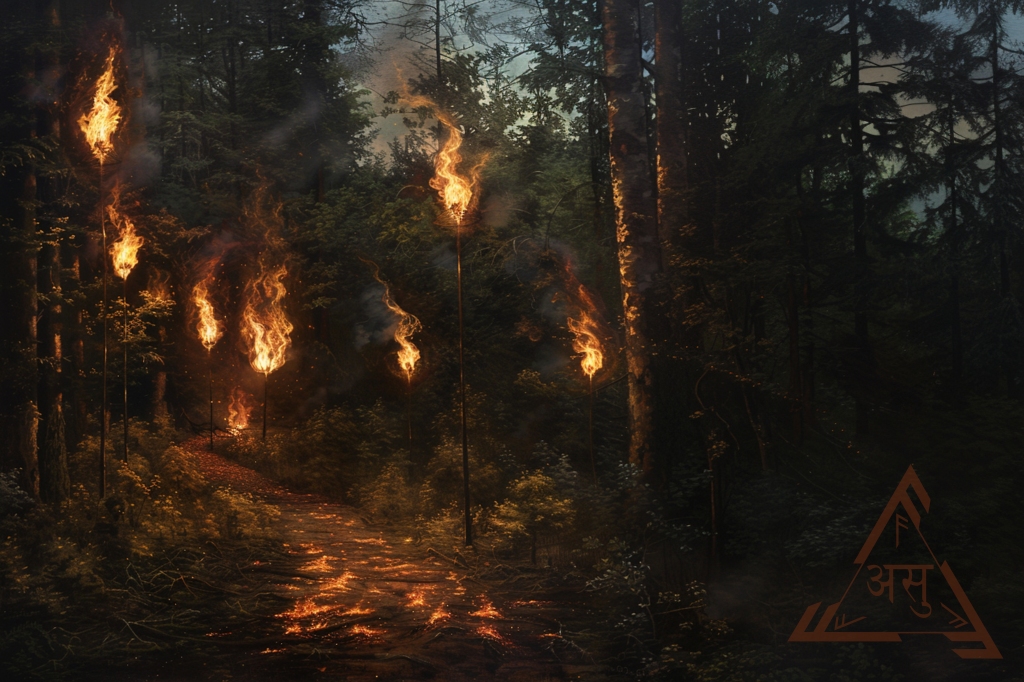
Kenaz is a particular rune, changing dramatically in context from Elder to Younger runes. The continental Germans seemed to hold this rune in a more positive light than their Scandinavian neighbors in the North. Kenaz is a reconstructed word from Proto-Germanic meaning “torch,” associated with creative fire, skills, knowledge, and teaching. The torch is that which illuminates the darkness, showing us the way in places unknown. This has been equated with an internal creative “spark” as well, which I think is reflected in the hard “k” sound represented by this rune. If we look to the Gothic language, we find evidence for this theory in the kindred word kōnja which refers to pine sap. This must be directly related to the torch, as pine/spruce has long been a favored wood for this use.
The Gothic name for this rune is kosma/kusma, stemming from kunnan meaning “to be able, to know how,” referring to one’s inner abilities and skills. This word travels through time and tribe almost unchanged in sound and meaning, showing up in modern English in the words know and keen. In my opinion, the best example of this concept is crystallized in the Swedish word konst, meaning “art, knowledge, science, magic, secret,” and in the cognate German word kunst meaning “skill, craft, ability, magic.” This internal power of knowledge, associated with a craft or specific artistic focus, is the secret “light” side of the Kenaz rune, symbolizing our ability to make things known, to teach them, and to exhibit mastery in arts, crafts, intellectual or occult matters.
When looking for clues in the rune poems, the only evidence we find in relation to a “torch” is from the ‘Old English Rune Poem,’ where it states:
“Torch is known by each of the living through its fire
-bright and blazing- it burns oftest
Where the athelings are at ease indoors.”
Here it is clear that the word “torch” is denoting skill as a display of one’s “inner fire.” This is something (as a torch in the dark) that all can witness. “Bright and blazing” is the external effect of mastery and true skill in craft, as creation is a bright and blazing power. The last line denotes a sense of peace inherent in the “athelings,” which means “nobles, lords, heroes.” This clearly reminds an English reader of the word athlete, which signifies “those competing to win a prize.” I believe this relates to the calm felt within an extremely wise, skilled, or focused group; where everyone’s flame is burning bright and clear, all can feel a sense of ease and comfort. We get another look at this concept with the Old English word kennan which means “to make known, declare” but also “to bring forth, produce.” This is essential to the function of a craftsmen, artist, musician, or anyone who actively works with creative energies and systems.
In Old Norse, this rune is represented in the word kaun, meaning “sore, ulcer, boil,” and carries a much more sinister and harmful aspect associated with it. In most old poetry and analysis, it seems this rune was more of a curse or fetter than something used for anything “positive.” Although, in some Freemason rites, it has been shown that the Younger rune (ᚴ) is still in effect as a “torch,” as it mimics the man holding his sword (torch) at this angle during initiation rituals. As one walks through this “tunnel of torches,” he is “illuminated/initiated” into a new reality.
In the ‘Old Norwegian Rune Rhyme” it is said:
“A sore is a curse for children;
Bale makes a man pale.”
Likewise, in the “Old Icelandic Rune Poem” it is said:
“A boil is bale for bairns, and a scourgeful spot,
And a home for flesh-rot.”
Here we see how our Scandinavian ancestors viewed this rune, as a much darker and fearful tone is taken with it. They viewed this rune in the context of evil and pain, without any allusions to a “lighter” aspect within the poetry. However, all these physical ailments have in common the sensation of “burning” within those experiencing it. This gives us insight into the deeper layers of the rune, where “fire” is still present, albeit in a new form. This rune was probably used strictly as a curse unless by the most skilled of sorcerers, who may have been able to turn this internal strife and struggle into acts of creation or transcendence. If looking at the Younger Futhorc as a whole, we see Kaun landing next to another very sorcerous and powerful rune, Hagal, the hail stone of transformation. Seeing these very destructive and feared runes side by side, as fire and ice respectively, shows a sort of miniature Ragnarök within the cycle of the Futhorc, enhancing the importance of viewing them in their respective “aetts” or groups, as here we end the first and begin the second. This is something I plan to venture into with more thought later…
To conclude, Kenaz is a rune steeped in much power and is tied together throughout all linguistic changes in the concept of an internal “fire” or a “burning” sensation. We have the older associations with torches, knowledge, creation and skill; being associated with teachers, students, craftsmen, and artistic masters. We also have the concept of “keenness” tied in, being exceptionally skilled and knowledgeable, “sharp” of mind and highly productive. In the North, this rune carried a more malicious nature, representing sickness, pain, and struggle. When approaching this rune from all the previous angles, we see a very wide range of meanings one can attribute to this rune, depending mostly on which system of runes one is working with. If using the Elder or Anglo-Saxon runes, this rune is viewed in relation to the torch. If using the Younger runes, it is likely you will associate this rune with pain or sickness.
Taken from the book “Wandering the Runic Path: Esoteric Analysis of the Germanic Runes” by Hrukjan.
Mahakala, black in color and fearsome in appearance, represents spiritual activity beyond our comprehension; the true consciousness that is unseen. His name means “Beyond Time/Great Black One” because he is all pervasive and unmanifested in material form, free of the shackles of tangibility. As a presence beyond matter, he remains untouched by Samsara, residing in the very fabric of space (consciousness) that permeates the entirety of the cosmos. Mahakala, like all Yidam (Ishtadevata) deities, represents the Vajra mind, fixed and indestructible; the primordial state of sentient awareness. Surrounded by the flames of wisdom, he is beyond the reach of times’ destruction. Mahakala is the foundation of conscious reality; a force of gravity that pulls beings towards the practice and service of the Dharma.
“…Such undeluded energy, like a windblown fire, can burn away the dross. Mahakala has strong legs and Mahakala has sure feet; They are well able to trample down demonic thoughts and deeds!…”
We have recorded a rendition of the Mahamrityunjaya mantra with a new affiliate @kshatriyacowboy. This verse can be found in the Rigveda (RV 7.59.12) and is devoted to the great Rudra-Shiva in his form of Tryambakam or “The Three Eyed One.”
There are many translations of this mantra, but it is generally referred to as the “Great Conquest Over Death” or “Death Destroying” mantra.
The Mahamrityunjaya mantra is a request to be separated from the clutches of death; a longing to be free of attachments to samsara and one’s inherent ignorance regarding the perception of self. The mantra expresses a specific wish to not be removed from the possibility of immortality; requesting to have one’s attachment to samsara be broken (the suffering of bodily/individual bondage) but for one’s consciousness (Self/Atman) to remain intact for eternity; completely overwhelmed and overflowing with devotion for the primeval essence. This is requested as a means to continue worshiping the divine Shiva for all of infinity, who is none other than the progenitor of primordial consciousness; the true state of one’s being. The mantra describes this metaphorically as a cucumber (or melon) being separated from its vine but continuing to live on as an emanation of its source (Shiva). This request is for consciousness to become free from the shackles of the flesh (vine) associated with the experience of samsara (change), ego, and death. Through this process, one’s true Self may live on forever in constant reverence of the primordial source; the original state of awareness from which one’s perception comes and to what one’s consciousness is inseparable from, no matter how obscured or hidden by one’s mundane delusions.
Oh Three Eyed one, great Shiva,
Fragrant (blissful, aromatic) sustainer of prosperity,
As the cucumber is removed from its vine (bondage),
May I be relinquished from death (attachment to samsara) but not from immortality.
We are wrapping up the final edits for the second rune book by Hrukjan titled “Wandering the Runic Path: Esoteric Analysis of the Germanic Runes.”
These will be published early next month and copies will be available from us around Samhain.
For those interested in the book, we’d like to share some information from the introduction:
“This book is meant to help guide the runic adept through various untrodden paths regarding the runes and their use in esoteric Pagan practice. Through many avenues such as language, myth, religious comparison, and thorough analysis, one can expand the dimensions of each rune into the endless fathoms of space and time. Each rune of the Elder Futhark has been dissected and tirelessly studied so that no stone is left unturned in their usability and ultimate meaning. Along with in-depth study, each “aett” of runes has also been given a set of common themes that one can ponder in association to their roles within the entirety of the Futhark. Not only this, but it is speculated throughout the book that the order of the runes is not only important, but carefully tells a unique story regarding life, death, rebirth, and the ultimate truth of existence as expressed by the people who created and used them.
While much of this book is speculative in nature, offering a deeply subjective analysis of these symbols, there is also much concrete and objective information regarding their history, etymology, and journey through time. From their many connections to Sanskrit and other Indo-European languages, the reader can form a thorough understanding of these symbols based on thousands of years of transformation. The reader will see how these runes transcend culture and relate to the natural surroundings of the different tribes that used them as they migrated across much of Europe, Asia, and beyond. Through this approach, one will see that the use of the runes is not only universally applicable, but also, not restrained to a certain “folk” or people. By realizing the scope of their use, one can see them as a divine tool for Self-development and transformation, as each rune is a key to ultimate realization.
If you are looking for a book that is not just informative, but also applicable to religious and spiritual practice, then this book should offer you many avenues towards your own purified understanding of these ancient symbols as used by the greatest of sages and magicians of the past. My hope is that this book will act as a compass for the devoted reader as they traverse the dark and endless paths laid before them by these ancient symbols. By doing so, one does not get lost or steered in detrimental directions by those who would rather see you confused and reliant on outside influences. Runic knowledge and the wisdom inherent within them are present in every sentient being, especially those who have the memories of these signs within their very soul. These secret symbols mirror that which exists within us and each rune is a key to unlocking the mysteries that lie dormant within our experience of reality. May this book help you transcend the limitations of individual existence and soar into the ether as Odin once did upon the great World Tree.”
Odin as the primordial state of consciousness applies to women as well, as Odin is said to have given soul to both. This innate awareness is formless and is beyond any associations with body or sexual identity. Therefore, one does not have to look at primal awareness as something based on these limiting and mundane concepts. This doesn’t mean that Freyja is not involved in the equation, as Freyja is the energy and flux of the natural/material universe, identical to great Kali/Shakti/Tara Ma. Freyja represents matter, while Odin represents consciousness. Without Odin, there would be no Freyja, and without Freyja, Odin would have nothing to manifest into. These are the two pieces of the puzzle that create what we know of our existence and reality; the Father (consciousness) and the Mother (material world). Each sentient being and all physical matter encapsulates these qualities. They are inseparable. Through training and practice, one can destroy the surface duality represented in these two halves, reuniting them into one single point of experience. Either deity can be venerated as supreme, as they both express one final outcome of creation.
We have uploaded a new galdr track titled “Ek Immi Óðinn” to our YouTube channel.
Ek Immi Óðinn can be translated to “I am Odin” and is meant to invoke the supreme awareness within. After one feels the deity present in their surroundings, one is to merge this primordial consciousness into oneself, replacing the mundane qualities of their hindered state of being associated with ignorance, weakness, and delusion. This method is mirrored in the Sanskrit mantra “Soham,” meaning “I am That.” This is a technique which allows the practitioner to become the deity (Odin) through the replacement of one’s limited state of mind, substituting it with the primordial awareness represented by the all-pervading consciousness of Odin. Through chanting this galdr repeatedly, one can transform themselves with immense speed and precision if one practices with single-pointed focus.
May all sentient beings seek the source of their consciousness and realize Odin within.
ALU represents orally transmitted knowledge that is passed down or transferred between individuals. This is akin to one “vessel” pouring liquid (ALU) into another vessel, representing the passing of tradition and secret wisdom from teacher/guru to student/disciple. This can be visualized like a great fountain, where water cascades down from one source point, representing the head of the spiritual lineage, falling down into further basins which overflow into more and more, representing each member who retains the teachings.
One could also speculate that the magical phrase ALU, while being associated with an “intoxicating” beverage, could be a reference to the “madness” that Odin is said to bring forth in his devotees. Other Proto-Germanic words like aluh (amulet) and alh (protect) can bring us to see ALU as being “protected by the intoxication of Odin.” It is quite possible, as with the Vedic and Egyptian ancient temples, that this ALU was a mix of substances, kept within the temple for sacred use. Other ingredients were likely various herbs and psychedelic mushrooms.
ALU can also be associated with inspiration and the “Mead of Poetry.” This magical liquid is said to cause consumers to become skalds (poets) and scholars; created by the dwarves Fjalar and Galar by mixing honey with the blood of the wise god Kvasir. Odin steals this magical mead disguised as an eagle and brings it back to Asgard. He then (through his mouth) delivers it to the gods and those skilled in poetry, emphasizing the concept of orally transmitted wisdom. This story can be found in Skáldskaparmál.
May ALU flow within all sentient beings and may divine intoxication drive your spirit forward.



 Ansuz Society