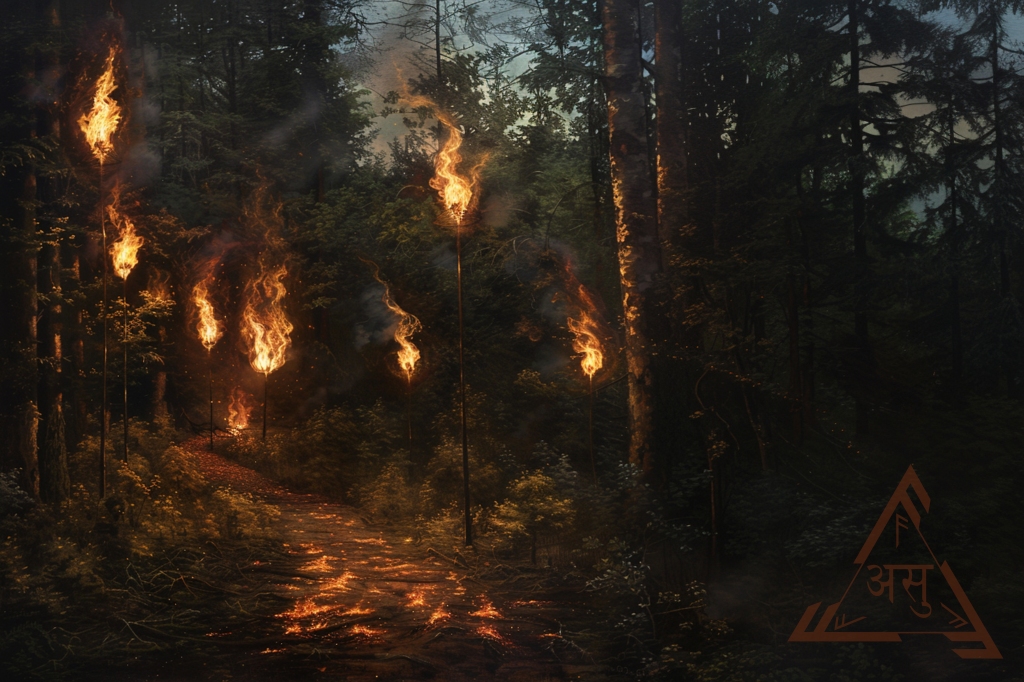
A short section from the new book “Wandering the Runic Path: Esoteric Analysis of the Germanic Runes” regarding the Kenaz (ᚲ) rune.
“Kenaz is a particular rune, changing dramatically in context from Elder to Younger runes. The continental Germans seemed to hold this rune in a more positive light than their Scandinavian neighbors in the North. Kenaz is a reconstructed word from Proto-Germanic meaning “torch”, associated with creative fire, skills, knowledge, and teaching. The torch is that which illuminates the darkness, showing us the way in places unknown. This has been equated with an internal creative “spark” as well, which I think is reflected in the hard “k” sound represented by this rune. If we look to the Gothic language, we find evidence for this theory in the kindred word kōnja which refers to pine sap. This must be directly related to the torch, as pine/spruce has long been a favored wood for this use.
The Gothic name for this rune is kosma/kusma, stemming from kunnan meaning “to be able, to know how,” referring to one’s inner abilities and skills. This word travels through time and tribe almost unchanged in sound and meaning, showing up in modern English in the words know and keen. In my opinion, the best example of this concept is crystallized in the Swedish word konst, meaning “art, knowledge, science, magic, secret,” and in the cognate German word kunst meaning “skill, craft, ability, magic.” This internal power of knowledge, associated with a craft or specific artistic focus, is the secret “light” side of the Kenaz rune, symbolizing our ability to make things known, to teach them, and to exhibit mastery in arts, crafts, intellectual or occult matters.”
May all sentient beings realize this rune within themselves.
We are wrapping up the final edits for the second rune book by Hrukjan titled “Wandering the Runic Path: Esoteric Analysis of the Germanic Runes.”
These will be published early next month and copies will be available from us around Samhain.
For those interested in the book, we’d like to share some information from the introduction:
“This book is meant to help guide the runic adept through various untrodden paths regarding the runes and their use in esoteric Pagan practice. Through many avenues such as language, myth, religious comparison, and thorough analysis, one can expand the dimensions of each rune into the endless fathoms of space and time. Each rune of the Elder Futhark has been dissected and tirelessly studied so that no stone is left unturned in their usability and ultimate meaning. Along with in-depth study, each “aett” of runes has also been given a set of common themes that one can ponder in association to their roles within the entirety of the Futhark. Not only this, but it is speculated throughout the book that the order of the runes is not only important, but carefully tells a unique story regarding life, death, rebirth, and the ultimate truth of existence as expressed by the people who created and used them.
While much of this book is speculative in nature, offering a deeply subjective analysis of these symbols, there is also much concrete and objective information regarding their history, etymology, and journey through time. From their many connections to Sanskrit and other Indo-European languages, the reader can form a thorough understanding of these symbols based on thousands of years of transformation. The reader will see how these runes transcend culture and relate to the natural surroundings of the different tribes that used them as they migrated across much of Europe, Asia, and beyond. Through this approach, one will see that the use of the runes is not only universally applicable, but also, not restrained to a certain “folk” or people. By realizing the scope of their use, one can see them as a divine tool for Self-development and transformation, as each rune is a key to ultimate realization.
If you are looking for a book that is not just informative, but also applicable to religious and spiritual practice, then this book should offer you many avenues towards your own purified understanding of these ancient symbols as used by the greatest of sages and magicians of the past. My hope is that this book will act as a compass for the devoted reader as they traverse the dark and endless paths laid before them by these ancient symbols. By doing so, one does not get lost or steered in detrimental directions by those who would rather see you confused and reliant on outside influences. Runic knowledge and the wisdom inherent within them are present in every sentient being, especially those who have the memories of these signs within their very soul. These secret symbols mirror that which exists within us and each rune is a key to unlocking the mysteries that lie dormant within our experience of reality. May this book help you transcend the limitations of individual existence and soar into the ether as Odin once did upon the great World Tree.”
“Think of the simplest thing you do, such as making a cup of tea. You know that in order to do something as easy and simple as making a cup of tea, you must acquire all the necessary conditions and ingredients. You need a source of heat and you need a source of water. You need a container in which to boil the water, you need tea leaves, and you need a cup to drink the tea in. If you do not have those things, you cannot make tea. When it comes to making tea, we take all of these things for granted. We think of it as a very simple process. Yet somehow when it comes to the practice of Dharma, we are unwilling to go through the process of accumulating what is necessary.
Furthermore, when you make tea you have to know what your are doing. You have to know how to use the stove. If you do not know what you are doing, you are going to burn your house down. When it comes to practicing Dharma, you think that you do not need to know what you are doing; you do not need to know anything, and you do not need to study. This is incorrect.”
-MD Vol. 3 (The Dispelling of Impediments or Obstructions)
It is important that we approach our practice in this simple and straight forward way, making sure to acquire and assemble all of the ingredients of a practice (physically and mentally) before attempting to accomplish it. If we expect fruition of a practice without doing any preliminaries to ensure our accomplishment, we will likely fail and discontinue, or worse, lose our faith altogether. Be diligent and disciplined with your routine, take things step by step. Don’t be afraid to ask for help or advice from those who embody the qualities you want to develop or achieve. This is crucial on our path towards awakening.
We have uploaded a new galdr track titled “Ek Immi Óðinn” to our YouTube channel.
Ek Immi Óðinn can be translated to “I am Odin” and is meant to invoke the supreme awareness within. After one feels the deity present in their surroundings, one is to merge this primordial consciousness into oneself, replacing the mundane qualities of their hindered state of being associated with ignorance, weakness, and delusion. This method is mirrored in the Sanskrit mantra “Soham,” meaning “I am That.” This is a technique which allows the practitioner to become the deity (Odin) through the replacement of one’s limited state of mind, substituting it with the primordial awareness represented by the all-pervading consciousness of Odin. Through chanting this galdr repeatedly, one can transform themselves with immense speed and precision if one practices with single-pointed focus.
May all sentient beings seek the source of their consciousness and realize Odin within.
ALU represents orally transmitted knowledge that is passed down or transferred between individuals. This is akin to one “vessel” pouring liquid (ALU) into another vessel, representing the passing of tradition and secret wisdom from teacher/guru to student/disciple. This can be visualized like a great fountain, where water cascades down from one source point, representing the head of the spiritual lineage, falling down into further basins which overflow into more and more, representing each member who retains the teachings.
One could also speculate that the magical phrase ALU, while being associated with an “intoxicating” beverage, could be a reference to the “madness” that Odin is said to bring forth in his devotees. Other Proto-Germanic words like aluh (amulet) and alh (protect) can bring us to see ALU as being “protected by the intoxication of Odin.” It is quite possible, as with the Vedic and Egyptian ancient temples, that this ALU was a mix of substances, kept within the temple for sacred use. Other ingredients were likely various herbs and psychedelic mushrooms.
ALU can also be associated with inspiration and the “Mead of Poetry.” This magical liquid is said to cause consumers to become skalds (poets) and scholars; created by the dwarves Fjalar and Galar by mixing honey with the blood of the wise god Kvasir. Odin steals this magical mead disguised as an eagle and brings it back to Asgard. He then (through his mouth) delivers it to the gods and those skilled in poetry, emphasizing the concept of orally transmitted wisdom. This story can be found in Skáldskaparmál.
May ALU flow within all sentient beings and may divine intoxication drive your spirit forward.
The scientific name for the common yarrow plant (Achillea millefolium) translates to ‘a thousand leaves’, in reference to the tiny, lacy, fern-like leaves. It is also called plumajillo (“little feather”) due to the shape and wispy characteristics of the leaves. Other names include chipmunk tail, milfoil, bloodwort, nosebleed plant, woundwort and field hops. The common name of yarrow may be derived from the Celtic word garw, which means “rough” and could be associated with yarrow’s ability to thrive in inhospitable conditions.
Yarrow was (scientifically) named after the Greek warrior Achilles, whose longevity in battle was credited to being dipped in a warm bath of yarrow shortly after birth. Later, it’s said that he used yarrow leaves to heal the wounds of his men. In keeping with this heroic legacy, yarrow is one of our strongest allies for heavy or hemorrhagic bleeding and first-aid herbalism.
Yarrow has long been associated with the occult and divination practice. It was considered an “herb of witches” due to its outstanding healing power. This could also have given rise to some of the common names for yarrow, such as bad man’s plaything, elf’s herb, devil’s plaything, devil’s herb and devil’s nettle. The Druids selected stems of yarrow to forecast weather for the season. The Irish included this as one of the herbs of St. John and hung it on houses as protection from sickness. In Celtic folklore, yarrow was used in handfasting and wedding rituals. It is said that yarrow keeps a newly married couple happy and at peace for seven years. I am not sure what happens after those seven years! Yarrow was also used by the Chinese as an oracle for foretelling the future.
Yarrow has been used in old European love charms for millennia. This plant is said to be a cure for heartache and has been used as a love charm. When the herb is pressed into a small sachet and placed under one’s pillow, it provokes dreams that can reveal the identity of one’s true love. One Gaelic incantation that is recited when plucking yarrow goes like this: “I will pluck the smooth yarrow that my figure may be sweeter, that my lips may be warmer, that my voice may be gladder. May my voice be like a sunbeam, may my lips be like the juice of the strawberry…” The Farmer’s Almanac published an article in 1986 that included an article titled “How to Find the Perfect Mate”. Several superstitious acts were listed, beginning with “Pluck a stalk of yarrow and stick it up your nose. If a drop of blood appears, your love is true.”
Yarrow was used by the Saxons as an amulet. These served as protection from all sorts of ailments and robbery. While it was used for security purposes, at the same time it could serve evil intents as well. Other legends state that when going on a journey, one should pull ten stalks of yarrow, keep nine, and throw the tenth away (as an offering to the spirits), place the nine under your right heel and evil spirits would have no power over you.
Amidst all the lore and practical uses, yarrow is also a ceremonial and mind-altering medicine. It is mildly psychotropic, and many herbalists have reported shifts in consciousness after taking high doses. When fermented in ale or mead, yarrow’s intoxicating effects seem to be enhanced. You won’t experience these effects if you’re taking yarrow in standard medicinal doses.
When it comes to Indo-European cultural and religious phenomena, the Kóryos is one of the most discussed aspects. The Kóryos,Männerbund, or Warband, was the living embodiment of the storm god; descending unexpectedly and laying waste to that on which it fell. Like the violent storm, tempest, or high winds, the wolf-warriors of Odin strike suddenly and swiftly. To the more “civilized” and agricultural folk, these storm god embodiments were the bane of farms, homes, and settlements. Originally, the Indo-European Kóryos/warbands were the living reflections of the “fury” and “rage” associated with the Vedic god Rudra, who to the Germanic people became known as Wodanaz/Wotan. Later on, the Vikings of Scandinavia would continue this traditional raiding under the guidance of the All-Father, Odin. Like Odin’s possession, fury, and madness, these wolf-warriors descend suddenly, unexpectedly, and terribly upon the sedentary, comfortable, and more “civilized” peoples that they encountered in their travels.
Odin/Wodanaz represents the storm, war, and sorcerous/magical powers. In the word Wodaz (excited, obsessed, furious) we get a glimpse of what the primordial state looked like in the mind of the ancient Germans, the “Awesome Consciousness” of Odin, which can otherwise be described as terrifying or exciting. This is a state of spaceless, heightened awareness. Complete focus on the present moment. The invocation of Wodaz was completely entrenched in the now, not lost in past or future. Within this state, lies the intense “frenzy” that these warriors have been known for and documented about for over 2000 years across many different Indo-European cultures including the Germans, Greeks, and Iranians. Because of this rampant focus and rage, these warriors would continue to be feared far into the Viking age, where this type of elite warrior emerged in the form of the Berserker (Bear Shirt) or Ulfheðnar (Wolf Coats). These warriors would also play an enormous role in the creation of the Werewolf myths and legends. As we can see, this shows a particular skill in what we would otherwise term as “shapeshifting.” Names of Odin that apply to this type of sorcery are Fjallgeiguðr (Shape God), Svipall (Changing/Shape-Shifter), and Grímnir (Masked One).
Because of this, many agricultural communities would rightfully view Odin/Rudra as more of a demon or deity that one wished to keep away. This practice originated from the Vedic practice of making offerings to Rudra, who was generally prayed to in order to send his disease and fury elsewhere; overlooking the ones making the offerings or sacrifices. Ultimately, one wanted to divert this storm god’s awesome and terrible wrath away from themselves and towards their enemies. These offerings were also given for his blessings of prosperity and to prolong the lives of the ritual participants, as Rudra was also a god of death, time, and disease. Like Odin, Rudra was also known for delivering and releasing fetters such as illness, obstacle, and hardship. Therefore, as much as one wanted to divert the god’s wrath away from themselves, they made offerings in exchange for his particular blessings.
Rudra means “The Howler/Roarer”, which refers to wind and storms. He is also known as Ugra, which means “Mighty, Wrathful, Furious,” and “Terrible.” This word is synonymous with the word Ghora, meaning “Frightful, Vehement, Sublime” and “Horror.” Ghora is also a name of Shiva, meaning “The Terrible.” Likewise, Odin has similar titles, including Hrjóðr (Roarer), Hrani (Blusterer), and Viðrir (Stormer). The epithet “Wodanaz” means something like “The Furious One,” “The Possessor,” or “The Exciter,” representing what would later become Odin (The Furious). He is also commonly known as Yggr, which means “Terrible One.”
Warbands embody the storm in this way, with each member taking on the “furious” form of Wodanaz/Rudra. This was done by ritually entrenching one’s focus in the moment and becoming “possessed” by the god himself. This is done through active cultivation of complete and total focus, or, “Wodaz,” via chanting, ceremony, or dance. Sometimes, intoxicants were used in order to reach a higher state of perception. Other relative names of Odin that portray this type of activity include Vakr (Wakeful, Alert), Hagvirkr (Skillful Worker), and Gapþrosnir (The One in Gaping Frenzy).
Because of this association with Odin and the Männerbund, we can see how Odin was the god of the young, traveling warrior, filling the roles of initiator and father. This connects Odin’s archetype as “The Wanderer”, as he must wander to gain the knowledge or rewards he seeks, not stay sedentary. Names of Odin that refer to wandering include Farmagnuðr (Journey Empowerer), Fengr (Fetcher/Catcher), and Gangari (Walker/Wanderer). This spiritual drive to travel can be associated with Odin, as he is the one who inspires us to set out on journeys, wander, and seek new places. He is also known as Hleifruðr (Wayfinder), Reiðartýr (Wagon God, God of Riders), and Vegtam (Way (Road) Tamer).
In conclusion, one can see how this cult of Wodanaz/Rudra developed, persisted, and eventually spread across Europe and Asia, mixing, altering, and diversifying the landscape as it spread. Like the Kóryos, Wodanaz/Odin spreads (or creates) new tribes, reinforcing his role as a progenitor deity, while Thor, the “Protector of Midgard” and Odin’s son, preserves the villages and enables auspicious conditions to arise within and around them. Odin/Wodanaz as the Sky Father mates with the native Earth Mothers that the Männerbund/Warband would encounter on their raids, giving birth to new mythologies, cultures, and tribes. The Kóryos, under the guidance of the wrathful storm god, is without a doubt responsible for the spread of Indo-European languages and cultures across the world. Paired with their domestication of the horse, elements of Indo-European culture, religion, and language exist in nearly every corner of the world today.