This process is something that is done differently by almost everyone, as there has never existed a pan-Pagan dogma regarding this type of activity. However, most would agree that when constructing an altar in the Germanic fashion, there are 4 main pieces to consider. These 4 pieces we will cover here along with other ideas for what one can add to their setup. Having an altar dedicated to spiritual activity is important, as it gives one a place to conduct work that is vital to the human experience.
First, one must find a location that one is drawn to, perhaps isolated in the forest at the foot of a particularly powerful tree, a secret natural site, or inside one’s home in a secluded area. Second, it is recommended that an organic “table” be present in the location to conduct exchanges and make offerings, such as a stump or flat stone. If there is not, one should build something for this purpose. This can be a simple platform, or it can be an entire temple, this all depends on the person’s means and dedication. Third, the deity with which one wishes to communicate (in this case Odin) needs a home or place to inhabit on the altar. This can take the form of a special tree, stone, idol, statue, image, or in some cases, the skull of an animal or human. Generally, the deity is thought to reside in this location indefinitely, although, some will argue that they are only meant as temporary dwellings for the gods and spirits to reside in while the operant conducts their business. The fourth piece, especially important in the case of Odin (but also relevant to any Pagan altar), would be the drinking vessel in which we offer libations.
Once one has completed these 4 tasks, the altar is ready to be blessed and put into immediate use. Blessings include fumigation, galdr, and various invocations to protect the space. Some other things to consider placing on the altar are offering bowls, incense vessels, candles, a set of runes, and a place to leave meat or gifts intended for Odin’s ravens and wolves. Aside from these things, it is up to one’s discretion what they choose to exchange with the High One. When it comes to maintaining this space, one must keep things fairly organized and clean. This shows respect to the deity and helps one stay disciplined.
Strive to replace the rune set every year, if made of wood. If the runes are made of stone, they should be washed, cleansed and re-consecrated through galdr and one’s own blood. Last, libations should be made according to your means, but it is recommended to refresh the drinking vessel either every 3 days, 9 days, 45 days, and/or on full Moons. When throwing out the old libation, it should be offered to a tree or local spirit, never put into the drain or trash.
May this be of use to new and current practitioners.
Lughnasadh is named after the Celtic Sun god Lugh. This is a time when the first harvests of the year would be brought in and prosperity would begin to be felt amongst the community. Summer is fully in bloom and the golden fields and vibrant flowers mirror the glory of the powerful Sun above. During this time, people would feast and make offerings to the gods with the first fruits of the year. During Lughnasadh, there would be singing, music, games, competitions, and much more, as the people could finally begin to enjoy the rewards of their hard work so far that year. Traditionally, Lughnasadh is the first of the 3 great harvest celebrations, kicking off the sacred celebrations when humans reap the results of what they have sown.
In “Celtic Mythology and Religion,” Macbain writes:
“It is called in Scottish Gaelic “Lunasduinn,” in Irish “Lunasd,” old Irish “Lugnasad,” the fair of Lug. The legend says that Luga of the Long Arms, the Tuatha De Danann king, instituted this fair in honour of his foster-mother Tailtiu, queen of the Firbolgs. Hence the place where it was held was called Tailtiu after her, and is the modern Teltown. The fair was held, however, in all the capitals of ancient Ireland on that day. Games and manly sports characterised the assemblies. Luga, it may be noted, is the sun-god, who thus institutes the festival, and it is remarkable that at ancient Lyons, in France, called of old Lug-dunum, a festival was held on this very day, which was famous over all Gaul.”
Wrestling tournaments, races, and various games would have been held during this time in honor of the god Lugh, who is known for being highly skilled in many different areas. Archery, stone lifting, and weight throwing contests were said to have occurred, continuing into the modern day with summer events like the Highland Games. Sacrifices were also common in Pagan times, generally of a bull, and a feast would be made from its flesh, while a portion of the blood and other pieces were given to the gods.
In “A History of Pagan Europe” by Jones & Pennick, it is said:
“Lughnasadh (1 August, also called Bron Trograin) appears to have been imported into Ireland at a later date, perhaps by continental devotees of Lugh, who in the Irish pantheon is a latecomer, the ildánach, master of all skills, more modern in character than the other goddesses and gods. Correspondingly, Lughnasadh differs from the other three festivals in being agrarian in character, marking the harvest, and baking of the first loaf from the new grain. The deity honoured at Lughnasadh was Lugh, who was said to have instituted the games in honour of his foster-mother, Tailtiu. Tailtiu (Teltown) is in fact the name of the site of the festival in Tara. It is an ancient burial ground, and its name is thought to mean ‘fair’ or ‘lovely’, so if it ever was associated with a presiding goddess of that name, like Demeter in Greece she would have ruled both the Underworld and the fruits which sprang from it.”
In modern Germanic Pagan practice, Lughnasadh is recognized as Freyfaxi or “Frey Day,” replacing the Celtic Lugh with the Norse Freyr. Special and careful thanks are given to Lord Ingwaz/Yngvi/Freyr during this time to honor his power and acknowledge his benevolence. A general sense of peace should be felt on this day as well as an internal feeling of gratitude for all one has in life. As a god of wealth, Freyr makes us reflect on the things that make us feel a sense of prosperity in our lives.
In “Sorcery and Religion in Ancient Scandinavia” by Vikernes, it says:
“The 15th day of Alfheimr was Harvest Sacrifice (No. Slatteblot), also known as Wake-Up-Day, known from Gaelic as the festival of Lugh (“light”). The day marked the beginning of harvest. Before harvest could begin the grain spirit was killed and burned, or it was – in the shape of a goat made from last year’s straw – cut into bits and pieces and buried in the field’s four corners and in the field itself. By the time of the Bronze Age the spirit of light and grain had become a goddess and a god, Sibijo and Fraujaz, known from the Scandinavian mythology as Sif and Freyr respectively. The grain deity was still represented by a straw figure in animal form – usually a goat. In addition to this, the god was cut down with a sax, sickle or scythe in a sword dance. Finally, a symbol of the god, usually a loaf of bread or (in the most ancient of times) a cone, was cut into bits and pieces and buried with the straw animal in the field/meadow. The grain spirit had to die and be buried in the ground for new grain to come. They took the first straw harvested and made a new animal of it, then stored it in a safe place for next year’s Harvest Sacrifice.”
In summary, whether celebrating Lughnasadh or Freyfaxi, this is a time when the first fruits of the year are reaped and specific rituals are undertaken to ensure the fertility of the land. Skills are put on display and the community is brought together under a common aim: prosperity, happiness, and peace. It is important to give thanks to natural and local spirits for their blessings, and to the gods for their gifts. During Lughnasadh, we revel in the light, we feast, and we celebrate our good fortune.
Fehu is a rune denoting possessions, wealth, and material resources. In the ancient German tongue, this word would have represented one’s livestock, particularly cattle or other large production animals. Fehu stems from the Proto-Indo-European word péḱu, which translates to “livestock.” Before the common man was able to call land his own, the only things he could really claim ownership of were his animals, assets, and family. This would evolve later into the English word fee, meaning “a right to the use of a superior’s land, inherited estate held of a lord, general property ownership, money paid or owned, payment for service, a prize or reward.” We see this same idea in the Old French word fief, meaning “an estate held by a person on condition of providing military service to a superior, something over which one has rights or exercises control, or an area of dominion.”
Another connection we find relating to the concept of land ownership is in the word feudalism, meaning “a social system based on personal ownership of resources and personal fealty between a lord and subject.” This word can be broken down into 3 parts as “fe-odal-ism,” which would imply the connection between the noble (odal) and the fee (fe) one pays to essentially sub-lease land from the noble. This fee would be in the form of food, money, or military service. We also can find further evidence in the word fealty, meaning “allegiance to an oath to one’s lord.”
This rune applies to all things monetary and material, whether in the form of the living flesh of animals or in the cold medium of actual money. Fehu, in this regard, can also be assigned powers of security, abundance, domestication, opportunity, and peace. Esoterically speaking, one could view Fehu as a fire rune, as one’s resources are a type of fuel/fire source, helping to propel us forward with more confidence, and ultimately, more focus towards our goals. Now that we’ve peeled away the outer layers of the Fehu rune, we can look deeper inside for further information.
Connections can be made to the twin Vanir gods Freyr and Freyja, as this stave belongs to their respective “aett” of runes. Frey(r) has long been known to reside over the homestead, fertility, and success of the farm. His powers are attributed to fair weather, peace, prosperity, and general safety within the “sacred” or enclosed space of the homestead/village. Freyja, on the other hand, represents fertility, lust, beauty, death, and the Earth. In the “Old English Rune Poem” it is said:
“Wealth is an ease to every man,
Though each should deal it out greatly
If he wishes to gain, before his Lord, an honored lot.”
At this point in history, the author would have been referring to the Christian God. Nonetheless, this could easily refer to Freyr as well, and in fact clearly alludes to him, as the very title of Freyr means “Lord.” This poem, and others, also indicate a certain antagonism of greed, saying one must “deal out” wealth as much as he can do so.
We see another connection to Fehu and Freyr in the word fairy, which is generally believed to be a being connected with the dead, magical powers, and the natural world. This word is cognate with the Latin Fata, who is the goddess of fate. We also have the English word fey, meaning “dying, dead, spellbound, doomed, or otherworldly.” Here, we can see remnants of powers inherent in the fairy, but also in Freyja, as she is a goddess residing over the dead alongside Odin. This could be insight into the overall order of the Futhark, as one could assume it resembles a Ragnarök-esque circle of events, symbolizing birth, death, and rebirth. Some refer to this as “the doom of the gods,” which could be a possible piece of evidence alluding to the Fehu rune representing doom or death, perhaps hinting at the resurrection of ones “Self” by means of retrieving material possessions from the burial mound; in turn beginning a new cycle, starting with one’s possessions.
Suggestion for this can be found in “Óláfs Saga Helga,” where King Olaf facilitates his resurrection through the prophetic dreams of Hrani, who takes the possessions of his (Olaf’s) mound to the wife of Herald the Greenlander. After this, she then gives birth to a son who is bestowed the name Olaf, ensuring another life according to their tradition. The new Olaf would later denounce this claim, as Christian ideals had become the norm by then and the concept of reincarnation was abolished in their religion aside from select, “underground” sects. Similarities can be seen in the way Tibetans choose the Dalai Lama; who is shown past possessions to pick from at a young age. If the child chooses the correct objects, he will be recognized as the reincarnated Holy Man.
Freyr has also been associated with the burial mound, the dead, and the cult of the ancestors. In “Ynglinga Saga” it is said that after Freyr had died, he was buried in a great mound with 3 holes bore into it. Each hole was offered a precious metal of either gold, silver, or copper to ensure good seasons and peace continued throughout the land. In connection with the dead, it is said that King Yngvi also used to perform “utisetta,” or Norse meditation, upon his dead queen’s burial mound.
One more piece of evidence I will add, in this regard, is the Irish word figh, meaning “to weave together, compose.” Here we see the idea of a new beginning, the “weaving” of a new story, connecting with the ideas we explored in relation to the goddess(es) of fate, who have long been associated with the “spinning” or weaving of the destinies of man and the cosmos. This further ties the rune to the goddess Freyja, who is known for teaching seiðr to Odin; a sorcery generally associated with a metaphysical “weaving, tying, or binding” of a specific target, the weather, or the forces of fate altogether.
Through this very material and resourceful rune we can form a more broad picture of how it may have been used as it moved through the ages. From a purely terrestrial concept revolving around possessions and livestock to the more metaphysical aspect of fire, energy, and prosperity within the Self and tribe. We are also given objective history into the idea of land ownership and how that system is constructed based on the notion of leasing out lands to those below you in caste. The king leases his land to nobles and the nobles, in turn, lease their land to the farmers/peasants.
In conclusion, we can be assured that the Fehu rune is a rune of one’s material possessions and that it is a rune of moveable wealth. Further, it can be attributed to gifts of abundance, prosperity, and fertility of the Earth. As this rune moves through the times, it reflects not only money, but the fuel-source it represents in respect to our desires and opportunities. We see esoteric connections to the dead, the burial mound, and the Heathen process of reincarnation associated with the retrieval of “past possessions,” similar to that of the Tibetan practice. These rather obscure connections, upon additional reflection, seem to hold more and more weight within them.
Back at headquarters after a very busy and powerful weekend at KTD.
Two empowerments were given (Stainless Ushnisha and Stainless Light Rays), both related to the construction of stupas, the consecration of the items therein, and the clearing away of obstacles. These were given by Khenpo Lodrö Dönyö Rinpoche, abbot of the Mirik Monastery. This is something we would like to sponsor here at some point in the future.
After that, the monks began a 7 day Chakrasamvara puja at the request of the Karmapa, whose father passed away.
It is always rejuvenating to visit this holy site, but, it is also hard to leave. If you find yourself in the area, you should certainly stop by.
May all beings thrive.
“There is an old saying that the path is the goal and goal is the path. You make your journey, you get to your destination, and arriving at your destination brings on another question: how to proceed from there? In that way each goal itself becomes the path. Particularly from the tantric point of view, you don’t achieve anything except path. Discovery of the path is achieving.”
…it is clear that when speaking about ancient Germanic Pagan ethics and morals, Gebo was the law. Gebo drives our interpersonal relationships, applying to both the physical and divine. All relationships revolve around a giving and receiving mechanism of some form. This balance of nature was represented by the ancient Germans in the form of the equal armed, crossing X.
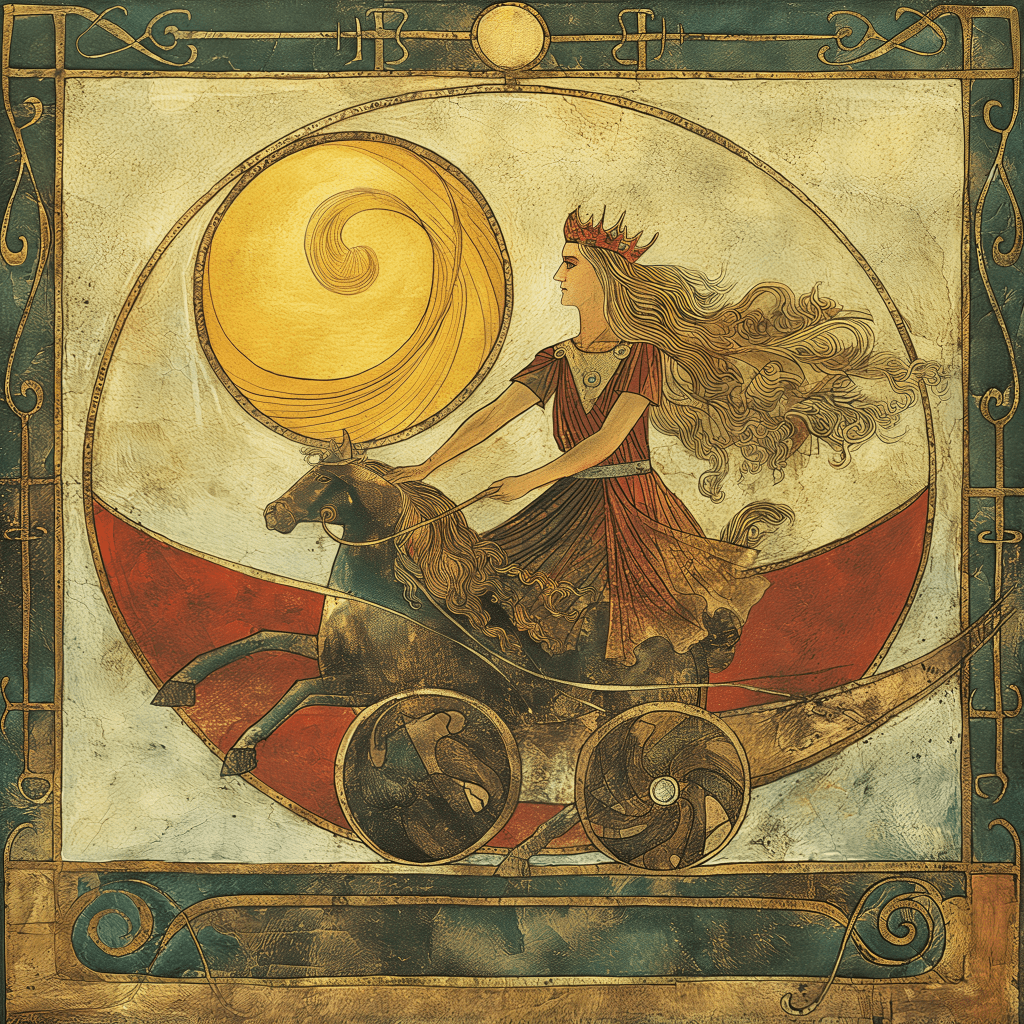
The Summer Solstice is the time of year when the daylight is longest, the power of the Sun is at its peak, and the solar cycle reaches its apex, tipping the scales towards the dark half of the year once again. After this turning point, the sunlight begins to wane, shortening the daylight minute by minute until the Winter Solstice. Typically, this was a time to celebrate the Sun, spend time outdoors, and enjoy the bliss of good weather. Mead, wine, and other beverages would be consumed, and great feasts would be enjoyed.
In “Teutonic Mythology” by Grimm, it is said:
“Twice in the year the sun changes his course, in summer to sink, in winter to rise. These turning-points of the sun were celebrated with great pomp in ancient times, and our St. John’s or Midsummer fires are a relic of the summer festival. The higher North, the stronger must have been the impression produced by either solstice, for at the time of the summer one there reigns almost perpetual day, and at the winter one perpetual night.”
Games and various competitions would be hosted along with other festivities such as dancing and music. Entertainment would be lively and abundant, encouraging joy and merriment among the community. In the Germanic context, many people honor the god Baldr during this time as a god of light and/or personification of the light of the Sun, which in a mythological context, “dies” and beings to decline after this time, mirrored by Baldr’s death and descent into Hel. Because of these connections, a common blot/ritual focus during the Summer Solstice is the death (or funeral) of Baldr, the god of light. Stone ships are erected, abundant offerings are made, and various sacrificial items are thrown into fire. These offerings are meant to aid Baldr in his journey on the long road of the underworld.
In “Celtic Mythology and Religion” by Macbain, he says:
“The midsummer festival, christianised into St John’s Eve and Day, for the celebration of the summer solstice, is not especially Celtic, as it is a Teutonic, feast. The wheels of wood, wrapped round with straw, set on fire, and sent rolling from a hillock summit, to end their course in some river or water, which thus typified the descending course of the sun onward till next solstice, is represented on Celtic ground by the occasional use of a wheel for producing the tinegin, but more especially by the custom in some districts of rolling the Beltane bannocks from the hill summit down its side. Shaw remarks – “They made the Deas-sail [at Midsummer] about their fields of corn with burning torches of wood in their hands, to obtain a blessing on their corn. This I have often seen, more, indeed, in the Lowlands than in the Highlands. On Midsummer Eve, they kindle fires near their cornfields, and walk round them with burning torches.” In Cornwall last century they used to perambulate the villages carrying lighted torches, and in Ireland the Eve of Midsummer was honoured with bonfires round which they carried torches.”
Large bonfires and “Sun-wheels” are made during this time, reflecting the power and glory of the Sun. Special attention was given to the goddess during this time as well, whether as a deification of the Sun itself, the Earth, the Mother, or a mix of the 3. Offerings such as flowers, cakes, milk, honey, and blood are given to the gods and spirits, a ritual exchange of abundance for abundance. As observed in the above quote, it was (and is) common practice to bring the energy of the Sun down to Earth in the form of a torch, then parade it through the fields, groves, or temples in order to bless them with this powerful energy.
In “A History of Pagan Europe” by Jones & Pennick, it says:
“…But the summer solstice, under its statutory date of 25 June, became a popular festivity early in Germanic history. The German word Sonnenwende always refers, in medieval texts, to the summer solstice, not to the winter solstice. At the end of the first century CE some German troops in the Roman army at Chesterholme listed their supplies for the celebration in a record which has come down to us. In the early seventh century, Bishop Eligius of Noyon in Flanders criticised the chants, carols and leaping practised by his flock on 24.”
Here we are given examples of some ancient Germanic practices revolving around the Summer Solstice. We are told of singing, chanting, and competitive games like “leaping”. Clearly, the Christian Romans were disturbed by this revelry, showing its clear Pagan origins. This turning point in the year was extremely important to observe, as it strikes a pivotal moment in the Sun’s lifecycle, affecting every aspect of our lives.
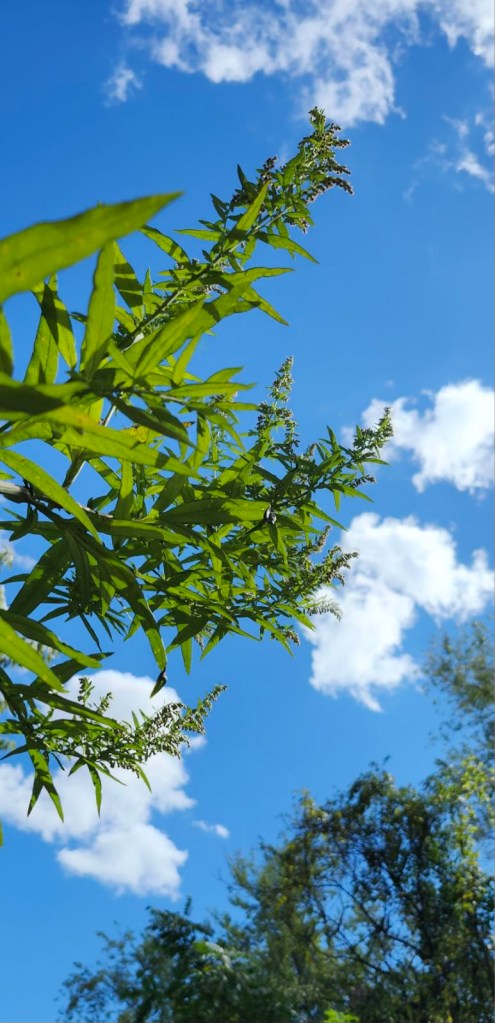
The beginning of Spring is a magical time. Everything starts to wake up from Winter’s sleep, the air becomes perfumed by unfurling buds and shoots of green, birthed under sky and warming Sun. The birds start to unleash their full songs, filling the landscape with sound. In short, pure magic. What better time than now for one of the most magical plants to start its ascent skyward. Mugwort is now lining roads and walkways, growing unchecked in fields. I’ve taken the plunge into the world of Mugwort and would love to take you with me.
Mugwort (Artemisia Vulgaris) is one of the oldest herbs referenced in Anglo-Saxon plant wisdom. Some of its earliest known uses were to help regulate menstrual cycles, as well as with divination and dreamwork. There is also evidence of Mugwort smoke as an offering to Isis in Ancient Egypt. It has been mentioned in poems dating back as far as 3 B.C. in China, such as the the Shi King/Jing Poetry Classic. It is also mentioned in the poem “Hortulus” by Walafrid Strabo (808 AD – 849 AD), as ‘the Mother of Herbs’. Mugwort’s roots pre-date modern history.
The name Mugwort comes from the Greek Goddess Artemis, Lady of the Moon. She is the Goddess of hunting and fertility, also assisting in the cultivation of willpower and self-reliance. She is a comforter to women in labor, a helper to midwives, and protector of young girls. Mugwort is ruled by the planet Venus, lending it even more feminine energy. Hippocrates and Dioscorides even endorsed the use of Mugwort to help ease childbirth, their works having influenced modern medicine. The “Hippocratic Oath” that says “First do no harm” is from, well, Hippocrates.
The herb has many healing properties, both physical and spiritual. Physically, Mugwort may help stimulate menstruation, keeping from stagnation. It can be used for help in treating rashes, sore joints, bruises, and bug bites. Mugwort has benefits for pain relief, especially from arthritis. It has powerful nervine qualities, nervines being things that help relieve stress on your nervous system, which can be very helpful when treating anxiety, depression, and stress. Mugwort also contains things like iron, phosphorus, potassium, zinc, and tannin. It’s also a nutrient dense plant found most everywhere.
Personally, Mugwort is one of my favorite herbs. It has the ability to induce incredibly vivid dreams and the ability to bring about lucid dreaming experiences. Those are two of the main reasons why I love mugwort. Dream work is an important part of my spiritual practice, and Mugwort has been the best tool I’ve used. It can be taken as a tincture in tea, smoked, or put in dream sachets and bundles for burning. Being an herb so deeply entrenched in feminine energies, it is perfect for those that want to connect to the divine feminine, bond with their personal intuition, and enhance sensitivity. It can help open yourself to being more empathetic and patient.
Stagnation in body and mind can cause all sorts of problems. Mugwort increases circulation and warms the blood, helping a stagnating body. A stagnating mind will lead to frustration, detachment, and anxiety, just to name a few. Mugwort opens the mind, allowing for deep meditation and vision work. It can help with opening thoughts and deeper spiritual meanings. It moves the things in us which have lain dormant. It’s an herb for gentle but serious action.
Any phase of the Moon will work when using Mugwort for lunar practices, as it is a lunar herb. However, the best and most interesting time to use it would be during the Balsamic moon or when the moon is fully waned. The Balsamic moon is a time of going inward and recharging. This is the phase right before the new moon, making this moon perfect for meditation and really digging into the self. The Balsamic moon is the time to find what intentions you want to set and why you are trying to set that intention. Using Mugwort to explore your inner world will really help you bring your intentions to the surface; the perfect time to put your plans into action.
We recorded another version of the popular mantra OM CHAM CHANDRAYA NAMAHA this Spring and are happy to share it with you.
This mantra is dedicated to the Moon god Chandra, also known as Soma, and can be translated many ways, such as “Homage! I Drink/Eat of the Moon!”.
The word cham comes from the Proto-Indo-European word kʷem which means “to swallow,” implying that one absorbs the energy of the Moon as one does when drinking water or eating food.
Chandra means “glittering/shining” and is a word used for the Moon personified. This light (or shine) is what we take in during meditation, transforming it into clarity of mind and peace in spirit.
Namaha comes from the Proto-Indo-Iranian word námas (respect, homage) which derives from the Proto-Indo-European word némos, meaning “to bend, sacrifice, worship.”
As this is chanted and visualized, one gives reverence with each repetition for the illuminating clarity that is given by the great Shining One, filling one’s consciousness with calm images of crystals, water, and moonlight.
In Vedic astrology, eclipses are seen as a symbol of revenge or as a bad omen.
According to mythology, eclipses are caused by the Chaya Graha (shadow planets) Rahu and Ketu, who were once part of a divine serpent. The story is traced back to a time before creation in the tale of the churning of the ocean, known as the Samudra Manthan. The churning of the ocean represents our consciousness. After an awful and lengthy war, the devas (gods) and asuras (demons) cooperated to churn the galactic material called the Milk Ocean. The churning poured forth several gifts and treasures. They included the goddess of wealth Lakshmi, the wish-fulfilling tree Kalpavriksha, the wish-fulfilling cow Kamadhenu, and Dhanvantari, who carries a pot of amrita and a book of medicine called Ayurveda. Amrita is a Sanskrit word that means “immortality” and is a drink (or nectar) intended only for the gods.
A serpent demon (Svarabhānu) aspired to become invincible. Sitting between Surya (the Sun) and Chandra (the Moon), Svarabhānu disguised himself as a deva and managed to take a sip of Amrita during Samudra Manthan. Surya and Chandra recognized the imposter and informed Mohini (the female form of Lord Vishnu), preserver of life and order, who quickly decapitated him. As they were now immortal, Lord Vishnu needed to find a place for them, so he put them in two specific points in the sky.
The head of the serpent demon (without the body) became Ratu, who fell on one side of the sun. The tail without the head that fell on the opposite side of the sun became Ketu. The sun stopped all movement in order to keep Rahu and Ketu from meeting one another. Twice a year they can create confusion and exact revenge by consuming the Sun and Moon causing the world to suffer from darkness.Rahu swallows the Sun, and Ketu, the Moon. But only for a short while as the Sun and Moon have also taken in the amrita. Offerings of coal, mustard, sesame, saffron and lead are made to appease Rahu. For Ketu, offerings of lead, sugar, saffron and sesame are made along with offering food to a dog with black and white fur.
As seen above, eclipses can be seen as highly inauspicious. Light and power diminish which corrupts their positive qualities and creates disturbances in the natural order of things. It is believed that auspicious work should only be started in the light. Because of this, beginning any new ventures during this period of darkness is not recommended, as it can bring upheavals, obstacles, and turmoil.