The cult of Thor generally revolves around the community, fertility, farming, and the daily routine that most humans experience. Because of this, Thor was the most widely worshiped of the ancient gods and was the chief deity observed by the common folk. Thor protects man and the world from chaos, endowing power into our material forms. This force keeps man strong, driven, and determined, acting in accordance with honor, loyalty, and vitality. Thor represents the physical and temporal qualities of human life, things we can build, destroy, and manipulate in accordance with our will. Thor establishes order out of chaos, rhythm out of randomness. He represents the “tempo” of the seasons, symbolized by the wheel (or fylfot), and like the wheel, carries us forward safely through time and space.
May all revere the Thunder god.
“Reid is reins, Reid is spokes, Thor’s wagon, Behind the goats.”
Isa is among the most powerful of runes, although, easily overlooked due to its simple form. On the outside, this rune represents ice and the powers inherent within “frozen” states of being; nearly removed from the degradation of time. When looking for etymological clues during the research of this rune, I was unable to break free from the “ice,” so to speak. No matter where I searched, there wasn’t much material stretching this rune out. So, most of what we can say about Isa is largely subjective, although, some basic core concepts have been generally accepted as interpretations, such as focus, patience, and stillness. These ideas we will explore more as we dive further into this mysterious rune.
Isa is a word that hasn’t changed much since its’ theoretical use in Iron Age Germania. We still see it quite clearly in the English word ice and German eis, even loaning itself to Japanese in the form of aisu. At the root of Isa is the Proto-Indo-European h₁eyH- meaning “ice, hoarfrost, rime,” most likely referring to the icy residue left upon sprawling steppe landscape in cold months. Later, this would evolve into the Old Norse íss, which also means “ice.” This word, likewise, is used as a kenning or poetic reference to a sword, which clearly resembles the long, sharp icicles that hang from roofs and rafters in the winter.
The “Old English Rune Poem” gives us a beautiful description of this rune, stating:
“Ice is extra cold and immensely slick,
It glistens clear as glass, most gemlike,
A frost-wrought floor, fair to behold.”
The first line seems to have a precautionary feeling to it, expressing the obvious physical qualities of the rune. The second line starts to unfold the more metaphysical associations that the Anglo-Saxons attached to it, as ice can have a “mesmerizing” effect on the observer; clear like glass and mimicking the beauty of a fine gemstone. The final line shows that the ice was held in reverence by our ancestors, as the force held in Isa is one of beauty, radiance, and power. It is in this sense that we can attribute qualities like focus, stillness, and even a sense of “peace” to Isa.
Isa represents meditation, concentration, and patience. Isa is still and quiet, as one who is meditating. Isa is concentrated matter; power focused inward. Isa is a force of patience, taking long periods of “human time” to affect its surroundings. We can attribute a great energy and power to Isa, the same force inherent in continents of ice and gargantuan glaciers that carve the face of the Earth. This is an unseen and long-lasting power, extremely “dense” and focused; opposite to the quick and clearly observable power of fire which consumes all. It is with this evidence that we can grant this rune half of the powers fundamental in the Norse creation myth.
With Isa, we can invoke the now familiar concept of “Odin’s 9,” being a rune that is unchanged whether right side up or inverted. In relation to Odin, it is said that he is the offspring of the ice giant Bestla and the primordial being Borr, connecting him and the giants/jötunns directly to this rune. This evidence enforces theories about Isa regarding the past and its’ association with memory. Ice freezes and “locks” matter within it, encasing things and moments in a space beyond time. Essentially, ice holds the memories of the past within it. This has been further reinforced in modern science, as it has been proven that water can actually carry information within it. Isa slows and halts the forces of change.
This brings up the god/giant Mímir. Mímir translates to “memory” and further connects to Proto-Indo-European (s)mer- which means “to fall into thinking, remember, care for,” or essentially, meditation. This applies connection to Isa and to Odin, as meditation and the unlocking of “memories” is one of Odin’s most sought-after goals, consulting often the head of Mimir for advice and counsel. It is with this evidence that, I would argue, Isa is synonymous with the traditional symbol of the “crystal ball” that magicians, wizards, and various occultists have been said to consult throughout history. Mimir’s head could very well be associated with a large, clear gemstone or crystal, one which Odin uses for prophecy, wisdom, and focus.
Within Isa we also have a key to creation, as this rune represents a building block of design; the ancient and primordial ice that met with the all-encompassing “heat” or furious fire in the middle expanse of Ginnungagap (yawning abyss). With Isa we can see the ancient concept of Germanic “duality.” Not as one dealing necessarily with good and evil, but with “fire and ice”; chaos and order, change and stillness.
The ”Old Norwegian Rune Rhyme” gives us two rather obscure lines regarding Isa, stating :
“Ice we call a broad bridge;
A blind man needs to be led.”
Surely the Norwegians experienced a difference in form and force of ice than their ancestors from the steppe, as the first line alludes to massive and expansive “bridges” of ice. The second line seems to me to indicate that if one is “blind” or inexperienced that he will need to be led safely over these “bridges of ice.” Here we can see this rune is able to be applied to many circumstances in life where one is potentially “blind,” making this rune a more practically applicable concept.
Lastly, we will refer to the “Old Icelandic Rune Poem,” where it is said:
“Ice is the rind on a river, and a wave’s roof,
And a danger for doomed men.”
Here we have a more objective picture of this rune. We see its form as the “rind” or crust/peel of the river, referring to the layer of ice upon the top of bodies of water. We also have a reference to oceanic ice as the “wave’s roof,” something the Icelanders would have had an intimate relationship with. Lastly, the obvious is stated as a warning, that this rune is danger for men who are “doomed.” On land or sea, if you are unprepared for ice, indeed you will likely be doomed.
To conclude, it is without a doubt evident that Isa holds immeasurable power within it. Although it is arguably the “quietest” of all the runes, I think as with people, this is a sign of a different type of power; one that is slow, focused, precise, calm, and internalized. Cunningness as opposed to a purely aggressive, outward force. Isa is mastery over the forces within, a “silence” that is akin to serenity. With Isa we can associate deep and focused acts of meditation, a Shiva-like “stillness” that deeply reverberates within, radiating a crystal brilliance internally. This is the clear awareness of Odin; clear, bright, and entirely concentrated.
-Wandering the Runic Path: Esoteric Analysis of the Germanic Runes
Padmasambhava, also known as Guru Rinpoche, was a legendary tantric Yogi and the founder of Vajrayana Buddhism in Tibet, bringing the religion from India around the 8th century and establishing the first Tibetan sect now known as the Nyingma (Old School). He is considered by many to be the second Buddha, foretold by Shakyamuni (Gautama Buddha) to reveal the tantric/esoteric (Vajrayana) teachings and to propel and protect Buddhism in the degenerate age (Kali Yuga).
Jigme Khyentse writes in the book “White Lotus,”
“Before he [Shakyamuni] passed into mahaparinirvana, the Buddha prophesized that his activities would be prolonged and his teachings propagated and protected by Padmasambhava, whom Tibetan Buddhists frequently refer to as Guru Rinpoche, the Precious Master.”
Vajrayana is an outgrowth of Mahayana Buddhism and involves a wide collection of practices aimed at providing liberation (nirvana) in a single lifetime, hence its name meaning “Thunderbolt Vehicle.” This differs from the Mahayana (Great Vehicle) path where it can take an untold number of lives (incarnations) to accomplish complete liberation. Because of this difference in philosophy, the indigenous Tibetan and Himalayan peoples could only be persuaded by the infinite power of the Vajrayana and were quite reluctant to adopt Buddhism prior to Padmasambhava’s arrival.
Through various trials and tribulations, Padmasambhava was able to subdue the powerful gods and beings who inhabited the region of Tibet. In doing so, he gained their favor and service in return, incorporating them into the Buddhist religion as protectors and stewards of the Dharma. This is why we see numerous gods from other pantheons mentioned in the rituals and myths of tantric Buddhism, as Vajrayana practitioners of all nationalities seem to include their own ancestral deities into their practice. This is easily observed in the Tibetan, Japanese, Chinese, and Mongolian variants of Vajrayana, where each culture has created a syncretic and unique flavor of religious practice, not completely removed from its source but rather philosophically reformed and reworked.
The mantra of Padmasambhava OM AH HUM VAJRA GURU PADMA SIDDHI HUM is one of the most popular and powerful mantras used in Tibetan Buddhism, recited often to instantly evoke the Guru, gain enlightenment, and achieve siddhi (occult power). It can be translated in many ways and has various levels of meaning, but a general interpretation of the syllables would be:
OM AH HUM – Purifies body, speech, and mind.
VAJRA GURU – Perfect Teacher.
PADMA – Lotus, synonymous with nature of mind.
SIDDHI – Occult power, success in practice, accomplishment.
HUM – The syllable of enlightenment, the unshakable nature of ultimate truth.
Padmasambhava permeates everything and exists everywhere, nestled into the very fabric of space and time. At the time of his death (parinirvana), he achieved “Rainbow Body,” dissolving into light and leaving behind nothing but hair, nails, and clothing. He is known also as Padmakara (Lotus-Born), meaning he is born in our minds, existing eternally in the unstained regions of our consciousness, quickly summoned by this sacred formula. This mantra should be recited as often as needed, whether for guidance, protection, clarity, wisdom, or any other purpose.
Samhain is a time when the spirits of nature, the dead, and the gods are most likely to emerge to walk amongst the living. During these days, when daylight becomes shorter and shorter, nature around us seems to die and shed its vitality, leaving trunks and branches barren, resembling bones protruding from the forest soil. This is a time when we are meant to shift our focus from outdoors to indoors and shed our dead weight from the previous year. By doing this, we are mirroring the process of nature and turning our energy inward. During this time of year come the final harvests, meaning that the workload is drastically cut down and many daily activities change. These hours were to now be replaced with indoor tasks such as tending to animals, repairing tools, spiritual practice, and performing various crafts such as woodworking, writing, or blacksmithing.
It is customary to make offerings to the deities, ancestors, and wandering spirits during this time in order to receive their favors, blessings, and good luck. We please the spirits to avoid their wrath. We offer to the ancestors to uphold family honor. We give our veneration to the gods to gain their power and visage. By performing rituals during this particular time of year, one enables themselves to access various forces and gain insight into the past, future, and matters regarding cause and effect within the present which will aid one’s progress moving forward.
In “A History of Pagan Europe” by Jones & Pennick, they write:
“Samhain (1 November). This was the most important festival of the year, showing the pastoralist, rather than agricultural, origin of the calendar. Samhain was the end of the grazing season, when flocks and herds were collected together, and only the breeding stock set aside from slaughter. It was a time of gathering-together of the tribe at their ritual centre for rituals of death and renewal, dedicated to the union of the tribal god (in Ireland, the Daghda) with a goddess of sovereignty, the Morrigan, or, more localised, Boann, deity of the River Boyne.”
As the last of the great harvests, Samhain brings reward and celebration, the end of one year and the transition into the next. According to many European tribes, Samhain marked the turning point between the years and represented the New Year celebration of their cultures. With Samhain we descend into “night,” resembling the womb of the goddess or the abode in which she resides. The goddess reigning over this time of year was almost always in the form of a grim, fate-controlling hag or crone, such as Hel or the Morrigan.
In “Celtic Mythology and Religion,” Macbain writes:
“Equal to Beltane in importance was the solemnity of Hallowe’en, known in Gaelic as Samhuinn or ‘summerend.’ Like Beltan it was sacred to the gods of light and of earth; Ceres, Apollo, and Dis also, must have been the deities whose worship was honoured. The earth goddess was celebrated for the ingathering of the fruits; Apollo or Belinus and Proserpine were bewailed for their disappearing from earth, and Dis, who was god of death and winter’s cold, and who was especially worshipped by the Celts, as Caesar says, was implored for mercy, and his subjects, the manes of the dead, had special worship directed to them. It was, indeed, a great festival—the festival of fire, fruits, and death.”
In reference to Norse and Germanic paganism, we see the worship of elves and land spirits was also common during this time. In modern Germanic paganism, many people celebrate Samhain under the name Álfablót (Elf Sacrifice), which is a time when harvests are reaped and sacrifices are made to the elves and gods. Elves and the dead are strongly connected to the ancient mounds of the Pagans, therefore, much of the activity surrounding this festival would have likely involved distributing offerings to the gods and conducting sacrifices directly upon the mound (or grave) of the dead. This is where the elves were thought to reside.
In “Sorcery and Religion in Ancient Scandinavia,” Vikernes gives us further examples pertaining to the Nordic new year and pre-Christian Halloween customs. He writes:
“The first holiday of the year was New Year’s Day, better known in English as Halloween (“initiation evening”), and in Gaelic as Samhain (“summer’s end”). The sorcerers and later the gods (i, e. religious kings) and their challengers dressed up as different creatures with access to the realm of the dead. They fasted and hung their clothes in a tree or the gallows, to make it look as if they had hanged themselves. They wounded themselves with a spear, to bleed, smeared ash or white mud all over their bodies to look like the dead, they put on masks and sacrificed a cow or an ox on the grave mound, so that the blood poured down and into the grave underneath; into the realm of the dead. They then blew a horn, in the Bronze Age a lure, to open up the entrance to the realm of the dead. They then traveled into hollow trees, caves in the mountain, holes in the ground, or more commonly into the burial mounds. These were all seen as entrances to the realm of the dead. Inside, in the darkness of the grave, a woman was waiting for them, sprinkled in the sacrificed animal’s blood and dressed like the queen of death. They then took at least some of the objects their dead forebears had been buried with and brought them back out.”
As we can see, Samhain (or Álfablót) type celebrations were not only distinct to Celtic and Germanic culture, but rather appear as a pan-European tradition representing a celebration of the dead, the ancestors, and the final harvests of the year. It is clear that no matter which form of paganism(s) one practices, the celebration and event known to us now as Halloween is of very ancient and sacred importance. Not only as a transitional period between the seasons, but as a time when it was believed to be easiest to pierce the veil between states and interact with beings outside of our normal cognition. It is because of the superstitions and pagan worldviews of the past that we have many (if not all) of our current yearly celebrations.
We’ve just released another mantra track on our channel, may it benefit all beings.
Tara is a prominent goddess in both Hindu and Buddhist traditions, representing the feminine aspects of the Supreme, whether as an emanation (Mahavidya) of the great Durga or as a female embodiment of the Buddha. Tara has an exceptionally wide array of forms depending on which religious pantheon one is focusing on, varying from entirely wrathful forms to completely peaceful ones. These different emanations are necessary according to each individuals’ particular inclinations (due to karmic imprints) or specific school of practice.
In Vajrayana Buddhism, Tara is believed to have 21 forms with varying attributes, colors, and characteristics. She is invoked for protection and liberation from obstacles, to dispel poisons and bad dreams, and to destroy demons or other harmful spirits. Tara is revered as a loving mother and is often referred to as the “Mother of All Buddhas.” She guards sentient beings against fear, anxiety, and disease. Tara is often Green in color, representing all the activities of the Buddha, but white is also common, used for achieving long life and longevity. Other forms and colors exist as well. The seed syllable of Tara is TAM.
The Sanskrit word tā́rā means “star”, stemming from the Proto-Indo-European word h₂stḗr, which refers to stars (or planets) and means “shiner or glower.” Her mantra is OM TARE TUTTARE TURE SVAHA which means “Praise to Tara the Swift Liberator, Hail!” Above her sits Amitabha, Buddha of Boundless Light.
“…Homage to her whose face is like one hundred full autumn moons
And who blazes with light like that of thousands of stars…
…Homage to her whom Indra, Agni, Brahma, Vayudeva,
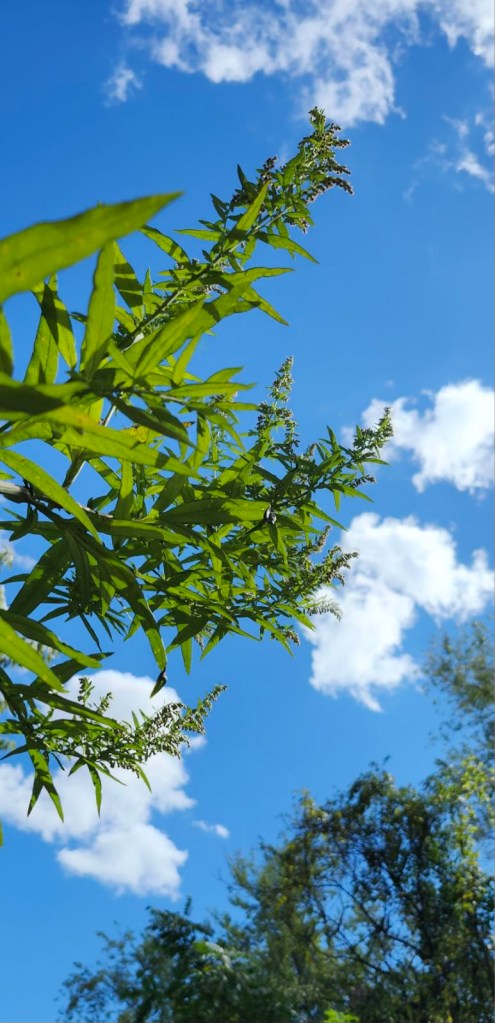
An herb as powerful as Mugwort is an invaluable way to connect and learn more about Goddesses of not only Greek, but Norse and Celtic mythology. Mugwort and its association with women, those who protect and champion women, as well as those seeking to expand their metaphysical world through dream and deity work, is as important today as it was thousands of years ago.
Artemis, the namesake of Mugwort, is the logical starting point. Artemis is a goddess of the hunt, the moon, and especially of female initiation and protection. She is associated with girls and women, but is also a goddess to boys and men in rites of initiation and the hunt. All who wish to learn more and work with her are welcome, as she is a goddess for everyone. Mugwort, having derived its name from her, is the mother herb mirroring her mothering prowess.
However, in the Greek mythos, she was not a goddess to suffer fools gladly. She vehemently defended her virginity and reputation as the greatest of hunters. Some sources suggest she was the patron goddess of the fearsome women warrior tribe, the Amazonians. A passionate and ferocious fighter for what she believes is right, a beacon for those who need strength.
Of everything that Artemis is known for, Mugwort is most closely related to her powers as midwife, a deity for both comforting women in labor and the newborn. Mugwort is also an important herb for dream and trance work, lending itself nicely to moon rituals, as Artemis was also a goddess of the moon. Using Mugwort in its tincture form, or burning as a smudge stick, will help to expand consciousness and enter a trance state for magical work. Adding Mugwort into your meditation on Artemis during the moon, especially the full moon, will greatly enhance communication.
In Norse mythology, Frigg, the most powerful volva, was believed to be the first practitioner of seidr magic. Frigg is the wife of Odin and a fiercely protective mother of Baldur. She is the goddess of family, motherhood, fertility and the balance of love and wisdom. Mugwort works perfectly with Frigg as it is an herb whose main use has been for assistance in prophetic dreaming and the overall health of women.
Runes that can be used when invoking Frigg are Fehu, Pertho and Berkano. Fehu, when related to Frigg, is a female rune for fertility concerned with livestock, and especially newly born cattle in spring. Fehu is always a rune of productivity. It can also be used for spiritual or artistic creativity, carrying a fiery power within. Fehu can also represent certain aspects of the life force.
Freya Aswin correlates Pertho with birth. Pertho can also be used to help find hidden aspects within yourself. The joining of these attributes with Frigg, who governs birth and is involved with weaving fate (through work as a volva and through seidr magic), very nicely encapsulates the magic of Mugwort.
The Berkano rune indicates birth, being rooted, and the feminine, has been called a rune of ‘bringing into being’, the first protection given to children at birth. Both Artemis and Frigg were known as unrelenting defenders of children and women. Incorporating Mugwort when working with Frigg can be very beneficial.
The goddess of Celtic mythology most closely associated with Mugwort is Brigid. Brigid is known as a goddess of fire, poetry, and healing; a maternal goddess who embodies the divine feminine. She is like spring, representing new beginnings.
As a goddess of fire and hearth, she was said to watch over all the fires in the homes of Ireland. She was closely associated with the sun and the warmth of spring, the time of renewal and rebirth. Mugwort is also an herb closely associated with fertility, the goddess, and of womanhood. Brigid, as a goddess that protected the flame (which was so important for ancient people’s survival), is like a mother radiating maternal compassion.
Poetry (and creativity) have always had close ties with the metaphysical and dream world, a world that Mugwort works so well in. Brigid was called upon to help with creativity and inspiration, especially with bards, who held a very high position in Celtic society. Bards were the keepers of history and culture, and Brigid was often invoked to help inspire creativity.
Brigid was also a goddess of healing. She was often called upon to help cure sickness and injury, as her touch was said to have healing powers. In addition to being a healer of sickness and injury, she was a goddess of childbirth, watching over women in labor. Her presence helped ease pain and ensured a safe delivery. She was also a protector of children and was asked by parents to watch over children’s safety and health. Brigid and her divine energies align well with Mugwort and its properties.


 Ansuz Society