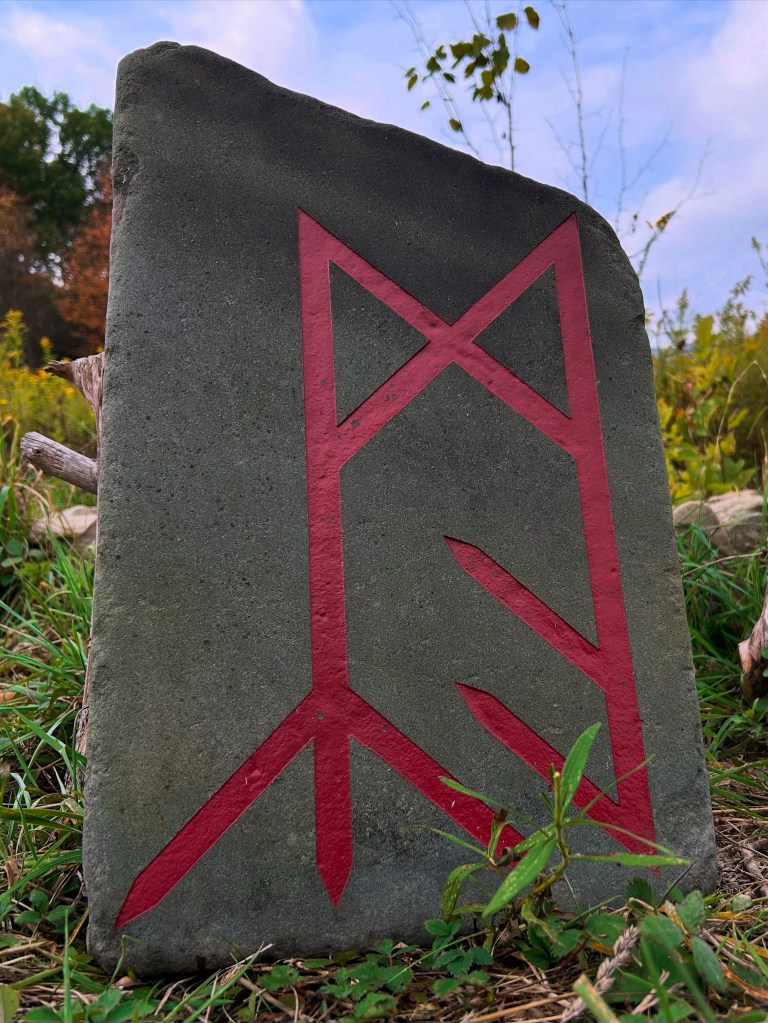
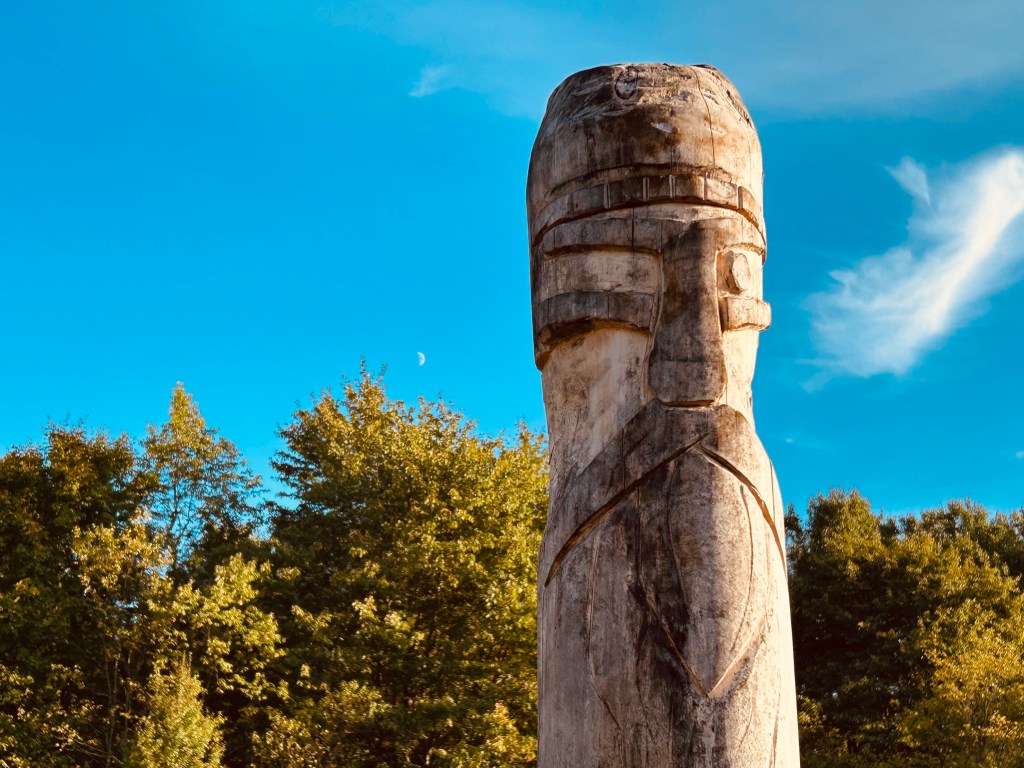
Eihwaz : ᛇ

Eihwaz is a rune of life, death, rebirth, endurance, strength, and the eternal cycle of change. This rune represents the Axis Mundi, the metaphysical center of the world. In the Germanic tongues, this would have gone by the name Irminsul, Donar’s Oak, or Yggdrasil, and represented the great World Tree of Pagan cosmology. This tree was believed to connect all the realms of existence, resembling the “shamanistic” cultures of Eurasia, associating it with Odin’s magical abilities and techniques. These practices allow him to travel as he pleases around the 9 different worlds of the cosmos, linked together by the great World Tree. The word Yggdrasil gives us this clue, as ygg(r) means “terrible one” and drasil means “steed,” reading something like “The Steed of the Terrible One.” This alludes to Odin’s ability to use this tree (or pillar) to travel outside of himself.

When looking at the rune poems, we only have one which speaks of Eihwaz directly, as the other two poems invoke the rune Ýr instead, connecting it more so to the previously mentioned Yggdrasil. The “Old English Rune Poem” states:

“Yew is on the outside an unsmooth tree,

Hardy and earth-fast, fire’s keeper,

Under-rung by its roots, best on the estate.”

This poem has a mysterious tone to it, although objective in its observation. The ancient Yew trees of the UK are highly impressive giants to behold, reaching back in time over 2000 years in some cases. These trees, like the first line says, are quite “lumpy” and gnarled, having many twists and turns. It isn’t hard to imagine why our ancestors used this tree to represent so much in their lives, as its immense canopy and knotted sprawl resembles the growth of family “trees” and essentially all concepts that seem to “branch” or “stem” from one another. The second line alludes to the endurance that Yew trees exhibit, boasting long life spans. The last line pertains to these trees having wild and intense root systems. This would make them “best on the estate,” as the Yew has a fairly slim chance of being knocked down by wind or storm.

It must be noted that while the Anglo-Saxon runes do include Eihwaz under the name ēoh, which means “Yew,” they also include another rune in their Futhorc; the rune Ýr (ᚣ), which distinctly means “Yew bow.” It is strange that the Anglo-Saxon Futhorc retains the original Eihwaz rune while also incorporating the Younger Ýr rune as well. This, to me, does indicate a significant difference in the two runes, and perhaps any attribution to bows and arrows may be strictly given to the Ýr rune, while the Eihwaz rune retains a predominant symbol of the World Tree: life, death, and rebirth.

My theory is that the Anglo-Saxons had, by this time, new geographical associations with the runes. Once they got to England, they must have been in total awe of the Yew trees. Either this, or they noticed how their Celtic adversaries/neighbors held this tree in high regard. We can see evidence for this connection in the Proto-Celtic word iwos, meaning “yew.” Perhaps these mighty Yew trees were not as common or prominent as was the Oak or other sacred trees on the continent. I believe evidence for this can be found in the absence of any word for “Yew” in the Gothic language, enforcing the Celtic influence on this word and rune. In its original form, Eihwaz would have likely been associated with the Oak, as in Gothic, the work aik means “Oak.” Not only this, but the root word eih, in Old High German, also means “Oak.” We can assume this rune came from the East, and not the West, therefor, the word Eihwaz would have most likely been a formal name for the Oak. When looking for past reference to Indo-European World Trees, the Oak is by far the most frequently described, with other minor references to Birch, Beech, Apple, Olive, and certain types of Evergreens; in this case, most notably the Yew.

The Younger runes of the North would later evolve in connection with these older runes, invoking again the infamous Yew tree. Although, their Futhorc would no longer contain the Eihwaz (ᛇ) rune. Instead, they carry over only the Ýr rune in the form of (ᛣ), associating it more directly with the Yew tree. The “Old Norwegian Rune Rhyme” states:

“Yew is the winter-greenest of trees,

It is wont for what burns to singe.”

This poem invokes the “evergreen” concept, which in the Pagan north was a symbol of eternal life. This is one reason for the incorporation of the “Yule Tree” in the winter customs, as it was a sacred reminder of beauty, life, and strength. The second line, I believe, is referring to its excellent quality as firewood, as Yew wood has been said to burn the brightest. We have no mention of bows here, so it must have been more-so acquainted with hearth-fire, life, and hope.

Lastly, the “Old Icelandic Rune Poem” gives us another angle to view this rune, in connection to the death of Baldr. It is said:

“Yew is a bended bow,

and iron eager to break,

and an etin’s arrow.”

Here, we first see mention of the bow. As stated before, the Yew was among the top choices, if not the best choice for bow making in the Heathen north. Therefore, Eihwaz / Ýr can be associated with bows, arrows, and archery. It has been theorized that this can also relate to “tension,” as the pulled bow string is very tense and holds a lot of energy within it. This, some say, can be associated with death when life’s energy is finally released. The last line can without doubt be associated with the events surrounding the death of Baldr. Baldr is killed (technically) by the etin (giant) Loki’s arrow/dart made of mistletoe, something that grows on various trees and was of a highly medicinal and magical use in the north. Of course, it is the blind god Höðr who throws the dart, but it was Loki who planned the act. This story can be found in Gylfaginning in Snorri’s “Prose Edda.”

In conclusion, we can see that Eihwaz is connected to the primordial World Tree of the European peoples, whether in the form of the Oak, the Yew, or any other tree that our ancestors venerated as a sacred center. Its association to eternal life, death, rebirth, and endurance can be seen in the symbolism of the evergreen; the ancient symbol of everlasting existence. We’ve also uncovered direct evidence concerning the possibility that this rune was originally a symbol of the Oak tree, as this was the most sacred tree cross-culturally amongst ancient Europeans, being idolized extensively from Ireland to Finland, Portugal to Greece. The Oak was the main representation of the World Tree cosmology. Therefore, this rune can not only take the meaning of “Yew,” but also of “Oak.” This, to me, would all depend on the geography surrounding the one using the runes.

-Wandering the Runic Path: Esoteric Analysis of the Germanic Runes

Amitabha Mantra | Om Ami Dewa Hrih

Amitabha (Boundless/Infinite Light) is an important figure found in the Mahayana and Vajrayana schools of Buddhism, with his function varying differently between the two.

In the Mahayana schools, especially the Pure Land school, Amitabha is venerated as a fully enlightened Buddha and his realm Sukhavati (a place ideal to practice the Dharma) is aspired after death. This isn’t a permanent heaven, but rather a flawless realm for one to continue practice and achieve enlightenment in.

In Vajrayana, Amitabha is a Dhyani (meditation/wisdom) Buddha and is the head of the Lotus (Padma) family, associated with the direction of the West, the same direction of his heavenly realm Sukhavati. He is responsible for the transformation of desire and attachment into discerning wisdom. He is also invoked in the practice of Phowa meaning “transfer of consciousness.” However, when practiced in accordance with long-life rituals, he appears as Amitayus (Buddha of Infinite Life), a sambhogakaya (enjoyment body) form of Amitabha.

Amitabha usually appears as a red Buddha in meditation posture, adorned with Dharma robes and holding a begging bowl with both hands. The meditator is to visualize oneself as a bodhisattva, white in color, with Amitabha, the Bhagavat, in front. Through his sadhana, one eventually dissolves the barrier between Amitabha and oneself, becoming the very essence of “lucidity and emptiness.”

Om Ami Dewa Hri

Front Image Link: https://www.himalayanart.org/items/24733/images/primary#-617,-1000,1381,0

Back Image Link: https://www.himalayanart.org/items/77019/images/primary#-1434,-2204,2971,0

Non-Profit 501(c)(3) Approval

We have finally received our approval to operate as a 501c3. With this comes many new opportunities for people to get involved and for us to expand on our event and activity planning.

We will be looking for more individuals who are interested in hosting lectures, retreats, classes, rituals, hikes and projects of various kinds. If you have skills to share or knowledge to teach, please feel free to get in touch.

Rune classes will resume this fall, sign up will begin in September. Weekly galdr sessions held Wednesday and Saturdays.

Groups who want to collaborate on ritual or music, please get in touch.

Hailaz

Triratna (Triple Gem) Mantra

The Sanskrit Triratna (Triple Gem/Three Gems) mantra is a universal refuge prayer for all Buddhists, sung in all schools of Buddhism from the Theravada to the Mahayana and Vajrayana. The mantra proclaims the following:

“I go for refuge to the Buddha,

I go for refuge to the Dharma,

I go for refuge to the Sangha.”

Refuge in the Buddha means to acknowledge the omniscient and unshakable nature that the Buddha represents, and to aspire to acquire that state. Refuge in the Dharma means to accept the authority of the teachings and to follow them diligently as a road map to enlightenment. Refuge in the Sangha means to find solace and inspiration in spiritual friends, teachers, and community.

This is a basic interpretation of the mantra as generally understood by most practicing Buddhists. However, as one gains deeper meditative insight, one’s guru will reveal further interpretation, depending on the school one involves themselves in.

Sanskrit:

Buddhaṃ śaraṇaṃ gacchāmi.

Dharmaṃ śaraṇaṃ gacchāmi.

Saṃghaṃ śaraṇaṃ gacchāmi

Pali:

Buddham saraṇaṁ gacchāmi

Dhammaṁ saraṇaṁ gacchāmi

Saṅghaṁ saraṇaṁ gacchāmi

Image link: https://www.himalayanart.org/items/61240

#buddhism #triratna #refuge #dharma

Lughnasadh/Freyfaxi

Subscribe to continue reading

Subscribe to get access to the rest of this post and other subscriber-only content.

Isa

Isa is among the most powerful of runes, although, easily overlooked due to its simple form. On the outside, this rune represents ice and the powers inherent within “frozen” states of being; nearly removed from the degradation of time. When looking for etymological clues during the research of this rune, I was unable to break free from the “ice,” so to speak. No matter where I searched, there wasn’t much material stretching this rune out. So, most of what we can say about Isa is largely subjective, although, some basic core concepts have been generally accepted as interpretations, such as focus, patience, and stillness. These ideas we will explore more as we dive further into this mysterious rune.

Isa is a word that hasn’t changed much since its’ theoretical use in Iron Age Germania. We still see it quite clearly in the English word ice and German eis, even loaning itself to Japanese in the form of aisu. At the root of Isa is the Proto-Indo-European heyH- meaning “ice, hoarfrost, rime,” most likely referring to the icy residue left upon sprawling steppe landscape in cold months. Later, this would evolve into the Old Norse íss, which also means “ice.” This word, likewise, is used as a kenning or poetic reference to a sword, which clearly resembles the long, sharp icicles that hang from roofs and rafters in the winter.

The “Old English Rune Poem” gives us a beautiful description of this rune, stating:

“Ice is extra cold and immensely slick,

It glistens clear as glass, most gemlike,

A frost-wrought floor, fair to behold.”

The first line seems to have a precautionary feeling to it, expressing the obvious physical qualities of the rune. The second line starts to unfold the more metaphysical associations that the Anglo-Saxons attached to it, as ice can have a “mesmerizing” effect on the observer; clear like glass and mimicking the beauty of a fine gemstone. The final line shows that the ice was held in reverence by our ancestors, as the force held in Isa is one of beauty, radiance, and power. It is in this sense that we can attribute qualities like focus, stillness, and even a sense of “peace” to Isa.

Isa represents meditation, concentration, and patience. Isa is still and quiet, as one who is meditating. Isa is concentrated matter; power focused inward. Isa is a force of patience, taking long periods of “human time” to affect its surroundings. We can attribute a great energy and power to Isa, the same force inherent in continents of ice and gargantuan glaciers that carve the face of the Earth. This is an unseen and long-lasting power, extremely “dense” and focused; opposite to the quick and clearly observable power of fire which consumes all. It is with this evidence that we can grant this rune half of the powers fundamental in the Norse creation myth.

With Isa, we can invoke the now familiar concept of “Odin’s 9,” being a rune that is unchanged whether right side up or inverted. In relation to Odin, it is said that he is the offspring of the ice giant Bestla and the primordial being Borr, connecting him and the giants/jötunns directly to this rune. This evidence enforces theories about Isa regarding the past and its’ association with memory. Ice freezes and “locks” matter within it, encasing things and moments in a space beyond time. Essentially, ice holds the memories of the past within it. This has been further reinforced in modern science, as it has been proven that water can actually carry information within it. Isa slows and halts the forces of change.

This brings up the god/giant Mímir. Mímir translates to “memory” and further connects to Proto-Indo-European (s)mer- which means “to fall into thinking, remember, care for,” or essentially, meditation. This applies connection to Isa and to Odin, as meditation and the unlocking of “memories” is one of Odin’s most sought-after goals, consulting often the head of Mimir for advice and counsel. It is with this evidence that, I would argue, Isa is synonymous with the traditional symbol of the “crystal ball” that magicians, wizards, and various occultists have been said to consult throughout history. Mimir’s head could very well be associated with a large, clear gemstone or crystal, one which Odin uses for prophecy, wisdom, and focus.

Within Isa we also have a key to creation, as this rune represents a building block of design; the ancient and primordial ice that met with the all-encompassing “heat” or furious fire in the middle expanse of Ginnungagap (yawning abyss). With Isa we can see the ancient concept of Germanic “duality.” Not as one dealing necessarily with good and evil, but with “fire and ice”; chaos and order, change and stillness.

The ”Old Norwegian Rune Rhyme” gives us two rather obscure lines regarding Isa, stating :

“Ice we call a broad bridge;

A blind man needs to be led.”

Surely the Norwegians experienced a difference in form and force of ice than their ancestors from the steppe, as the first line alludes to massive and expansive “bridges” of ice. The second line seems to me to indicate that if one is “blind” or inexperienced that he will need to be led safely over these “bridges of ice.” Here we can see this rune is able to be applied to many circumstances in life where one is potentially “blind,” making this rune a more practically applicable concept.

Lastly, we will refer to the “Old Icelandic Rune Poem,” where it is said:

“Ice is the rind on a river, and a wave’s roof,

And a danger for doomed men.”

Here we have a more objective picture of this rune. We see its form as the “rind” or crust/peel of the river, referring to the layer of ice upon the top of bodies of water. We also have a reference to oceanic ice as the “wave’s roof,” something the Icelanders would have had an intimate relationship with. Lastly, the obvious is stated as a warning, that this rune is danger for men who are “doomed.” On land or sea, if you are unprepared for ice, indeed you will likely be doomed.

To conclude, it is without a doubt evident that Isa holds immeasurable power within it. Although it is arguably the “quietest” of all the runes, I think as with people, this is a sign of a different type of power; one that is slow, focused, precise, calm, and internalized. Cunningness as opposed to a purely aggressive, outward force. Isa is mastery over the forces within, a “silence” that is akin to serenity. With Isa we can associate deep and focused acts of meditation, a Shiva-like “stillness” that deeply reverberates within, radiating a crystal brilliance internally. This is the clear awareness of Odin; clear, bright, and entirely concentrated.

-Wandering the Runic Path: Esoteric Analysis of the Germanic Runes

May Day/Beltane

May Day marks the true climax of Spring and transition into Summer in the Northern regions. During this month, lots of plants and herbs begin to emerge after the long winter, bringing a plethora of flora and fauna to the land. On May Day, many Pagans resurrect (uncover) their idols of fertility and parade them through the towns and fields, blessing them for the upcoming agricultural year. In the past, this idol would have been housed in a cart or wagon and was presided over by specific individuals. Sometimes, these exclusive ritual participants were killed after laying eyes on the goddess in the wagon.

Jones & Pennick refer to this in “A History of Pagan Europe,” stating:

“The tribes around the mouth of the Elbe and in the south of modern Denmark are the ones who, as is now well known, worshiped Nerthus, Mother Earth. They saw her as intervening in human affairs and riding among her people in a wagon drawn by cows. The priest of Nerthus would sense when she was ready to leave her island shrine, and then with deep reverence would follow the wagon on its tour through the lands of her people, which would be the occasion for a general holiday, the only time when these warlike people put down their arms. At the end of the perambulation, the wagon and its contents would be washed in a lake by slaves who were then drowned. Noone was allowed to see the goddess on pain of death.”

In many cases, this idol was a goddess, and in others, a god would have taken its place, most notably Freyr. The idol that represented the god/goddess/spirit would be housed in the wagon, other times, a living person was chosen to embody the specific deity. Everyone would treat the person as if he/she was the actual deity themselves, dressing them in flowers and other pleasant things, parading them around in reverence.

Bonfires are customary during this time. Many people perform purification rituals using smoke and various other substances to cleanse themselves for the new year. Birch wood was most commonly used for these purposes and the smoke created would thus be walked through or “bathed” in. This was done to cleanse oneself and family of evil, sickness, and bad luck. Not only people, but livestock were said to be paraded through a pair of fires, ensuring a prosperous year, good health, and good harvests.

In “Celtic Mythology and Religion”, Macbain refers to the writings of Cormac:

“Most authorities hold, with Cormac, that there were two fires, between which and through which they passed their cattle and even their children. Criminals were made to stand between the two fires, and hence the proverb, in regard to a person in extreme danger, as the Rev. D Macqueen gives it, “He is betwixt two Beltein fires.”

Beltane bonfires are also referenced in “A History of Pagan Europe” by Jones & Pennick, where it says:

“The second great festival of the year was Beltane or Cétshamhain (1 May, May Day). This was the beginning of the summer half of the year, also a pastoralist festival. As at Samhain, the lighting of bonfires was an important rite. Cattle were driven through the smoke to protect them in the coming season. Beltane may be connected with the Austrian deity Belenos, who was particularly associated with pastoralism, or it may simply take its name from the bright (bel) fires which were part of its celebration. Beltane is the only festival recorded in the ninth-century Welsh tales, a time when the Otherworld communicates with the world of humans, either through portents such as the dragon fight in the tale of Lludd and Llevelys, or through apparitions such as the hero Pwyll’s sighting of the goddess Rhiannon.”

Later, around the 12th century, “May Baskets” became common practice in Germanic culture, which involved hanging flowers on strangers’ doorknobs or delivering flowers to friends, family, and the local community. This is still done today in many parts of the world, where people will anonymously leave flowers on people’s doorsteps in honor of the season. Essentially, May Day revolves around life, youth, and the beauty of the natural world around us. Through the blessing and beauty of the May Queen, we are propelled into the new farming season with inspiration and vigor.

As we can see from these various historical accounts, this particular event was of significant importance to not only Germanic and Celtic Pagans, but a pan-European celebration centered around a specific goddess, ritual cleansing, and Sun worship. Plenty of other cultures outside of Europe celebrate this occasion as well, such as some Native Americans, Persians, and Hindus. This renewal of life has been central to human experience for most of its history, promising us the glory of Summer and the proliferation of life.

In “Sorcery and Religion in Ancient Scandinavia,” Vikernes writes:

“On White Queen Monday they travelled the land to collect bacon, flour, eggs and other white food items for the large bride’s race. Dressed in white and wearing ribbons and wreaths of flowers they danced and sang all the way, from farm to farm, women and men, girls and boys, led by the king (alias the May King) and the queen (alias the May Queen), whether they were sorcerers or deities. The king and queen sat in a carriage, drawn by horses or the others in the procession. The queen did all the talking and the ladies and girls sang “Bride, bride, most beautiful bride”, to invite to the race all the women who believed they stood a chance at winning the bride’s race. The females in the procession wore men’s clothes on their upper bodies, and the men wore dresses, because they represented the hermaphroditic spirits. This custom remained even after the belief in spirits was supplemented with a belief in deities.”

On our homestead, May Day generally consists of uncovering our Freyr idol and walking him through the gardens and fields, either in a small mock-wagon or by hand. Once we have visited all the necessary areas, we return the idol to his altar and leave generous offerings for his blessings and fortune. Two fires are built in front of the altar and each ritual participant walks between them, purifying themselves of yearly baggage and giving personal thanks to the great Yngvi-Freyr. By doing this, each person can shed negative, dark, detrimental energies; inspiring wellbeing, clarity, and positive development.

ᚠᚢᚦᚬᚱᚴ (FUTHORC)

The Younger Futhark (Futhorc) emerged around the 8th century C.E. in Scandinavia and is comprised of 16 runes. These runes were developed from the older 24 rune system we now call the Elder Futhark. Because of this reduction in symbols, some runes inevitably absorbed others in the process, making the system more cryptic. This also made reading and writing more complicated, as now some runes could supply a wider array of sounds. We see this for instance in the Tyr (ᛏ) rune, which indicates the “t” sound, now symbolizing the “d” sound as well, or in the Bjarkan (ᛒ) rune, which represents the “b” sound, now including the “p” sound as well. However, the rune with the most sounds is the Ur (ᚢ) rune, which includes over 5 different phonetic values such as U/W/V/Y/O.

This galdr track includes 16 repetitions of the Younger Futhorc, intended to help with meditation, memorization, and focus.

May it be of use to practitioners and anyone wanting to learn the runes.

Hailaz

Nauthiz

Subscribe to continue reading

Subscribe to get access to the rest of this post and other subscriber-only content.

Othin Galdr

Subscribe to continue reading

Subscribe to get access to the rest of this post and other subscriber-only content.