
Subscribe to continue reading
Subscribe to get access to the rest of this post and other subscriber-only content.

Subscribe to get access to the rest of this post and other subscriber-only content.
Samhain is a time when the spirits of nature, the dead, and the gods are most likely to emerge to interact with the living. During these days, when daylight becomes shorter and shorter, nature around us seems to die and shed its vitality, leaving stalks, trunks and branches barren, resembling bones protruding from the soil. This is a time when we are meant to shift our focus from outdoors to indoors and shed our dead weight from the previous year, like the trees shed their leaves. By doing this, we are mirroring the process of nature and turning our energy inward. With Samhain come the final harvests, meaning that soon the workload will be drastically cut down and many daily activities will change. This time is to now be replaced with indoor tasks such as tending to animal pens, preserving food, repairing tools, spiritual practice, and performing various crafts such as woodworking, writing, or blacksmithing.
It is customary to make offerings to the deities, ancestors, and wandering spirits during this time in order to receive their favors, blessings, and good luck. We please the spirits to avoid their wrath. We offer to the ancestors to uphold family honor. We give our veneration to the gods to gain their power and visage. By performing rituals during this particular time of year, one enables themselves to better access various forces and gain insight into the past, future, and matters regarding cause and effect within the present which will aid one’s progress moving forward.
In “A History of Pagan Europe” by Jones & Pennick, they write:
“Samhain (1 November). This was the most important festival of the year, showing the pastoralist, rather than agricultural, origin of the calendar. Samhain was the end of the grazing season, when flocks and herds were collected together, and only the breeding stock set aside from slaughter. It was a time of gathering-together of the tribe at their ritual centre for rituals of death and renewal, dedicated to the union of the tribal god (in Ireland, the Daghda) with a goddess of sovereignty, the Morrigan, or, more localised, Boann, deity of the River Boyne.”
As the last of the great harvests, Samhain brings reward and celebration, the end of one year and the transition into the next. According to many European tribes, Samhain marked the turning point between the years and represented the New Year celebration of their cultures. With Samhain we descend into “night,” resembling the womb of the goddess or the abode in which she resides. The goddess reigning over this time of year was almost always in the form of a grim, fate-controlling hag or crone, such as Hel, Frau Holle, or the Morrigan.
In “Celtic Mythology and Religion,” Macbain writes:
“Equal to Beltane in importance was the solemnity of Hallowe’en, known in Gaelic as Samhuinn or ‘summerend.’ Like Beltane it was sacred to the gods of light and of earth; Ceres, Apollo, and Dis also, must have been the deities whose worship was honoured. The earth goddess was celebrated for the ingathering of the fruits; Apollo or Belinus and Proserpine were bewailed for their disappearing from earth, and Dis, who was god of death and winter’s cold, and who was especially worshipped by the Celts, as Caesar says, was implored for mercy, and his subjects, the manes of the dead, had special worship directed to them. It was, indeed, a great festival—the festival of fire, fruits, and death.”
In reference to Norse and Germanic paganism, we see the worship of elves and land spirits was also common during this time. In modern Germanic paganism, many people celebrate Samhain under the name Álfablót (Elf Sacrifice), which is when harvests are reaped and sacrifices are made to the elves and gods. Elves and the dead are strongly connected to the ancient burial mounds of the Pagans, therefore, much of the activity surrounding this festival would have likely involved distributing offerings to the gods and conducting sacrifices directly upon the mound (or grave) of the dead. This is where the elves were thought to reside.
In our own Samhain/Álfablót practice, the fair-weather god Freyr, king of the elves, is given one last celebration of reverence, being the center focus of the rites and rituals of the two-day celebration. He is invoked and offered substantial food and drink, as well as prayers and songs, showing devotion and thanks to the spirits and deities of abundance and prosperity. The event begins on the last day of October (Halloween) and ends the night of November 1st, when Freyr is returned to his resting place until the first of May. This cycle is reflected in “Myths and Symbols in Pagan Europe,” where Davidson writes:
“He [Freyr] is said to have brought good seasons and prosperity to the land, and so when he died the Swedes brought great offerings to his mound, and believed that he remained alive and potent in the earth. The connection which seems to exist between Freyr and the elves and land-spirits thus provides an additional reason to associate them with the dead in their graves.”
Because of these associations, we place the death and rebirth of Freyr (the power of good weather and abundance) within this span of time (Nov 1-May 1). However, this is not the only way to do things nor is it recommended to everyone, as how one celebrates these sacred events revolves much around one’s lifestyle, geography, deity devotion, and overall means. For us in Western New York, this timeline coincides seamlessly with the natural cycle of the weather, and therefore is easy to follow. For those in a different climate or location, this may not make as much sense, and it is recommended to follow the patterns around you regarding these things.
In “Sorcery and Religion in Ancient Scandinavia,” Vikernes gives us further examples pertaining to the Nordic new year and pre-Christian Halloween customs. He writes:
“The first holiday of the year was New Year’s Day, better known in English as Halloween (“initiation evening”), and in Gaelic as Samhain (“summer’s end”). The sorcerers and later the gods (i, e. religious kings) and their challengers dressed up as different creatures with access to the realm of the dead. They fasted and hung their clothes in a tree or the gallows, to make it look as if they had hanged themselves. They wounded themselves with a spear, to bleed, smeared ash or white mud all over their bodies to look like the dead, they put on masks and sacrificed a cow or an ox on the grave mound, so that the blood poured down and into the grave underneath; into the realm of the dead. They then blew a horn, in the Bronze Age a lure, to open up the entrance to the realm of the dead. They then travelled into hollow trees, caves in the mountain, holes in the ground, or more commonly into the burial mounds. These were all seen as entrances to the realm of the dead. Inside, in the darkness of the grave, a woman was waiting for them, sprinkled in the sacrificed animal’s blood and dressed like the queen of death. They then took at least some of the objects their dead forebears had been buried with and brought them back out.”
As we can see, Samhain (or Álfablót) type celebrations were not only distinct to Celtic and Germanic culture, but rather appear as a pan-European tradition representing a celebration of the dead, the ancestors, and the final harvests of the year. It is clear that no matter which form of paganism(s) one practices, the celebration and event known to us now as Halloween is of very ancient and sacred importance. Not only as a transitional period between the seasons, but as a time when it was believed to be easiest to pierce the veil between dimensions and interact with beings outside of our normal cognition. It is because of the superstitions and Pagan worldviews of the past that we have many (if not all) of our current yearly celebrations in the West.

Subscribe to get access to the rest of this post and other subscriber-only content.
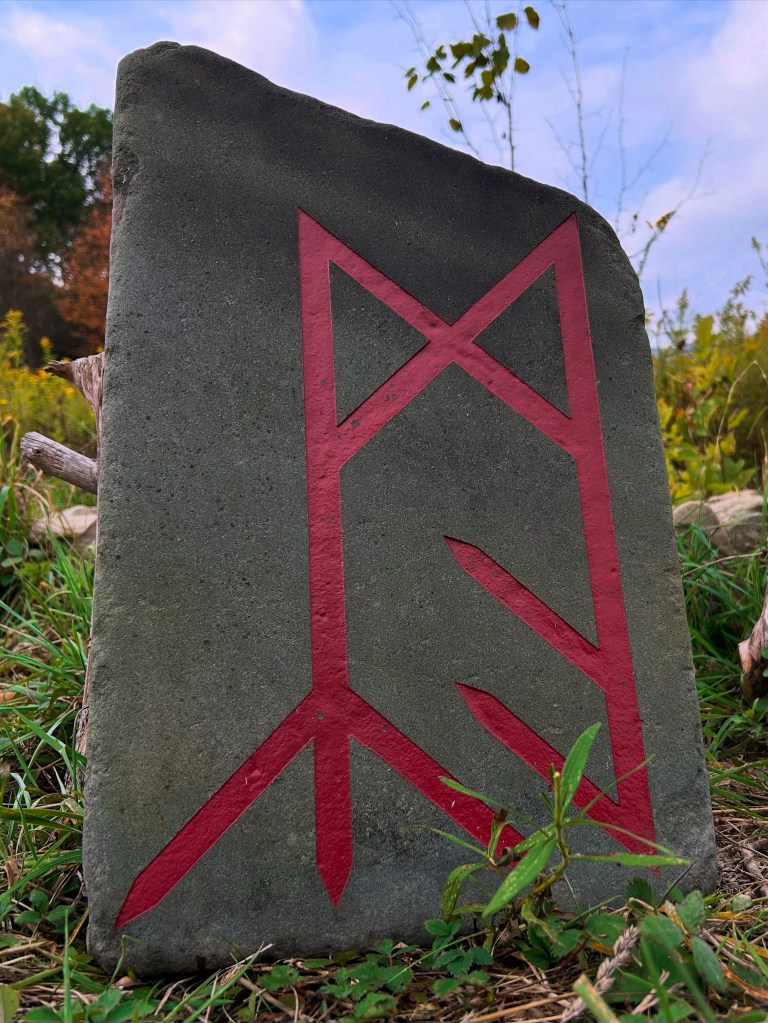
Perthro is a mysterious word, likely stemming from the two Proto-Germanic words peru and iþō, meaning “pear shaped” or “likeness of a pear.” Some say, rather lazily, that this refers simply to the pear tree or fruit. The reason being, usually, is because of Tacitus’ description of the Germanic divination practices; involving fruit tree twigs adorned with “symbols” on them that were then cast for prophecy. However, it was a typical characteristic of the Earth-Goddess amongst ancient Europeans to embody this “pear shape,” as we can see from the numerous figurines found in this form. As with aspects of Thursiaz, Perthro appears to hold remnants of the archaic European religion within it, in the form of the great and plentiful Earth Mother. This Earth Mother/Venus motif can be found in Europe as far back as 40,000 years ago; the oldest figurine being found in Schelklingen, Germany. That piece is named the “Venus of Hohle Fels” and is one of the earliest known depictions of a human being.
Perthro is the great womb of the underworld, representing the goddess Hel. From this womb, all will descend and all will be reborn. From this realm of “misty” blackness we emerge, and to this realm we shall return, time and time again. Perthro represents darkness, the world of the dead, and the cycle of reincarnation. It represents the great wisdom held within death and time; the ancient Völva (seeress/witch) that Odin consults for the answers he does not know.
Perthro is the rune of the goddess(es) of death, birth, and fate. We can attribute this to Frigga/Freyja, Hel/Hella, and to the triple goddesses of fate: Urðr, Verðandi, and Skuld. Regarding destiny, we can see where Perthro inherits its qualities as a “mysterious” rune, as it is associated with chance, risk, and the unknown. When interpreting this rune as possibility or probability, we can see how it has been long associated with gambling, being described as looking like a “dice cup.” The old concept of “Lady Luck” comes to mind here, associating this rune with the Hamingja, the Norse spirit that attaches itself to each person and is associated with one’s luck.
Perthro also resembles a mother with legs open, giving birth to new life. This idea is mirrored in the “P” sound, where one pushes the sound out of the lips. We can start to see a glimpse into this particular section of the Futhark, where the previous rune Eihwaz and the current rune Perthro invoke images of this eternal cycle of life, death, and rebirth. These two runes (ᛇ / ᛈ), like Othala and Dagaz, are the only two runes that have been found in alternating order in the Futhark, showing perhaps a philosophical difference amongst different tribes. Eihwaz can be viewed as Loki’s dart, while Perthro can be viewed as the womb of Hel, where Baldr is to be held until Ragnarok. Along with Baldr’s rebirth will come the next golden age on Earth.
With this evidence, we can deduce, without doubt, that the pre-Christian Germanic peoples believed in reincarnation. However, if one wanted to be released from the cycle, they would have to die a glorious and honorable death in battle. Only then would they achieve eternal union with the All-Father in his Golden Valhǫll. Another, more “continental” version of this concept, is when one is swept into the Wild Hunt of Wotan, eternally riding the wind with the “Furious Host.”
We can see this belief invoked in the one rune poem we have of Perthro from antiquity, existing in the “Old English Rune Poem” under the name Peorð. It is said in the poem:
“Peorð is ever leisure and laughter
To each of the proud ones, where warriors sit
In the beerhall blithely together.”
From this poem, we can infer that amongst the Anglo-Saxons, this rune was associated with games, merriment, and pleasure. I believe this can be attributed to the living, of course, but is more-so a conception of how they viewed death. Although the Anglo-Saxons were mostly Christian by this time, the poem has an echo of Valhǫll, conceivably relating to the afterlife of warriors and “proud” or honorable ones. This is a place that was eternal for those who had earned it, as it alludes to “proud warriors” and not the common folk. Either way, through this poem, we can attribute to Perthro the act of entertainment, happiness, and comradery of warriors.
Perthro is the underworld, the lightless depths beneath the world tree Yggdrasil. It represents the shadowy, hidden, murky realms where all wisdom is kept. This darkness is where all humans are born from and where all humans return to; until the cycle is broken. In the Germanic tradition, this samsara-esque cycle, as previously stated, could be bypassed by honorable deeds and death in battle, ascending eternally into higher realms such as Valhǫll (Hall of the Slain) or Fólkvangr (Field of the People). Perthro can also be connected to death and the underworld via its “cup” shape, as seen if placed on its side. In “Ynglinga Saga” it is said:
“At the burial of a king there was brought up a goblet called Bragafull (funeral toast cup), before which everyone stood up, took a solemn vow, and emptied it.”
Regardless of its subjectiveness, I believe the “cup” theory holds weight, especially as seen here in association with death ceremonies and rituals for transporting the soul. Not only this, but we have an ancient name for Odin in the form of Gautaz, meaning “one who pours/flows out, he who pours out.” In this context, it can be speculated that Odin “pours” out of the underworld; from this dark and endless “pool” of spirits. Perthro is also gloom and death, resembling the jaws of the great wolf, Fenrir. Perthro, in its “darker” form, embodies the degrading power of time.
In conclusion, while Perthro can most certainly be associated with death, the underworld, darkness and the unknown, it can also be associated with the forces of life, growth, and rebirth. In appearance, Perthro resembles a few key forms, the main ones being the womb, the cup, and the jaws of the wolf. These images invoke visions of the death of Baldr, Ragnarök, and the underworld. Clear associations can be made to the goddess in the forms of Freyja, Hel, and the Fates; those residing over the netherworld, death, and destiny. Perthro also invokes male gods like Odin, Baldr, and Loki, as these three gods are catalysts of changes and fate, tied to the aspects of death and rebirth. We see the possibility of an eternal afterlife of pleasure amongst warriors, either in Valhǫll, the underworld, or amongst those in the Wild Hunt. We can associate Perthro with games, gambling, chance, and risk; as this unpredictable, exciting, and mysterious entertainment is one that is said to be pre-destined by the triple goddess of Fate. We can see Perthro also associated with the “web of fate,” as destiny has already been previously “spun.” Our job is to connect the dots of this web within and strive for ultimate awareness of its pattern.
Rune classes will be available again starting in October.
These will be focused on the Elder Futhark and be catered to each individuals current level of use, study, and interests.
Lessons will be private, either in person or via zoom. No fee or donation required, just a genuine urge to learn the runes in the traditional oral fashion.
Please use the contact form for all questions and inquires.
Hailaz
Subscribe to get access to the rest of this post and other subscriber-only content.
The Autumn Equinox is the turning point in the year when daylight and darkness become even once again, tipping the scales towards the darkest period of the year when the nights grow longer than the days and the weather gets colder. Traditionally, harvests would be reaped during this time and various rituals were conducted for the gods and spirits residing over abundance. Attention was given to the spirits and ancestors as it was believed that this time was liminal and other realms were accessible. At the cusp of the Equinox, the dark half of the year begins to slowly gain dominance once again.
Bonfires are especially common as well as sacrifices, whether physical or symbolic. People give thanks and ask for future abundant harvests, ensuring a healthy stock of goods for the upcoming Winter months. Much depended on this pivotal time of year and many rites were undertaken to guarantee success. Feasts would be widespread as well as games, echoing other Summer/Fall festivals in atmosphere. For us here in the Northeastern United States, many crops are ripening at this time, such as squash, tomatoes, and beans. With this comes canning and drying to stock pantries for the Winter.
In “Teutonic Mythology” by Grimm, it says:
“In some parts of northern England, in Yorkshire, especially Hallamshire, popular customs show remnants of the worship of Frieg. In the neighborhood of Dent, at certain seasons of the year, especially autumn, the country folk hold a procession and perform old dances, one called the giant’s dance: the leading giant they name Woden, and his wife Frigga, the principal action of the play consisting in two swords being swung and clashed together about the neck of a boy without hurting him.”
As seen above, many early English (and Germanic) peoples would honor the god/goddess Frieg (Frigga) and Woden (Odin) during this time. Woden/Wotan in early Germanic belief was sometimes associated with wheat fields, where offerings were left for his horse Sleipnir during pivotal moments of the year. Certain epithets of Odin give reason to believe that he has been worshipped as a benevolent god to some extent, reigning over wealth, fate, and general prosperity. Names like this include Farmatýr (Lord of Cargoes) and Óski (God of Wishes).
Regarding Odin and continental Pagan belief, Grimm also states:
“As these names [Woden/Mercury/Hermes], denoting the wagon and the mountain of the old god, have survived chiefly in Lower Germany, where heathenism maintained itself longest; a remarkable custom of the people in Lower Saxony at harvest-time points the same way. It is usual to leave a clump of standing corn in afield to Woden for his horse.”
Of all the ancient celebrations, the Autumn Equinox was the most difficult one to find any references for. My belief is that it was a lesser celebratory event and more centralized in each community, where the harvest would be brought in and the local spirits offered to. People were likely working hard and didn’t have time to prepare for anything large like they would have during the last harvest of Samhain, which certainly would have taken the forefront in terms of importance, at least to the Pagan Celts.
In “The One-Eyed God” by Kershaw, it says:
“These times of transition are strange times, whether the transition is from month to month, or season to season, or year to year; they are times which are not quite one thing or the other. They are like boundary lines, which are not quite my property or yours, or doorways, which are not quite inside or outside. As Eitrem said, it is at these dividing lines of time and space that the dead and Hermes are particularly active.”
It was common to not only focus on the harvest at this time, but to also give special attention to the dead and gods (or spirits) associated with death. The year was to start its final stages of descent into darkness and the deified Sun/Light was to begin the darkest part of its journey through the underworld. Because of this, symbolic bonfires are lit in order to emulate the Sun and prolong the light.
In “Sorcery and Religion in Ancient Scandinavia” by Vikernes, it says:
“Odinn placed his eye in the grave, in the well of the past, every year, in order to learn from the past. This might sound strange, but his eye was the Sun, Baldr, that lost its power every autumn and therefore had to spend the winter in the world of the dead. In other words, Odinn had one eye in the world of the living and one eye in the world of the dead.”
Aside from the various gods, goddesses, and spirits of prosperity, it is clear that Odin and Frigga took a central role in (Germanic) Equinox observances in pagan Europe. Odin (Woden) was recognized as a god of wishes, death, darkness, gifts, and clairvoyance, mirroring the exoteric liminality of the period between light and dark invoked by the Equinox. Frigga, on the other hand, represented the Earth, love, fertility, wisdom, strength, and magic. Essentially, Frigga is the symbol of Nature herself.
This celestial event is to also be reflected internally, as darkness begins to gain supremacy after this transition. We begin to look inward and conduct deeper spiritual work, creating light within to combat the impending darkness of Winter.
-The Celto-Germanic Wheel of the Year According to Past and Present Pagan Customs
Eihwaz is a rune of life, death, rebirth, endurance, strength, and the eternal cycle of change. This rune represents the Axis Mundi, the metaphysical center of the world. In the Germanic tongues, this would have gone by the name Irminsul, Donar’s Oak, or Yggdrasil, and represented the great World Tree of Pagan cosmology. This tree was believed to connect all the realms of existence, resembling the “shamanistic” cultures of Eurasia, associating it with Odin’s magical abilities and techniques. These practices allow him to travel as he pleases around the 9 different worlds of the cosmos, linked together by the great World Tree. The word Yggdrasil gives us this clue, as ygg(r) means “terrible one” and drasil means “steed,” reading something like “The Steed of the Terrible One.” This alludes to Odin’s ability to use this tree (or pillar) to travel outside of himself.
When looking at the rune poems, we only have one which speaks of Eihwaz directly, as the other two poems invoke the rune Ýr instead, connecting it more so to the previously mentioned Yggdrasil. The “Old English Rune Poem” states:
“Yew is on the outside an unsmooth tree,
Hardy and earth-fast, fire’s keeper,
Under-rung by its roots, best on the estate.”
This poem has a mysterious tone to it, although objective in its observation. The ancient Yew trees of the UK are highly impressive giants to behold, reaching back in time over 2000 years in some cases. These trees, like the first line says, are quite “lumpy” and gnarled, having many twists and turns. It isn’t hard to imagine why our ancestors used this tree to represent so much in their lives, as its immense canopy and knotted sprawl resembles the growth of family “trees” and essentially all concepts that seem to “branch” or “stem” from one another. The second line alludes to the endurance that Yew trees exhibit, boasting long life spans. The last line pertains to these trees having wild and intense root systems. This would make them “best on the estate,” as the Yew has a fairly slim chance of being knocked down by wind or storm.
It must be noted that while the Anglo-Saxon runes do include Eihwaz under the name ēoh, which means “Yew,” they also include another rune in their Futhorc; the rune Ýr (ᚣ), which distinctly means “Yew bow.” It is strange that the Anglo-Saxon Futhorc retains the original Eihwaz rune while also incorporating the Younger Ýr rune as well. This, to me, does indicate a significant difference in the two runes, and perhaps any attribution to bows and arrows may be strictly given to the Ýr rune, while the Eihwaz rune retains a predominant symbol of the World Tree: life, death, and rebirth.
My theory is that the Anglo-Saxons had, by this time, new geographical associations with the runes. Once they got to England, they must have been in total awe of the Yew trees. Either this, or they noticed how their Celtic adversaries/neighbors held this tree in high regard. We can see evidence for this connection in the Proto-Celtic word iwos, meaning “yew.” Perhaps these mighty Yew trees were not as common or prominent as was the Oak or other sacred trees on the continent. I believe evidence for this can be found in the absence of any word for “Yew” in the Gothic language, enforcing the Celtic influence on this word and rune. In its original form, Eihwaz would have likely been associated with the Oak, as in Gothic, the work aik means “Oak.” Not only this, but the root word eih, in Old High German, also means “Oak.” We can assume this rune came from the East, and not the West, therefor, the word Eihwaz would have most likely been a formal name for the Oak. When looking for past reference to Indo-European World Trees, the Oak is by far the most frequently described, with other minor references to Birch, Beech, Apple, Olive, and certain types of Evergreens; in this case, most notably the Yew.
The Younger runes of the North would later evolve in connection with these older runes, invoking again the infamous Yew tree. Although, their Futhorc would no longer contain the Eihwaz (ᛇ) rune. Instead, they carry over only the Ýr rune in the form of (ᛣ), associating it more directly with the Yew tree. The “Old Norwegian Rune Rhyme” states:
“Yew is the winter-greenest of trees,
It is wont for what burns to singe.”
This poem invokes the “evergreen” concept, which in the Pagan north was a symbol of eternal life. This is one reason for the incorporation of the “Yule Tree” in the winter customs, as it was a sacred reminder of beauty, life, and strength. The second line, I believe, is referring to its excellent quality as firewood, as Yew wood has been said to burn the brightest. We have no mention of bows here, so it must have been more-so acquainted with hearth-fire, life, and hope.
Lastly, the “Old Icelandic Rune Poem” gives us another angle to view this rune, in connection to the death of Baldr. It is said:
“Yew is a bended bow,
and iron eager to break,
and an etin’s arrow.”
Here, we first see mention of the bow. As stated before, the Yew was among the top choices, if not the best choice for bow making in the Heathen north. Therefore, Eihwaz / Ýr can be associated with bows, arrows, and archery. It has been theorized that this can also relate to “tension,” as the pulled bow string is very tense and holds a lot of energy within it. This, some say, can be associated with death when life’s energy is finally released. The last line can without doubt be associated with the events surrounding the death of Baldr. Baldr is killed (technically) by the etin (giant) Loki’s arrow/dart made of mistletoe, something that grows on various trees and was of a highly medicinal and magical use in the north. Of course, it is the blind god Höðr who throws the dart, but it was Loki who planned the act. This story can be found in Gylfaginning in Snorri’s “Prose Edda.”
In conclusion, we can see that Eihwaz is connected to the primordial World Tree of the European peoples, whether in the form of the Oak, the Yew, or any other tree that our ancestors venerated as a sacred center. Its association to eternal life, death, rebirth, and endurance can be seen in the symbolism of the evergreen; the ancient symbol of everlasting existence. We’ve also uncovered direct evidence concerning the possibility that this rune was originally a symbol of the Oak tree, as this was the most sacred tree cross-culturally amongst ancient Europeans, being idolized extensively from Ireland to Finland, Portugal to Greece. The Oak was the main representation of the World Tree cosmology. Therefore, this rune can not only take the meaning of “Yew,” but also of “Oak.” This, to me, would all depend on the geography surrounding the one using the runes.
-Wandering the Runic Path: Esoteric Analysis of the Germanic Runes
Stanza 23 of The Hávamál reads:
“The witless man is awake all night,
Thinking of many things;
Care-worn he is when the morning comes,
And his woe is just as it was.”
This stanza offers timeless insight into the nature of worry and sleeplessness. It warns against the unproductive torment of overthinking, something that transcends time, culture, and language.
Insomnia and nighttime rumination are now well documented features of anxiety and depression. The pre-dawn hours, when the world is still and our thoughts are loudest, can feel especially oppressive.
Odin’s advice urges wisdom through healthy and proactive emotional moderation. He implies that constant brooding leads us nowhere. A sleepless night of rumination changes nothing and only compounds one’s suffering. This is the product of avoiding one’s anxieties during waking hours. We cannot hide from these things.
This emotional state also appears in Anglo-Saxon poetry, such as in The Wanderer. The speaker describes his lonely morning sorrows: “Often I must bewail my sorrows alone every morning: none is now alive to whom I dare plainly speak my mind”.
Interestingly, a similar concept is found in the Old English word uhtceare, which roughly translates as “pre-dawn anxiety” or “the sorrow before dawn.” It refers to the experience of lying awake in the early hours, consumed by worry. The word is formed from uhta, meaning the time just before daybreak, and cearu, meaning care, grief, or anxiety.
The fact that both Norse and Anglo-Saxon traditions preserved and named this specific experience speaks to how universally felt it was throughout the Germanic world.
Yet, perhaps there is comfort to be found in this. The ancients wrestled with the same restlessness that plagues us today. If even the Allfather himself thought it important enough to caution against, then perhaps it’s a reminder that we’re not alone in our struggles. And that, in itself, may offer some solace.

Amitabha (Boundless/Infinite Light) is an important figure found in the Mahayana and Vajrayana schools of Buddhism, with his function varying differently between the two.
In the Mahayana schools, especially the Pure Land school, Amitabha is venerated as a fully enlightened Buddha and his realm Sukhavati (a place ideal to practice the Dharma) is aspired after death. This isn’t a permanent heaven, but rather a flawless realm for one to continue practice and achieve enlightenment in.
In Vajrayana, Amitabha is a Dhyani (meditation/wisdom) Buddha and is the head of the Lotus (Padma) family, associated with the direction of the West, the same direction of his heavenly realm Sukhavati. He is responsible for the transformation of desire and attachment into discerning wisdom. He is also invoked in the practice of Phowa meaning “transfer of consciousness.” However, when practiced in accordance with long-life rituals, he appears as Amitayus (Buddha of Infinite Life), a sambhogakaya (enjoyment body) form of Amitabha.
Amitabha usually appears as a red Buddha in meditation posture, adorned with Dharma robes and holding a begging bowl with both hands. The meditator is to visualize oneself as a bodhisattva, white in color, with Amitabha, the Bhagavat, in front. Through his sadhana, one eventually dissolves the barrier between Amitabha and oneself, becoming the very essence of “lucidity and emptiness.”
Om Ami Dewa Hri
Front Image Link: https://www.himalayanart.org/items/24733/images/primary#-617,-1000,1381,0
Back Image Link: https://www.himalayanart.org/items/77019/images/primary#-1434,-2204,2971,0
 Ansuz Society