
Subscribe to continue reading
Subscribe to get access to the rest of this post and other subscriber-only content.

Subscribe to get access to the rest of this post and other subscriber-only content.
The Autumn Equinox is the turning point in the year when daylight and darkness become even once again, tipping the scales towards the darkest period of the year when the nights grow longer than the days and the weather gets colder. Traditionally, harvests would be reaped during this time and various rituals were conducted for the gods and spirits residing over abundance. Attention was given to the spirits and ancestors as it was believed that this time was liminal and other realms were accessible. At the cusp of the Equinox, the dark half of the year begins to slowly gain dominance once again.
Bonfires are especially common as well as sacrifices, whether physical or symbolic. People give thanks and ask for future abundant harvests, ensuring a healthy stock of goods for the upcoming Winter months. Much depended on this pivotal time of year and many rites were undertaken to guarantee success. Feasts would be widespread as well as games, echoing other Summer/Fall festivals in atmosphere. For us here in the Northeastern United States, many crops are ripening at this time, such as squash, tomatoes, and beans. With this comes canning and drying to stock pantries for the Winter.
In “Teutonic Mythology” by Grimm, it says:
“In some parts of northern England, in Yorkshire, especially Hallamshire, popular customs show remnants of the worship of Frieg. In the neighborhood of Dent, at certain seasons of the year, especially autumn, the country folk hold a procession and perform old dances, one called the giant’s dance: the leading giant they name Woden, and his wife Frigga, the principal action of the play consisting in two swords being swung and clashed together about the neck of a boy without hurting him.”
As seen above, many early English (and Germanic) peoples would honor the god/goddess Frieg (Frigga) and Woden (Odin) during this time. Woden/Wotan in early Germanic belief was sometimes associated with wheat fields, where offerings were left for his horse Sleipnir during pivotal moments of the year. Certain epithets of Odin give reason to believe that he has been worshipped as a benevolent god to some extent, reigning over wealth, fate, and general prosperity. Names like this include Farmatýr (Lord of Cargoes) and Óski (God of Wishes).
Regarding Odin and continental Pagan belief, Grimm also states:
“As these names [Woden/Mercury/Hermes], denoting the wagon and the mountain of the old god, have survived chiefly in Lower Germany, where heathenism maintained itself longest; a remarkable custom of the people in Lower Saxony at harvest-time points the same way. It is usual to leave a clump of standing corn in afield to Woden for his horse.”
Of all the ancient celebrations, the Autumn Equinox was the most difficult one to find any references for. My belief is that it was a lesser celebratory event and more centralized in each community, where the harvest would be brought in and the local spirits offered to. People were likely working hard and didn’t have time to prepare for anything large like they would have during the last harvest of Samhain, which certainly would have taken the forefront in terms of importance, at least to the Pagan Celts.
In “The One-Eyed God” by Kershaw, it says:
“These times of transition are strange times, whether the transition is from month to month, or season to season, or year to year; they are times which are not quite one thing or the other. They are like boundary lines, which are not quite my property or yours, or doorways, which are not quite inside or outside. As Eitrem said, it is at these dividing lines of time and space that the dead and Hermes are particularly active.”
It was common to not only focus on the harvest at this time, but to also give special attention to the dead and gods (or spirits) associated with death. The year was to start its final stages of descent into darkness and the deified Sun/Light was to begin the darkest part of its journey through the underworld. Because of this, symbolic bonfires are lit in order to emulate the Sun and prolong the light.
In “Sorcery and Religion in Ancient Scandinavia” by Vikernes, it says:
“Odinn placed his eye in the grave, in the well of the past, every year, in order to learn from the past. This might sound strange, but his eye was the Sun, Baldr, that lost its power every autumn and therefore had to spend the winter in the world of the dead. In other words, Odinn had one eye in the world of the living and one eye in the world of the dead.”
Aside from the various gods, goddesses, and spirits of prosperity, it is clear that Odin and Frigga took a central role in (Germanic) Equinox observances in pagan Europe. Odin (Woden) was recognized as a god of wishes, death, darkness, gifts, and clairvoyance, mirroring the exoteric liminality of the period between light and dark invoked by the Equinox. Frigga, on the other hand, represented the Earth, love, fertility, wisdom, strength, and magic. Essentially, Frigga is the symbol of Nature herself.
This celestial event is to also be reflected internally, as darkness begins to gain supremacy after this transition. We begin to look inward and conduct deeper spiritual work, creating light within to combat the impending darkness of Winter.
-The Celto-Germanic Wheel of the Year According to Past and Present Pagan Customs
The Autumn Equinox is the turning point in the year when daylight and darkness are equal once again, tipping the scales towards the darkest period of the year when the nights grow longer and the weather gets colder. Traditionally, harvests would be reaped during this time and various rituals were conducted for the gods and spirits residing over abundance. Attention was given to the wights and ancestors, as it was believed that this time was liminal and that other realms were accessible. At the cusp of Equinox, the dark half of the year begins to slowly gain dominance.
Bonfires are especially common as well as sacrifices, whether physical or symbolic. People give thanks and ask for future harvests, ensuring a healthy stock of goods for the upcoming Winter months. Much depended on this pivotal time of year and many rites were undertaken to guarantee success. Feasts would be widespread as well as games, echoing other Summer and Fall festivals in atmosphere. For us here in the Northeastern United States, many crops are ripening during this time such as squash, corn, and apples. With this comes canning and drying goods to stock pantries for the Winter.
In “Teutonic Mythology” by Grimm, it says:
“In some parts of northern England, in Yorkshire, especially Hallamshire, popular customs show remnants of the worship of Frieg. In the neighborhood of Dent, at certain seasons of the year, especially autumn, the country folk hold a procession and perform old dances, one called the giant’s dance: the leading giant they name Woden, and his wife Frigga, the principal action of the play consisting in two swords being swung and clashed together about the neck of a boy without hurting him.”
As seen above, many early English (and Germanic) peoples would honor the god/goddess Frieg (Frigga) and Woden (Odin) during this time. Woden/Wotan in early Germanic belief was sometimes associated with wheat fields, where offerings were left for his horse Sleipnir during pivotal moments of the year. Certain epithets of Odin give reason to believe that he has been worshipped as a benevolent god to some extent, reigning over wealth, fate, and general prosperity. Names like this include Farmatýr (Lord of Cargoes) and Óski (God of Wishes).
Regarding Odin and continental Pagan belief, Grimm also states:
“As these names [Woden/Mercury/Hermes], denoting the wagon and the mountain of the old god, have survived chiefly in Lower Germany, where heathenism maintained itself longest; a remarkable custom of the people in Lower Saxony at harvest-time points the same way. It is usual to leave a clump of standing corn in afield to Woden for his horse.”
Of all the ancient celebrations, the Autumn Equinox was the most difficult one to find any references for. My belief is that it was a lesser celebratory event and more centralized in each community, where the harvest would be brought in and the local spirits offered to. People were likely working hard and didn’t have time to prepare for anything extravagant like they would during the last harvest of the year (Samhain), which certainly would have taken the forefront in terms of importance, at least to the Pagan Celts.
In “The One-Eyed God” by Kershaw, it says:
“These times of transition are strange times, whether the transition is from month to month, or season to season, or year to year; they are times which are not quite one thing or the other. They are like boundary lines, which are not quite my property or yours, or doorways, which are not quite inside or outside. As Eitrem said, it is at these dividing lines of time and space that the dead and Hermes are particularly active.”
It was common to not only focus on the harvest at this time, but to also give special attention to the dead and gods (or spirits) associated with death. The year was about to start its descent into darkness and the deified Sun/Light was to begin the darkest part of its journey through the underworld. Because of this, symbolic bonfires are lit to emulate the Sun and prolong the light.
In “Sorcery and Religion in Ancient Scandinavia” by Vikernes, it says:
“Odinn placed his eye in the grave, in the well of the past, every year, in order to learn from the past. This might sound strange, but his eye was the Sun, Baldr, that lost its power every autumn and therefore had to spend the winter in the world of the dead. In other words, Odinn had one eye in the world of the living and one eye in the world of the dead.”
Aside from the various gods, goddesses, and spirits of prosperity, it is clear that Odin and Frigga took a central role in (Germanic) Equinox observances in some areas of Pagan Europe. Odin (Woden) was recognized as a god of wishes, death, darkness, gifts, and clairvoyance, mirroring the exoteric liminality of the period between light and dark invoked by the Equinox. This external event is to also be reflected internally, as darkness begins to gain supremacy after this transition. We begin to look inward and conduct deeper spiritual work, creating light within to combat the impending darkness of Winter.

Among the many gods, goddesses, spirits, ancestors and beings that we venerate on this endlessly generous Summer Solstice, we would like to give special reverence to the great Horned One who bestows protection and abundance among the wild realms of the land. May his health be mirrored within all of us.
May all beings thrive under the sun.
“Horns pierce the sky,
Soul of the land,
King of the woods,
Lord of the trail.
God of the wild,
And all that roam,
Scents of the Earth,
Flowers and bone.
Flowers and bones.”
ᛋ : ᛉ : ᚷ
Hailaz and happy Summer Solstice!
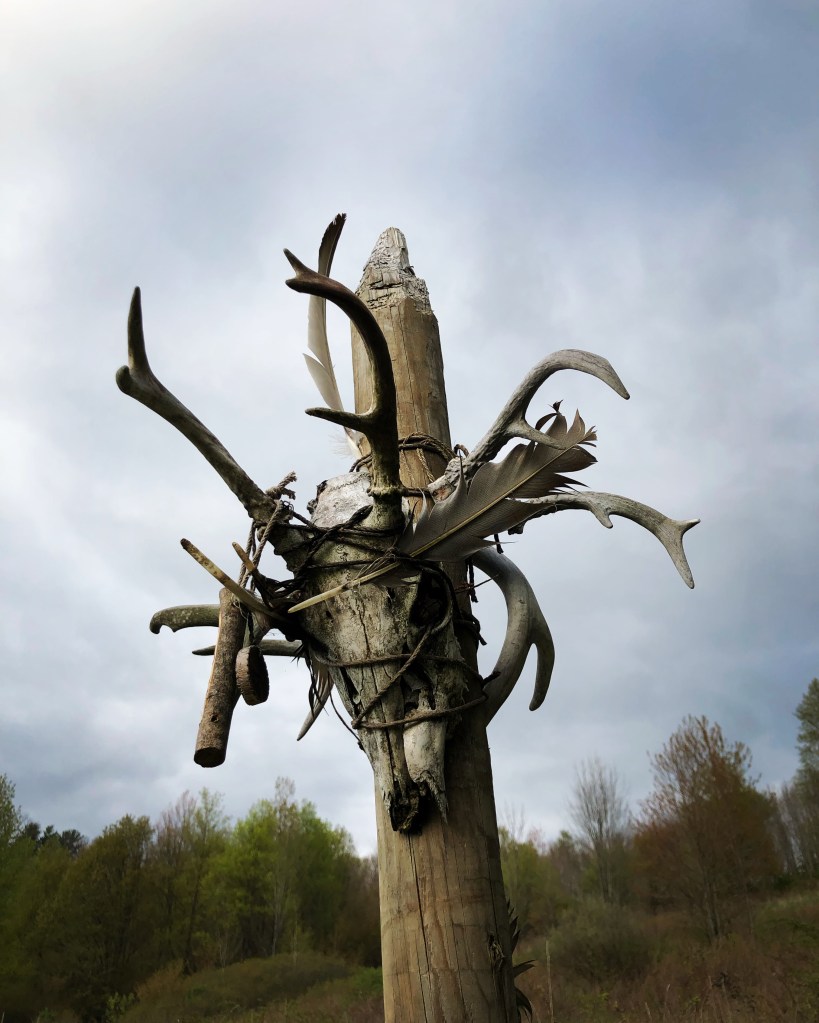
Cernunnos/Hurnaz represents the spirit, soul, or incarnation of the forest itself. Unlike most gods, which fill an archetypal form congruent to their other roles, Cernunnos isn’t necessarily one that the practitioner aspires to be(come), but rather, a spirit one asks for protection, aid, and blessings from. Our idol stands at the edge of our property where things are considered “ordered,” representing the liminal space between the safety of the homestead and the inherent dangers of the wilderness. With this in mind, and within a Germanic context, we see Cernunnos representing an older, ancient, natural “Jotun” or “Wight” type of spirit; one that we must form a relationship with if we want to have a completely unified connection and understanding of the forest and all of its life forms.
It is here we bring the dead we find and offer fruits and other foods for the wildlife, the children (and embodiment) of the forest. Cernunnos represents all landavetter and spirits residing in the mysterious woods.
This god, as all others, has many different venerative systems, especially based on where it is you are practicing. If in a more urban setting, one might view this god as the Roman’s or civilized Gaul’s did, as a fertility and commerce god. If in the rural or farther reaches of society, one might have a more direct relationship with this god as the embodiment of the forest, as one by the sea would visualize the entirety of the ocean as Poseidon or Njord. Likewise, many cultures practiced this type of veneration in association with their geographical surroundings. Volcanoes, mountains, forests, lakes, oceans, etc., all embodied a certain god form inherent within them. This is where polytheism and animism overlap, forming the mindset of many of our ancestors prior to Christianity.
May we all venerate the great spirits of nature.
 Ansuz Society