
Subscribe to continue reading
Subscribe to get access to the rest of this post and other subscriber-only content.

Subscribe to get access to the rest of this post and other subscriber-only content.
Subscribe to get access to the rest of this post and other subscriber-only content.
Subscribe to get access to the rest of this post and other subscriber-only content.
Odin as the primordial state of consciousness applies to women as well, as Odin is said to have given soul to both. This innate awareness is formless and is beyond any associations with body or sexual identity. Therefore, one does not have to look at primal awareness as something based on these limiting and mundane concepts. This doesn’t mean that Freyja is not involved in the equation, as Freyja is the energy and flux of the natural/material universe, identical to great Kali/Shakti/Tara Ma. Freyja represents matter, while Odin represents consciousness. Without Odin, there would be no Freyja, and without Freyja, Odin would have nothing to manifest into. These are the two pieces of the puzzle that create what we know of our existence and reality; the Father (consciousness) and the Mother (material world). Each sentient being and all physical matter encapsulates these qualities. They are inseparable. Through training and practice, one can destroy the surface duality represented in these two halves, reuniting them into one single point of experience. Either deity can be venerated as supreme, as they both express one final outcome of creation.
Hail the Mother, Hail the Father!

One interpretation of Odin’s world tree ritual is the destruction of his ego: the sacrificing of his lower self to his higher Self. The ritual is a metaphor for replacing our material limitations for the infinite potential of primordial wisdom; exchanging our mundane form for that of the almighty consciousness of Odin. Odin, as the material individual, strives to return to the source, which like Shiva or Buddha, is nothing other than his innate, true nature, beyond constructs and existing within everything. This is why Odin is known as the “Masked God” or “God of Masks,” as his shapeless state allows him to cloak himself in whatever physical form he wants, being able to shift appearances according to his worldly goals.
Names of Odin relating to this are Fjallgeiguðr (Shape God), Fjolnir (The One Who is Many), and Grimnir (Masked One). Odin, in this way, represents all possible expressions of life and exists within all sentient beings. Odin is the great animator of matter, obscured and covered up to varying degrees by the limitations of our ignorance and material attachments. By removing these obstacles one by one, Odin, as the common man, realizes and becomes his true Self; the unchanging reality which can be described as furious, terrifying, and awesome. This is why he is known as “The Terrible” or “Furious One,” as the realization of this state can be deemed nothing other than ferocious and shocking. This is identical to some names of Shiva that relate to this same phenomenon, such as Bhairava (Lord of Terror), Mahakala (Beyond Time), and Rudra (The Howler/Dreadful).
This primordial state, the formless consciousness beyond conceptual and dualistic framework, can be further represented by Odin’s one eye, which sees nothing but the true state of reality: non-dual and single focused. This pure vision shows him all things; the causes and effects of all phenomena; unaffected by time, change, or abstract forms. Odin as the “One-Eyed God” appears in many ways such as Hoárr (One Eyed), Báleygr (Flaming Eye) and Bileygr (Flashing Eye). Odin, the individual, has but one single motive: the search for ultimate wisdom/source. Further evidence for this is reflected in his names Sanngetall (Seeker of Truth), Fjǫlsviðr (Very Wise), and Forni (Ancient One).
This is the eternal Odin within us, the awareness we must all uncover if we want to transcend our worldly limitations. This formless state of being is what remains when the body falls to the wayside, remaining intact for all of eternity. Through his ritual on the world tree, Odin loses attachment to his body/shape/name and realizes his supreme nature; flooded by the ancient wisdom of the cosmos represented by the runes, poetry, and other various magical techniques.
May all sentient beings seek the source of consciousness and realize Odin within themselves.
Hailaz / Namaste

When it comes to Indo-European cultural and religious phenomena, the Kóryos is one of the most discussed aspects. The Kóryos, Männerbund, or Warband, was the living embodiment of the storm god; descending unexpectedly and laying waste to that on which it fell. Like the violent storm, tempest, or high winds, the wolf-warriors of Odin strike suddenly and swiftly. To the more “civilized” and agricultural folk, these storm god embodiments were the bane of farms, homes, and settlements. Originally, the Indo-European Kóryos/warbands were the living reflections of the “fury” and “rage” associated with the Vedic god Rudra, who to the Germanic people became known as Wodanaz/Wotan. Later on, the Vikings of Scandinavia would continue this traditional raiding under the guidance of the All-Father, Odin. Like Odin’s possession, fury, and madness, these wolf-warriors descend suddenly, unexpectedly, and terribly upon the sedentary, comfortable, and more “civilized” peoples that they encountered in their travels.
Odin/Wodanaz represents the storm, war, and sorcerous/magical powers. In the word Wodaz (excited, obsessed, furious) we get a glimpse of what the primordial state looked like in the mind of the ancient Germans, the “Awesome Consciousness” of Odin, which can otherwise be described as terrifying or exciting. This is a state of spaceless, heightened awareness. Complete focus on the present moment. The invocation of Wodaz was completely entrenched in the now, not lost in past or future. Within this state, lies the intense “frenzy” that these warriors have been known for and documented about for over 2000 years across many different Indo-European cultures including the Germans, Greeks, and Iranians. Because of this rampant focus and rage, these warriors would continue to be feared far into the Viking age, where this type of elite warrior emerged in the form of the Berserker (Bear Shirt) or Ulfheðnar (Wolf Coats). These warriors would also play an enormous role in the creation of the Werewolf myths and legends. As we can see, this shows a particular skill in what we would otherwise term as “shapeshifting.” Names of Odin that apply to this type of sorcery are Fjallgeiguðr (Shape God), Svipall (Changing/Shape-Shifter), and Grímnir (Masked One).
Because of this, many agricultural communities would rightfully view Odin/Rudra as more of a demon or deity that one wished to keep away. This practice originated from the Vedic practice of making offerings to Rudra, who was generally prayed to in order to send his disease and fury elsewhere; overlooking the ones making the offerings or sacrifices. Ultimately, one wanted to divert this storm god’s awesome and terrible wrath away from themselves and towards their enemies. These offerings were also given for his blessings of prosperity and to prolong the lives of the ritual participants, as Rudra was also a god of death, time, and disease. Like Odin, Rudra was also known for delivering and releasing fetters such as illness, obstacle, and hardship. Therefore, as much as one wanted to divert the god’s wrath away from themselves, they made offerings in exchange for his particular blessings.
Rudra means “The Howler/Roarer”, which refers to wind and storms. He is also known as Ugra, which means “Mighty, Wrathful, Furious,” and “Terrible.” This word is synonymous with the word Ghora, meaning “Frightful, Vehement, Sublime” and “Horror.” Ghora is also a name of Shiva, meaning “The Terrible.” Likewise, Odin has similar titles, including Hrjóðr (Roarer), Hrani (Blusterer), and Viðrir (Stormer). The epithet “Wodanaz” means something like “The Furious One,” “The Possessor,” or “The Exciter,” representing what would later become Odin (The Furious). He is also commonly known as Yggr, which means “Terrible One.”
Warbands embody the storm in this way, with each member taking on the “furious” form of Wodanaz/Rudra. This was done by ritually entrenching one’s focus in the moment and becoming “possessed” by the god himself. This is done through active cultivation of complete and total focus, or, “Wodaz,” via chanting, ceremony, or dance. Sometimes, intoxicants were used in order to reach a higher state of perception. Other relative names of Odin that portray this type of activity include Vakr (Wakeful, Alert), Hagvirkr (Skillful Worker), and Gapþrosnir (The One in Gaping Frenzy).
Because of this association with Odin and the Männerbund, we can see how Odin was the god of the young, traveling warrior, filling the roles of initiator and father. This connects Odin’s archetype as “The Wanderer”, as he must wander to gain the knowledge or rewards he seeks, not stay sedentary. Names of Odin that refer to wandering include Farmagnuðr (Journey Empowerer), Fengr (Fetcher/Catcher), and Gangari (Walker/Wanderer). This spiritual drive to travel can be associated with Odin, as he is the one who inspires us to set out on journeys, wander, and seek new places. He is also known as Hleifruðr (Wayfinder), Reiðartýr (Wagon God, God of Riders), and Vegtam (Way (Road) Tamer).
In conclusion, one can see how this cult of Wodanaz/Rudra developed, persisted, and eventually spread across Europe and Asia, mixing, altering, and diversifying the landscape as it spread. Like the Kóryos, Wodanaz/Odin spreads (or creates) new tribes, reinforcing his role as a progenitor deity, while Thor, the “Protector of Midgard” and Odin’s son, preserves the villages and enables auspicious conditions to arise within and around them. Odin/Wodanaz as the Sky Father mates with the native Earth Mothers that the Männerbund/Warband would encounter on their raids, giving birth to new mythologies, cultures, and tribes. The Kóryos, under the guidance of the wrathful storm god, is without a doubt responsible for the spread of Indo-European languages and cultures across the world. Paired with their domestication of the horse, elements of Indo-European culture, religion, and language exist in nearly every corner of the world today.

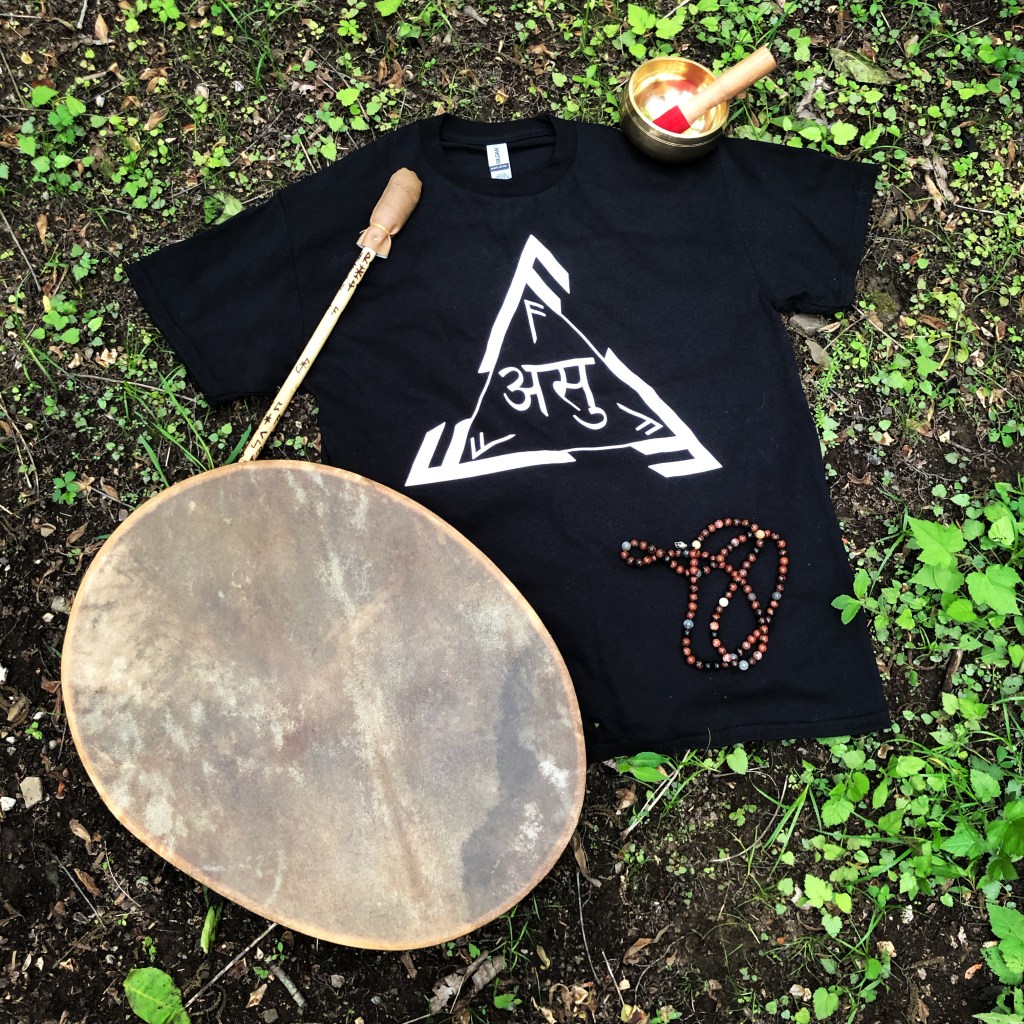
Our first batch of shirts have arrived and look awesome.
These will be given out to members, donors, volunteers and collaborators in order to spread not only the sign, but the culture of the Ansuz Society.
Our hope is that these will be worn with modesty, positivity, and respect.
For those who would like to purchase a shirt directly, they can be ordered for $20 with free shipping in the USA. Please use the contact form to order. Sizes available are small, medium, and large. Very limited quantity available.
While we invite everyone to interpret these symbols as they see fit, we would like to offer a brief overview of the design:
-3 Ansuz runes representing the gods Odin (soul), Vili (will), and Ve (body); the 3 components necessary for human life.
-the related Sanskrit word ásu, meaning “breath, spirit, life force, life.”
In regards to the triangular shape, we have a strong emphasis on the fire element, hence one interpretation of the triangle as fire. This fire is being propagated by the breath or wind represented by the Ansuz runes. The upward triangle also has associations with the air element, and therefore, is another representation of the breath, wind, and soul of which Odin is said to have given to mankind. With these connections in mind, this sign can be viewed as an internal flame driven by the winds of inspiration, or, Odin.
We also believe that all matter is a form of the Great Mother who strives for union with the Great Father (source of consciousness). That said, another interpretation of the upward triangle is to represent the male aspect of primordial awareness; the unmovable, foundational consciousness which exists in all sentient life. Because of this connection, the upward triangle can also be perceived of as representing Shiva, as his half of the Shatkona is the △ shape, while Shakti is symbolized by the ▽ shape. This primordial awareness, associated with male energy, is called by many names across the world and seen in deities such as Odin, Shiva, and Vajradhara.
May all beings benefit from these signs.
Hailaz / Namaste
-Ansuz Society
The fact that there will always exist a present moment is a point of permanence one can take solace in.
Past and future are littered with attachments and desires, polluted by expectations and other products of our ignorance like fear, anxiety, etc.
Whether we know it or not, these afflictions are the causes of our suffering, keeping us “fettered” in a state of constant flux, away from the present moment.
Although this is the case, it isn’t something that we need to be upset about. This is just the nature of living within the confines of endless change, the endless spinning of Samsara that all beings are subject to.
One thing that doesn’t change in our experience, however, is the primordial state of awareness regarding the here and now. Minds natural state of naked clarity. Like the center of a wheel, true nature of mind is fixed in place no matter how fast the rest of its parts may be going.
When one can reach this realization and become familiar with it, they can observe their minds’ habits and patterns more easily, removing obstacles, worries, and distractions with consistent practice. One can begin to sever problems from their roots.
This is a method to liberate one from Samsara and achieve a state of samadhi, free of time and space. A tiny glimpse of this pure “enlightenment” is enough to shatter our many delusions and make us strive to practice with more vigor and dedication.
To reach that place within that doesn’t change, is to escape the motion that the “Wheel of Life/Wheel of Becoming” represents, giving one a sense of peace that doesn’t exist in any materially found means.
If we can learn to rest in this experience of present awareness, we can observe all phenomenon that arise in our experience without attaching ourselves to them, giving us a a sense of well-being, freedom and love.
May all sentient beings find a place of unchanging peace within.

 Ansuz Society