
Subscribe to continue reading
Subscribe to get access to the rest of this post and other subscriber-only content.

Subscribe to get access to the rest of this post and other subscriber-only content.
Subscribe to get access to the rest of this post and other subscriber-only content.
Subscribe to get access to the rest of this post and other subscriber-only content.
Tiwaz is an interesting rune, representing a broad spectrum of meanings, associations, and uses. In Proto-Germanic, Tiwaz means “deity/god,” later developing into the Norse god Týr. In most cases, it is agreed upon that Tiwaz is a rune of victory, war, warriors, justice, and the sky. Tiwaz stems from the Proto-Indo-European word deywós, meaning “god,” which was a deification of the daytime sky. When Tacitus wrote of the Germanic tribes, he spoke of a certain war god they worshiped, identifying it with the Roman god Mars. Tiwaz is cognate with the Greek god Zeus, another great sky god of the Pagans. The Luwians of Anatolia had a Sun-god named Tiwaz as well, with another epithet of Tati, meaning “father.”
There has been much debate over whether Tyr or Odin was the chief god of the Germans before Christianity, mostly due to this word and the emphasis on the god in Tacitus’ Germania. Not only this, but on the Negau helmets found in Slovenia, dated 450-350 B.C., we have a runic inscription reading “Teiva,” which would indicate ancient worship of this god. I think it is possible there was more emphasis on Tiwaz in some areas of Europe, although, it could have just been a term used for Odin. There are many names for Odin ending with the word –týr, including Valtýr (god of dead warriors) and Farmatýr (god of cargoes). When viewing Tiwaz (and its shape) through the lens of Odin, we can attribute this rune to his magic spear, Gungnir, which he hurls over enemies that are to be conquered. In Völuspá verse 23, it is said:
“On the host his spear
did Othin hurl,
Then in the world
did war first come…”
Evidence for Tiwaz being invoked in war or magical purposes can be found in Sigrdrífumál, verse 6, where the great valkyrie Sigrdrífa states:
“Winning-runes learn,
if thou longest to win,
And the runes on thy sword-hilt write;
Some on the furrow,
and some on the flat,
And twice shalt thou call on Tyr.”
In Old English, this rune/god was called Tīw. This is where we get our modern word Tuesday from, as the second day of the week in the time of the early English was called Tiwesdæg. The “Old English Rune Poem” states:
“Tyr is a certain sign, it keeps covenant well
with athelings; it is ever on course
above the night’s mists; it never misleads.”
This poem invokes Tiwaz as a “certain” sign, meaning one that is unwavering. Tiwaz is stable and stoic, as Tyr is a god of honor, justice, and judgement. This is another reason why Tiwaz can be seen as a “pillar” that holds up the sky. This is reflected in another Old English word, tīr, meaning “fame, glory, honor.” As an Aesir god, his duty is to reign over judgement and order, helping to protect the gods from the forces of chaos. His purpose is unclouded in their ranks, representing stability within social and cosmic law. The last line mentions this rune as a star, likely Polaris, which has been used to navigate the northern hemisphere since antiquity. With this perspective, one can see the Tiwaz rune when looking at the “Little Dipper.” Dr. Svoboda writes in “Vastu: Breathing Life into Space” about Polaris and its significance:
“This resonance between life and the northern direction is significantly enhanced by the eternal presence in the northern sky of the polestar, Polaris. The northern pole of the Earth’s axis of rotation points almost directly at Polaris, which makes the heavens appear to rotate around the star, and makes it a reliable guide to north. The polestar’s relative immobility garners it the Sanskrit name Dhruva (‘fixed, stable, immovable’).”
When assigning Polaris to Tiwaz, we can see why some rune adepts have perceived this rune as a “World Pillar” or “Irminsul.” The apparent reliability of the polestar’s location provided ancient man with a “certain” celestial guide, directing one towards north. Like the World Pillar, Tiwaz stands for stability and union between Earth and Sky.
The “Old Norwegian Rune Rhyme” is less descriptive but more cryptic in tone, stating:
“Tyr is the one-handed among gods.
Oft the smith has to be blowing.”
This poem invokes Tyr’s mythological context of being one-handed, as he is said to have had one bitten off by the wolf Fenrir. The second line refers to Tyr as a war-god, as during wartime, a smith is hard at work making weapons and tools of battle. Tyr is usually identified with the sword, and thus, would further connect him closely with the smith and smithing. The mysterious tone of this poem is likely due to poetic artistry.
The “Old Icelandic Rune Poem” adds another element to the previous poem, stating:
“Tyr is the one-handed Ase, and the wolf’s leftovers,
And the helmsman of holy sites.”
Here we see the same concepts brought up as in the former poem, although, the second line clarifies the connection with the wolf, as “leftovers” refers to Tyr after having his hand bitten off. The “helmsmen” of holy sites is an interesting line, showing Tyr’s role as a mediator, judge, or presence of justice. Tyr is truth, law, and vigilance.
Tyr’s shape has been said to symbolize a pillar holding up the sky, perhaps giving deeper insight into his role in the ancient worldview of the Pagans. Tiwaz was a protector and upholder of the glorious daytime heavens, the unobstructed Sun and fair weather on the land. Another Proto-Indo-European root word for Tiwaz is dyew, meaning “sky, Heaven” and “to be bright.” Together, with the notion of a god, I believe it is without doubt that we are looking at a sky-god representing the unobstructed Sun. The glory of the daytime sky was synonymous with God and Heaven.
In conclusion, it is clear that Tiwaz, in his many forms and titles, has persisted for many thousands of years throughout time and culture. Whether associated directly with the sky, Heaven, and Sun, or whether associated with honor, oaths, and justice, we see a god of high rank and merit. No matter which pantheon we look at, Tiwaz can be found in some way, ranking highest or near the top. The Old English associated this rune highly with honor, fame, and glory, while the continental tribes associated Tiwaz more directly with war and victory. Either way, Tiwaz can be attributed to warriors, weapons (spears/swords), and victory in battle. For modern Pagans, we shouldn’t overlook this god in our practice, as Tuesdays should be dedicated to his admiration and veneration. Tiwaz is a good god for those interested in criminal justice, honor, or warfare. In this respect, Tiwaz has long been a god of warriors and military personnel. Therefore, practicing Pagans in the military should look to this god for protection and guidance. May he protect you always and fill you with the courage and stability to do what is right.
-Wandering the Runic Path: Esoteric Analysis of the Germanic Runes
Subscribe to get access to the rest of this post and other subscriber-only content.
Perthro is a mysterious word, likely stemming from the two Proto-Germanic words peru and iþō, meaning “pear shaped” or “likeness of a pear.” Some say, rather lazily, that this refers simply to the pear tree or fruit. The reason being, usually, is because of Tacitus’ description of the Germanic divination practices; involving fruit tree twigs adorned with “symbols” on them that were then cast for prophecy. However, it was a typical characteristic of the Earth-Goddess amongst ancient Europeans to embody this “pear shape,” as we can see from the numerous figurines found in this form. As with aspects of Thursiaz, Perthro appears to hold remnants of the archaic European religion within it, in the form of the great and plentiful Earth Mother. This Earth Mother/Venus motif can be found in Europe as far back as 40,000 years ago; the oldest figurine being found in Schelklingen, Germany. That piece is named the “Venus of Hohle Fels” and is one of the earliest known depictions of a human being.
Perthro is the great womb of the underworld, representing the goddess Hel. From this womb, all will descend and all will be reborn. From this realm of “misty” blackness we emerge, and to this realm we shall return, time and time again. Perthro represents darkness, the world of the dead, and the cycle of reincarnation. It represents the great wisdom held within death and time; the ancient Völva (seeress/witch) that Odin consults for the answers he does not know.
Perthro is the rune of the goddess(es) of death, birth, and fate. We can attribute this to Frigga/Freyja, Hel/Hella, and to the triple goddesses of fate: Urðr, Verðandi, and Skuld. Regarding destiny, we can see where Perthro inherits its qualities as a “mysterious” rune, as it is associated with chance, risk, and the unknown. When interpreting this rune as possibility or probability, we can see how it has been long associated with gambling, being described as looking like a “dice cup.” The old concept of “Lady Luck” comes to mind here, associating this rune with the Hamingja, the Norse spirit that attaches itself to each person and is associated with one’s luck.
Perthro also resembles a mother with legs open, giving birth to new life. This idea is mirrored in the “P” sound, where one pushes the sound out of the lips. We can start to see a glimpse into this particular section of the Futhark, where the previous rune Eihwaz and the current rune Perthro invoke images of this eternal cycle of life, death, and rebirth. These two runes (ᛇ / ᛈ), like Othala and Dagaz, are the only two runes that have been found in alternating order in the Futhark, showing perhaps a philosophical difference amongst different tribes. Eihwaz can be viewed as Loki’s dart, while Perthro can be viewed as the womb of Hel, where Baldr is to be held until Ragnarok. Along with Baldr’s rebirth will come the next golden age on Earth.
With this evidence, we can deduce, without doubt, that the pre-Christian Germanic peoples believed in reincarnation. However, if one wanted to be released from the cycle, they would have to die a glorious and honorable death in battle. Only then would they achieve eternal union with the All-Father in his Golden Valhǫll. Another, more “continental” version of this concept, is when one is swept into the Wild Hunt of Wotan, eternally riding the wind with the “Furious Host.”
We can see this belief invoked in the one rune poem we have of Perthro from antiquity, existing in the “Old English Rune Poem” under the name Peorð. It is said in the poem:
“Peorð is ever leisure and laughter
To each of the proud ones, where warriors sit
In the beerhall blithely together.”
From this poem, we can infer that amongst the Anglo-Saxons, this rune was associated with games, merriment, and pleasure. I believe this can be attributed to the living, of course, but is more-so a conception of how they viewed death. Although the Anglo-Saxons were mostly Christian by this time, the poem has an echo of Valhǫll, conceivably relating to the afterlife of warriors and “proud” or honorable ones. This is a place that was eternal for those who had earned it, as it alludes to “proud warriors” and not the common folk. Either way, through this poem, we can attribute to Perthro the act of entertainment, happiness, and comradery of warriors.
Perthro is the underworld, the lightless depths beneath the world tree Yggdrasil. It represents the shadowy, hidden, murky realms where all wisdom is kept. This darkness is where all humans are born from and where all humans return to; until the cycle is broken. In the Germanic tradition, this samsara-esque cycle, as previously stated, could be bypassed by honorable deeds and death in battle, ascending eternally into higher realms such as Valhǫll (Hall of the Slain) or Fólkvangr (Field of the People). Perthro can also be connected to death and the underworld via its “cup” shape, as seen if placed on its side. In “Ynglinga Saga” it is said:
“At the burial of a king there was brought up a goblet called Bragafull (funeral toast cup), before which everyone stood up, took a solemn vow, and emptied it.”
Regardless of its subjectiveness, I believe the “cup” theory holds weight, especially as seen here in association with death ceremonies and rituals for transporting the soul. Not only this, but we have an ancient name for Odin in the form of Gautaz, meaning “one who pours/flows out, he who pours out.” In this context, it can be speculated that Odin “pours” out of the underworld; from this dark and endless “pool” of spirits. Perthro is also gloom and death, resembling the jaws of the great wolf, Fenrir. Perthro, in its “darker” form, embodies the degrading power of time.
In conclusion, while Perthro can most certainly be associated with death, the underworld, darkness and the unknown, it can also be associated with the forces of life, growth, and rebirth. In appearance, Perthro resembles a few key forms, the main ones being the womb, the cup, and the jaws of the wolf. These images invoke visions of the death of Baldr, Ragnarök, and the underworld. Clear associations can be made to the goddess in the forms of Freyja, Hel, and the Fates; those residing over the netherworld, death, and destiny. Perthro also invokes male gods like Odin, Baldr, and Loki, as these three gods are catalysts of changes and fate, tied to the aspects of death and rebirth. We see the possibility of an eternal afterlife of pleasure amongst warriors, either in Valhǫll, the underworld, or amongst those in the Wild Hunt. We can associate Perthro with games, gambling, chance, and risk; as this unpredictable, exciting, and mysterious entertainment is one that is said to be pre-destined by the triple goddess of Fate. We can see Perthro also associated with the “web of fate,” as destiny has already been previously “spun.” Our job is to connect the dots of this web within and strive for ultimate awareness of its pattern.
Rune classes will be available again starting in October.
These will be focused on the Elder Futhark and be catered to each individuals current level of use, study, and interests.
Lessons will be private, either in person or via zoom. No fee or donation required, just a genuine urge to learn the runes in the traditional oral fashion.
Please use the contact form for all questions and inquires.
Hailaz
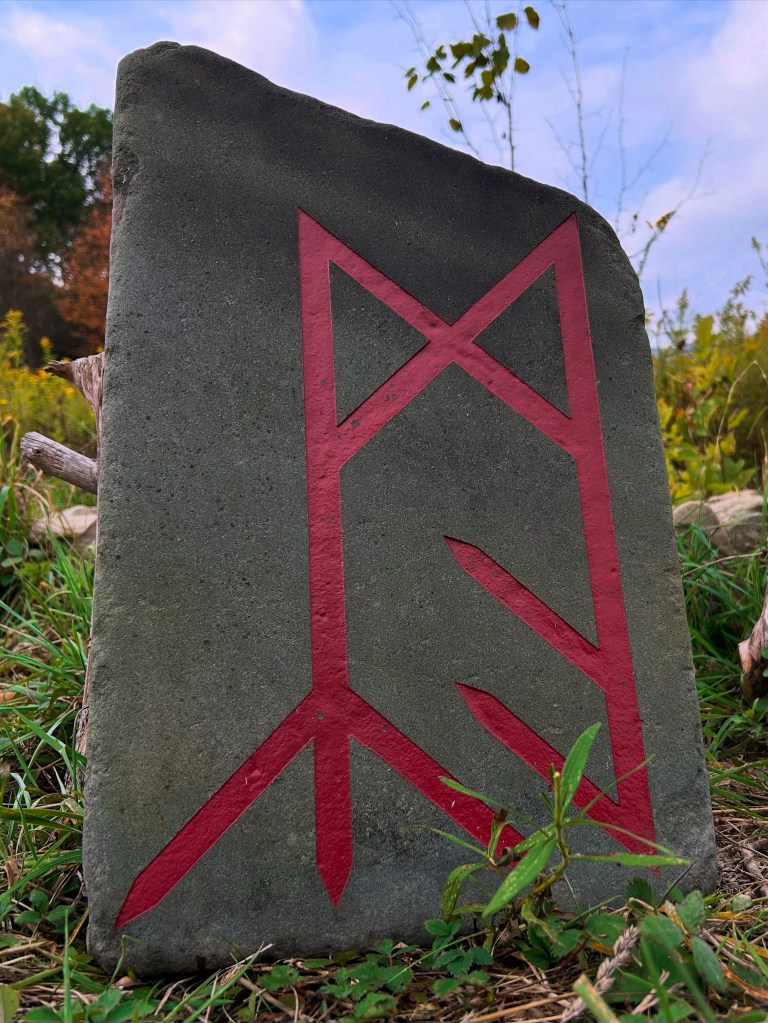
Eihwaz is a rune of life, death, rebirth, endurance, strength, and the eternal cycle of change. This rune represents the Axis Mundi, the metaphysical center of the world. In the Germanic tongues, this would have gone by the name Irminsul, Donar’s Oak, or Yggdrasil, and represented the great World Tree of Pagan cosmology. This tree was believed to connect all the realms of existence, resembling the “shamanistic” cultures of Eurasia, associating it with Odin’s magical abilities and techniques. These practices allow him to travel as he pleases around the 9 different worlds of the cosmos, linked together by the great World Tree. The word Yggdrasil gives us this clue, as ygg(r) means “terrible one” and drasil means “steed,” reading something like “The Steed of the Terrible One.” This alludes to Odin’s ability to use this tree (or pillar) to travel outside of himself.
When looking at the rune poems, we only have one which speaks of Eihwaz directly, as the other two poems invoke the rune Ýr instead, connecting it more so to the previously mentioned Yggdrasil. The “Old English Rune Poem” states:
“Yew is on the outside an unsmooth tree,
Hardy and earth-fast, fire’s keeper,
Under-rung by its roots, best on the estate.”
This poem has a mysterious tone to it, although objective in its observation. The ancient Yew trees of the UK are highly impressive giants to behold, reaching back in time over 2000 years in some cases. These trees, like the first line says, are quite “lumpy” and gnarled, having many twists and turns. It isn’t hard to imagine why our ancestors used this tree to represent so much in their lives, as its immense canopy and knotted sprawl resembles the growth of family “trees” and essentially all concepts that seem to “branch” or “stem” from one another. The second line alludes to the endurance that Yew trees exhibit, boasting long life spans. The last line pertains to these trees having wild and intense root systems. This would make them “best on the estate,” as the Yew has a fairly slim chance of being knocked down by wind or storm.
It must be noted that while the Anglo-Saxon runes do include Eihwaz under the name ēoh, which means “Yew,” they also include another rune in their Futhorc; the rune Ýr (ᚣ), which distinctly means “Yew bow.” It is strange that the Anglo-Saxon Futhorc retains the original Eihwaz rune while also incorporating the Younger Ýr rune as well. This, to me, does indicate a significant difference in the two runes, and perhaps any attribution to bows and arrows may be strictly given to the Ýr rune, while the Eihwaz rune retains a predominant symbol of the World Tree: life, death, and rebirth.
My theory is that the Anglo-Saxons had, by this time, new geographical associations with the runes. Once they got to England, they must have been in total awe of the Yew trees. Either this, or they noticed how their Celtic adversaries/neighbors held this tree in high regard. We can see evidence for this connection in the Proto-Celtic word iwos, meaning “yew.” Perhaps these mighty Yew trees were not as common or prominent as was the Oak or other sacred trees on the continent. I believe evidence for this can be found in the absence of any word for “Yew” in the Gothic language, enforcing the Celtic influence on this word and rune. In its original form, Eihwaz would have likely been associated with the Oak, as in Gothic, the work aik means “Oak.” Not only this, but the root word eih, in Old High German, also means “Oak.” We can assume this rune came from the East, and not the West, therefor, the word Eihwaz would have most likely been a formal name for the Oak. When looking for past reference to Indo-European World Trees, the Oak is by far the most frequently described, with other minor references to Birch, Beech, Apple, Olive, and certain types of Evergreens; in this case, most notably the Yew.
The Younger runes of the North would later evolve in connection with these older runes, invoking again the infamous Yew tree. Although, their Futhorc would no longer contain the Eihwaz (ᛇ) rune. Instead, they carry over only the Ýr rune in the form of (ᛣ), associating it more directly with the Yew tree. The “Old Norwegian Rune Rhyme” states:
“Yew is the winter-greenest of trees,
It is wont for what burns to singe.”
This poem invokes the “evergreen” concept, which in the Pagan north was a symbol of eternal life. This is one reason for the incorporation of the “Yule Tree” in the winter customs, as it was a sacred reminder of beauty, life, and strength. The second line, I believe, is referring to its excellent quality as firewood, as Yew wood has been said to burn the brightest. We have no mention of bows here, so it must have been more-so acquainted with hearth-fire, life, and hope.
Lastly, the “Old Icelandic Rune Poem” gives us another angle to view this rune, in connection to the death of Baldr. It is said:
“Yew is a bended bow,
and iron eager to break,
and an etin’s arrow.”
Here, we first see mention of the bow. As stated before, the Yew was among the top choices, if not the best choice for bow making in the Heathen north. Therefore, Eihwaz / Ýr can be associated with bows, arrows, and archery. It has been theorized that this can also relate to “tension,” as the pulled bow string is very tense and holds a lot of energy within it. This, some say, can be associated with death when life’s energy is finally released. The last line can without doubt be associated with the events surrounding the death of Baldr. Baldr is killed (technically) by the etin (giant) Loki’s arrow/dart made of mistletoe, something that grows on various trees and was of a highly medicinal and magical use in the north. Of course, it is the blind god Höðr who throws the dart, but it was Loki who planned the act. This story can be found in Gylfaginning in Snorri’s “Prose Edda.”
In conclusion, we can see that Eihwaz is connected to the primordial World Tree of the European peoples, whether in the form of the Oak, the Yew, or any other tree that our ancestors venerated as a sacred center. Its association to eternal life, death, rebirth, and endurance can be seen in the symbolism of the evergreen; the ancient symbol of everlasting existence. We’ve also uncovered direct evidence concerning the possibility that this rune was originally a symbol of the Oak tree, as this was the most sacred tree cross-culturally amongst ancient Europeans, being idolized extensively from Ireland to Finland, Portugal to Greece. The Oak was the main representation of the World Tree cosmology. Therefore, this rune can not only take the meaning of “Yew,” but also of “Oak.” This, to me, would all depend on the geography surrounding the one using the runes.
-Wandering the Runic Path: Esoteric Analysis of the Germanic Runes
Jera marks the midway point of the Elder Futhark, meaning “year” or “season” in Proto-Germanic. This word is the ancestor of our own English word year, representing the time it takes the Earth to make a full rotation around the Sun. Jera is associated with rewards, harvests, and seasonal cycles; representing the time when we get to reap what we have sown. Many attribute this rune to the fall when our ancestors would celebrate the fruitful year and bountiful harvests. We can also attribute sacrifice and the blood of slain livestock to this rune, as this is the time animals were killed in preparation for winter.
In Old Norse, this rune/word is called ár (ᛅ), meaning “year, abundance, plenty.” This rune, according to the “Old Norwegian Rune Rhyme,” is associated directly with the god Fróði, another epithet of Freyr, stating:
“Harvest tide is a blessing to men;
I know that Fróði was openhanded.”
Fróði was a mythical king of the Danes who was associated with prosperity and a golden age of peace. Many have theorized this is just another name for Freyr, who we can feel comfortable associating this rune with. The poem directly invokes harvests and blessings, enforcing our connection of Jera with autumn and the gods of plenty.
In Old English this rune is called ġēr, which also means “year.” In the “Old English Rune Poem,” it is stated:
“Harvest is the hope of men, when God allows,
Heaven’s holy king, the earth to bring forth
Bright fruits for both nobleman and needy.”
Here it shows that these early Anglo-Saxon Christians associated the harvest with God’s blessing, even stating that he “allows” the earth to bear fruit. This poem shows how much the world view was different by this point, as the “Earth Mother” concept had already been diminished in favor of monotheism. All powers over fate were now in God’s hands.
The “Old Icelandic Rune Poem” has a light tone to it, stating:
“Bounty is a boon for men,
and a splendid summer,
and a full-green field.”
This poem invokes relaxing and rewarding images; those of green fields and grand summers. Again, we see hints of harvests and fall, the time after summer when we reap our benefits. Lastly, we have the “Early Modern Swedish Rune Poem,” where one simple line clarifies yet again that this rune is associated with the harvest.
“Harvest is when leaf is longest.”
When approaching this specific piece, I was already convinced and aware of its previously mentioned associations. However, when digging deeper into the word and its origins, I was given yet another angle to view this rune from. The Proto-Indo-European root word yóh₁r̥ means “year” but also “spring,” opening another doorway into the Jera rune. This has further evidence in the Proto-Slavic jaro which means “spring.” One last word I found relevant was the Ancient Greek hṓrā, meaning “any defined period of time, season, year, hour,” but also, meaning “youth” or “the springtime of life.” Of course, we can see now this is where we get the English word and concept of the hour. With this evidence, we can attribute the very notion and phenomenon of “time” to Jera.
When I began to think about Jera as being also a “spring” rune, I first looked at its form. When looking at Jera, one could argue they were seeing two Kenaz (ᚲ) runes facing each other, or in other words, two fires. This brought forth images of the Celtic Beltane festival of May, where cattle and other livestock were driven between two fires to ward off bad luck, disease, and any other ill omens that may affect their year. This perhaps links this rune in someway to this Celtic festival, who their Germanic neighbors would have certainly been familiar with. However, when looking for etymological links to any Celtic language and the word jera, there was nothing to connect them together, that is, until exploring further the Ancient Greek hṓrā.
In Middle Irish we have the related word úar which means “hour, time, occasion,” but in Old Irish meant simply, “cold.” This can be applied to many times of year, however, and may not allude to spring or fall in particular. Another reference I thought was interesting was via the Latin word hornus, meaning “grown this year, this year.” This, to me, reflects the Proto-Germanic word hurnaz, which means “horn.” This horn is symbolized by the antler, which first begins to grow between late winter and spring. Thus, we can see how this rune can be applied to this pivotal time of year. This can also connect Jera to the mythical “Horn of Plenty” from the myths of the Mediterranean, representing the blessings of profusion.
Jera is a rune that reminds us of the cycle we are a part of, as spring and fall are transitional periods. These are times when temperatures, lifestyles, and priorities are changing; Jera as the “year” rune embodies these recurring and sentimental times of year that humans have grown so familiar with. Jera reminds us that we are locked in a cycle, one that exists inside as much as outside. In fact, the “outside” (cosmos, matter, nature) was often viewed as the mirror of our “inside” (spirit, consciousness, awareness) for most ancient peoples. This is best summarized by the old phrase “as above, so below.”
With Jera we are given another of the so-called “Odin’s 9” runes, meaning a rune that does not have alternative energies. Jera is existing in a constant state, endless and infinite. This can be attributed to Odin, as he is the current within all that breathes. He is the god of breath, the force of life. Jera can also be associated with the Sun and Moon, which have been said to be the eyes of Odin.
To conclude, when we approach the Jera rune, we are given images of the Sun, healthy fields, harvests, livestock, and an awareness of the seasonal cycle. We can feel confident in using this rune as a representation of not only fall, but spring as well. Jera represents rewards and growth; the reaping of wealth from the Earth. Jera can be associated with the wheel and with the cosmos, as well as with time and seasonal bonfires. The Jera rune marks the halfway point in our journey through the Elder Futhark runes, a perfect metaphor for this pivotal moment.
-Wandering the Runic Path: Esoteric Analysis of the Germanic Runes
Sowilo is the rune of the Sun. In nearly all Indo-European languages, you will find this word in some form, all originating from the Proto-Indo-European root sóh₂wl̥, meaning “Sun.” This cosmic body represents one of humanities oldest “gods” or divinities, being associated with power, glory, triumph, health, and life. In most Germanic cultures, the Sun was viewed as a goddess, while the Moon represented a god. In the North, this goddess went by the name of Sunna (Sun) and was drawn across the sky by a chariot, chased by the great wolf Sköll (treachery). In other cultures, such as Greek, the Sun was viewed as masculine, residing under the name Hḗlios, which means “Sun, east, day, and sunshine.”
In Latin and in Old Norse, the word for the Sun deified is sól/sōl. The difference is in gender association, as the Roman Sun-god was masculine and the Norse Sun-god(dess) was female in nature. In ancient Vedic, Persian, and Celtic culture, the Sun-god was revered as a masculine force under the various names of (Sanskrit) Surya, (Persian) Mithra, or (Celtic) Lugh. In the Baltic region, we find the Sun revered as goddess under the name Saule, representing the Sun, life and fertility.
When looking at the rune poems, we get a glimpse into common cross-cultural themes surrounding this rune. We see words like “hope, steer, light, holy, shield, and glory” arise, bestowing upon this rune many positive and powerful connotations. The “Old English Rune Poem”
“Sun for seamen is ever a source of hope,
When they ferry over the fish’s bath,
Until they steer their surf-steed to land.”
This poem alludes to sailors and the act of faring across the sea. Sun is “hope” on these voyages, guiding us across the seas as the ancient golden compass. In the gloomy North, they used mysterious “sun-stones” for guidance under the Icelandic name sólarsteinn. These were used for navigation and direction, as they were able to detect sunlight even through the clouds. This was their only means of navigation across the dark northern sea or landscape, pointing them in the right direction whether they could see the Sun or not. Until the voyage was complete, one relied on the sign of the Sun.
In reference to the word “sign,” we can look to another name for this rune in Old English, that being siġel, meaning “Sun.” This word would later evolve into our modern English word sigil, meaning “occult sign, seal, signature, pattern, symbol or design.” This, I believe, references the purely metaphysical and symbolic aspect of this rune, as the Sun is one of humanities oldest symbols, found cross culturally in the form of the wheel or swastika.
In the “Old Norwegian Rune Rhyme,” it is said:
“Sun is the lands’ light;
I bow to holy judgement.”
We see this poem take a more “terrestrial” tone, referring to the Sun more objectively as “land’s light.” The light-side of Sowilo is on the forefront here, echoed further in the second line, as one can clearly see the connotations held in the poem. The Sun is viewed as holy; a divine being able to bestow judgement upon man. This “bowing” to the Sun can be found in Armanen rune yoga and in varying names for the Sowilo rune in later Icelandic sources. One name is kné sýn, translating to “knee-sun,” referring to bowing or praying to the Sun.
The “Old Icelandic Rune Poem” states:
“Sun is the shield of the clouds, and gleaming glory,
And ice’s age-old anguish.”
This poem touches on many elements and aspects of life, the first being Sun as a “shield” to the clouds. This rings strangely, as the Sun resides over the clouds, giving insight into what the Pagan Icelanders thought they needed to be shielded from; perhaps enemies from above? Line two holds similar meaning to the other poems, linking the powers of glory to the Sun. The last line describes the destructive powers of the Sun, referencing it as the “age-old” anguish of ice, a nod to the myth of creation, where fire and ice collided to create the known universe.
In relation to Odin, this rune can be viewed as his “lighter” side, being attributed to his retained eye; the “solar” awareness. Evidence for this can be found in his epithet Báleygr, meaning “flaming eyed.” This type of philosophy can be found further in the Old Irish word súil, which means “eye, hope, expectation,” but also, is a reference to the Sun as well, as the Old Irish believed the Sun to be the “eye of the sky.” One last word-connection to Odin and the Sun is the word solitary, stemming from this sol- root, meaning “one who lives alone in solitude.” This can absolutely be attributed to the Sun, which is a solitary being, but also to Odin, as he is the solitary wanderer, ever-moving like the wind. Sowilo falls under the rule of “Odin’s 9” as well, having the same form whether upside down or right side up. I leave the reader to decide the importance of that connection.
This holy power of the Sun is one of healing, but also, as one can learn from the Thursatru tradition, is a power of cataclysmic destruction. In their tradition, Sowilo represents the fire-sword of Surt, guardian of Muspelheim: the primordial realm of fire. This force of fire is distinct in power when compared to the other fire rune, Kenaz. Sowilo is the ultimate force of cosmic fire and not the metaphysical, inner fires of creation. Sowilo is rather the inward and outward powers of destruction. This destructive energy does not necessarily carry negative connotations, but holy ones; the purifying and purging force of fire. At the end of Ragnarök, Surt will cover the earth in flames and all will be destroyed. However, the offspring of the gods return, Baldr at their helm, as a symbol of the reborn son/Sun. This cycle is mirrored in many traditions, as a constant flux and flow between creation and destruction.
To conclude, the Sowilo rune applies not only to the Sun, but also, conceptions of glory, guidance, sanctity, hope, and light. On a deeper level, it can be used to vanquish impurities and clean slates, representing a purifying, holy, cosmic fire or shield. The Sun and Moon have been viewed as gods for as long as mankind has been able to name them, representing core functions of not only the physical structure of the world, but the structure of sentient beings as well, being linked intrinsically to one another; the holy light of Heaven above and the holy light within man.
-Wandering the Runic Path: Esoteric Analysis of the Germanic Runes
 Ansuz Society