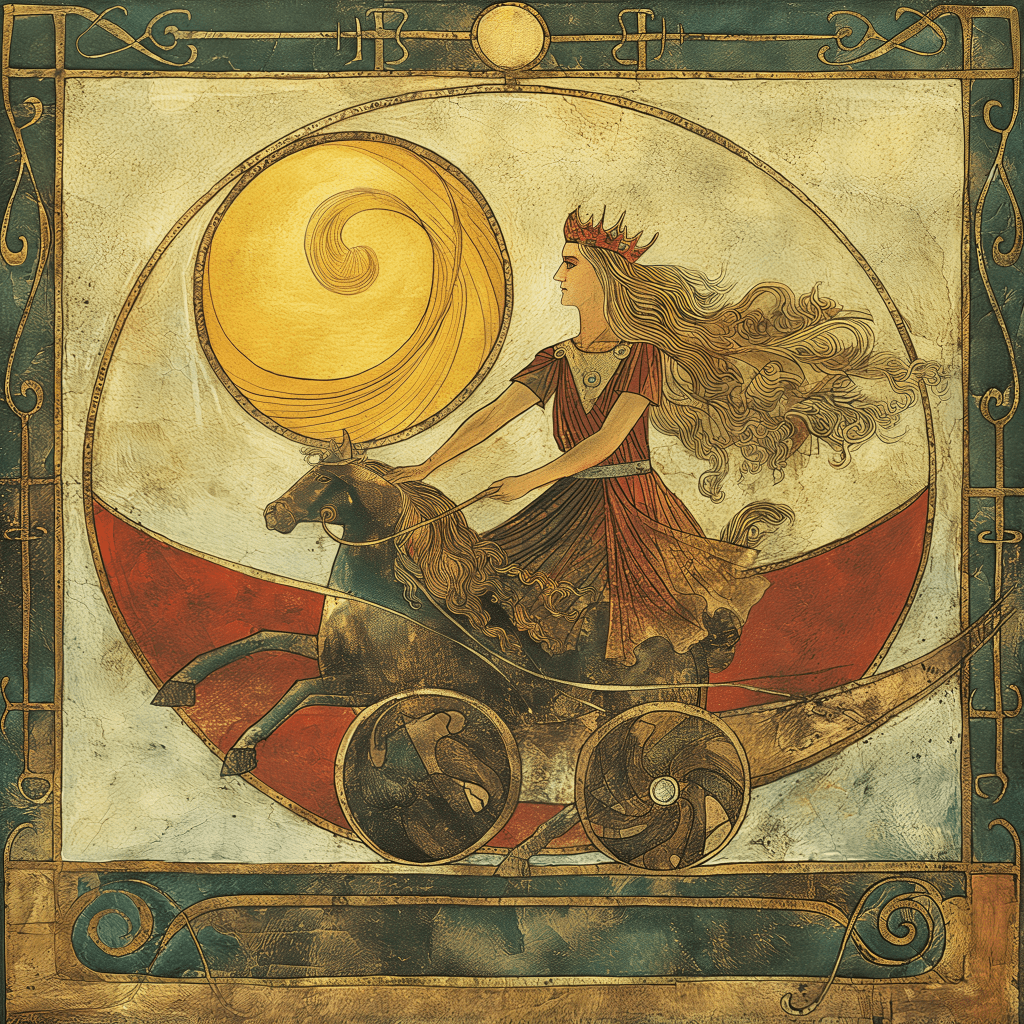
Samhain/Álfablót

Samhain is a time when the spirits of nature, the dead, and the gods are most likely to emerge to interact with the living. During these days, when daylight becomes shorter and shorter, nature around us seems to die and shed its vitality, leaving stalks, trunks and branches barren, resembling bones protruding from the soil. This is a time when we are meant to shift our focus from outdoors to indoors and shed our dead weight from the previous year, like the trees shed their leaves. By doing this, we are mirroring the process of nature and turning our energy inward. With Samhain come the final harvests, meaning that soon the workload will be drastically cut down and many daily activities will change. This time is to now be replaced with indoor tasks such as tending to animal pens, preserving food, repairing tools, spiritual practice, and performing various crafts such as woodworking, writing, or blacksmithing.

It is customary to make offerings to the deities, ancestors, and wandering spirits during this time in order to receive their favors, blessings, and good luck. We please the spirits to avoid their wrath. We offer to the ancestors to uphold family honor. We give our veneration to the gods to gain their power and visage. By performing rituals during this particular time of year, one enables themselves to better access various forces and gain insight into the past, future, and matters regarding cause and effect within the present which will aid one’s progress moving forward.

In “A History of Pagan Europe” by Jones & Pennick, they write:

“Samhain (1 November). This was the most important festival of the year, showing the pastoralist, rather than agricultural, origin of the calendar. Samhain was the end of the grazing season, when flocks and herds were collected together, and only the breeding stock set aside from slaughter. It was a time of gathering-together of the tribe at their ritual centre for rituals of death and renewal, dedicated to the union of the tribal god (in Ireland, the Daghda) with a goddess of sovereignty, the Morrigan, or, more localised, Boann, deity of the River Boyne.”

As the last of the great harvests, Samhain brings reward and celebration, the end of one year and the transition into the next. According to many European tribes, Samhain marked the turning point between the years and represented the New Year celebration of their cultures. With Samhain we descend into “night,” resembling the womb of the goddess or the abode in which she resides. The goddess reigning over this time of year was almost always in the form of a grim, fate-controlling hag or crone, such as Hel, Frau Holle, or the Morrigan.

In “Celtic Mythology and Religion,” Macbain writes:

“Equal to Beltane in importance was the solemnity of Hallowe’en, known in Gaelic as Samhuinn or ‘summerend.’ Like Beltane it was sacred to the gods of light and of earth; Ceres, Apollo, and Dis also, must have been the deities whose worship was honoured. The earth goddess was celebrated for the ingathering of the fruits; Apollo or Belinus and Proserpine were bewailed for their disappearing from earth, and Dis, who was god of death and winter’s cold, and who was especially worshipped by the Celts, as Caesar says, was implored for mercy, and his subjects, the manes of the dead, had special worship directed to them. It was, indeed, a great festival—the festival of fire, fruits, and death.”

In reference to Norse and Germanic paganism, we see the worship of elves and land spirits was also common during this time. In modern Germanic paganism, many people celebrate Samhain under the name Álfablót (Elf Sacrifice), which is when harvests are reaped and sacrifices are made to the elves and gods. Elves and the dead are strongly connected to the ancient burial mounds of the Pagans, therefore, much of the activity surrounding this festival would have likely involved distributing offerings to the gods and conducting sacrifices directly upon the mound (or grave) of the dead. This is where the elves were thought to reside.

In our own Samhain/Álfablót practice, the fair-weather god Freyr, king of the elves, is given one last celebration of reverence, being the center focus of the rites and rituals of the two-day celebration. He is invoked and offered substantial food and drink, as well as prayers and songs, showing devotion and thanks to the spirits and deities of abundance and prosperity. The event begins on the last day of October (Halloween) and ends the night of November 1st, when Freyr is returned to his resting place until the first of May. This cycle is reflected in “Myths and Symbols in Pagan Europe,” where Davidson writes:

“He [Freyr] is said to have brought good seasons and prosperity to the land, and so when he died the Swedes brought great offerings to his mound, and believed that he remained alive and potent in the earth. The connection which seems to exist between Freyr and the elves and land-spirits thus provides an additional reason to associate them with the dead in their graves.”

Because of these associations, we place the death and rebirth of Freyr (the power of good weather and abundance) within this span of time (Nov 1-May 1). However, this is not the only way to do things nor is it recommended to everyone, as how one celebrates these sacred events revolves much around one’s lifestyle, geography, deity devotion, and overall means. For us in Western New York, this timeline coincides seamlessly with the natural cycle of the weather, and therefore is easy to follow. For those in a different climate or location, this may not make as much sense, and it is recommended to follow the patterns around you regarding these things.

In “Sorcery and Religion in Ancient Scandinavia,” Vikernes gives us further examples pertaining to the Nordic new year and pre-Christian Halloween customs. He writes:

“The first holiday of the year was New Year’s Day, better known in English as Halloween (“initiation evening”), and in Gaelic as Samhain (“summer’s end”). The sorcerers and later the gods (i, e. religious kings) and their challengers dressed up as different creatures with access to the realm of the dead. They fasted and hung their clothes in a tree or the gallows, to make it look as if they had hanged themselves. They wounded themselves with a spear, to bleed, smeared ash or white mud all over their bodies to look like the dead, they put on masks and sacrificed a cow or an ox on the grave mound, so that the blood poured down and into the grave underneath; into the realm of the dead. They then blew a horn, in the Bronze Age a lure, to open up the entrance to the realm of the dead. They then travelled into hollow trees, caves in the mountain, holes in the ground, or more commonly into the burial mounds. These were all seen as entrances to the realm of the dead. Inside, in the darkness of the grave, a woman was waiting for them, sprinkled in the sacrificed animal’s blood and dressed like the queen of death. They then took at least some of the objects their dead forebears had been buried with and brought them back out.”

As we can see, Samhain (or Álfablót) type celebrations were not only distinct to Celtic and Germanic culture, but rather appear as a pan-European tradition representing a celebration of the dead, the ancestors, and the final harvests of the year. It is clear that no matter which form of paganism(s) one practices, the celebration and event known to us now as Halloween is of very ancient and sacred importance. Not only as a transitional period between the seasons, but as a time when it was believed to be easiest to pierce the veil between dimensions and interact with beings outside of our normal cognition. It is because of the superstitions and Pagan worldviews of the past that we have many (if not all) of our current yearly celebrations in the West.

Jera ᛃ

Jera marks the midway point of the Elder Futhark, meaning “year” or “season” in Proto-Germanic. This word is the ancestor of our own English word year, representing the time it takes the Earth to make a full rotation around the Sun. Jera is associated with rewards, harvests, and seasonal cycles; representing the time when we get to reap what we have sown. Many attribute this rune to the fall when our ancestors would celebrate the fruitful year and bountiful harvests. We can also attribute sacrifice and the blood of slain livestock to this rune, as this is the time animals were killed in preparation for winter.

In Old Norse, this rune/word is called ár (ᛅ), meaning “year, abundance, plenty.” This rune, according to the “Old Norwegian Rune Rhyme,” is associated directly with the god Fróði, another epithet of Freyr, stating:

“Harvest tide is a blessing to men;

I know that Fróði was openhanded.”

Fróði was a mythical king of the Danes who was associated with prosperity and a golden age of peace. Many have theorized this is just another name for Freyr, who we can feel comfortable associating this rune with. The poem directly invokes harvests and blessings, enforcing our connection of Jera with autumn and the gods of plenty.

In Old English this rune is called ġēr, which also means “year.” In the “Old English Rune Poem,” it is stated:

“Harvest is the hope of men, when God allows,

Heaven’s holy king, the earth to bring forth

Bright fruits for both nobleman and needy.”

Here it shows that these early Anglo-Saxon Christians associated the harvest with God’s blessing, even stating that he “allows” the earth to bear fruit. This poem shows how much the world view was different by this point, as the “Earth Mother” concept had already been diminished in favor of monotheism. All powers over fate were now in God’s hands.

The “Old Icelandic Rune Poem” has a light tone to it, stating:

“Bounty is a boon for men,

and a splendid summer,

and a full-green field.”

This poem invokes relaxing and rewarding images; those of green fields and grand summers. Again, we see hints of harvests and fall, the time after summer when we reap our benefits. Lastly, we have the “Early Modern Swedish Rune Poem,” where one simple line clarifies yet again that this rune is associated with the harvest.

“Harvest is when leaf is longest.”

When approaching this specific piece, I was already convinced and aware of its previously mentioned associations. However, when digging deeper into the word and its origins, I was given yet another angle to view this rune from. The Proto-Indo-European root word yóh₁r̥ means “year” but also “spring,” opening another doorway into the Jera rune. This has further evidence in the Proto-Slavic jaro which means “spring.” One last word I found relevant was the Ancient Greek hṓrā, meaning “any defined period of time, season, year, hour,” but also, meaning “youth” or “the springtime of life.” Of course, we can see now this is where we get the English word and concept of the hour. With this evidence, we can attribute the very notion and phenomenon of “time” to Jera.

When I began to think about Jera as being also a “spring” rune, I first looked at its form. When looking at Jera, one could argue they were seeing two Kenaz (ᚲ) runes facing each other, or in other words, two fires. This brought forth images of the Celtic Beltane festival of May, where cattle and other livestock were driven between two fires to ward off bad luck, disease, and any other ill omens that may affect their year. This perhaps links this rune in someway to this Celtic festival, who their Germanic neighbors would have certainly been familiar with. However, when looking for etymological links to any Celtic language and the word jera, there was nothing to connect them together, that is, until exploring further the Ancient Greek hṓrā.

In Middle Irish we have the related word úar which means “hour, time, occasion,” but in Old Irish meant simply, “cold.” This can be applied to many times of year, however, and may not allude to spring or fall in particular. Another reference I thought was interesting was via the Latin word hornus, meaning “grown this year, this year.” This, to me, reflects the Proto-Germanic word hurnaz, which means “horn.” This horn is symbolized by the antler, which first begins to grow between late winter and spring. Thus, we can see how this rune can be applied to this pivotal time of year. This can also connect Jera to the mythical “Horn of Plenty” from the myths of the Mediterranean, representing the blessings of profusion.

Jera is a rune that reminds us of the cycle we are a part of, as spring and fall are transitional periods. These are times when temperatures, lifestyles, and priorities are changing; Jera as the “year” rune embodies these recurring and sentimental times of year that humans have grown so familiar with. Jera reminds us that we are locked in a cycle, one that exists inside as much as outside. In fact, the “outside” (cosmos, matter, nature) was often viewed as the mirror of our “inside” (spirit, consciousness, awareness) for most ancient peoples. This is best summarized by the old phrase “as above, so below.”

With Jera we are given another of the so-called “Odin’s 9” runes, meaning a rune that does not have alternative energies. Jera is existing in a constant state, endless and infinite. This can be attributed to Odin, as he is the current within all that breathes. He is the god of breath, the force of life. Jera can also be associated with the Sun and Moon, which have been said to be the eyes of Odin.

To conclude, when we approach the Jera rune, we are given images of the Sun, healthy fields, harvests, livestock, and an awareness of the seasonal cycle. We can feel confident in using this rune as a representation of not only fall, but spring as well. Jera represents rewards and growth; the reaping of wealth from the Earth. Jera can be associated with the wheel and with the cosmos, as well as with time and seasonal bonfires. The Jera rune marks the halfway point in our journey through the Elder Futhark runes, a perfect metaphor for this pivotal moment.

-Wandering the Runic Path: Esoteric Analysis of the Germanic Runes

Summer Solstice/Midsummer

Subscribe to continue reading

Subscribe to get access to the rest of this post and other subscriber-only content.

Summer Solstice/Midsummer

The Summer Solstice is the time of year when the daylight is longest, the power of the Sun is at its peak, and the solar cycle reaches its apex, tipping the scales towards the dark half of the year once again. After this turning point, the sunlight begins to wane, shortening the daylight minute by minute until the Winter Solstice. Typically, this was a time to celebrate the Sun, spend time outdoors, and enjoy the bliss of good weather. Mead, wine, and other beverages would be consumed, and great feasts would be enjoyed.

In “Teutonic Mythology” by Grimm, it is said:

“Twice in the year the sun changes his course, in summer to sink, in winter to rise. These turning-points of the sun were celebrated with great pomp in ancient times, and our St. John’s or Midsummer fires are a relic of the summer festival. The higher North, the stronger must have been the impression produced by either solstice, for at the time of the summer one there reigns almost perpetual day, and at the winter one perpetual night.”

Games and various competitions would be hosted along with other festivities such as dancing and music. Entertainment would be lively and abundant, encouraging joy and merriment among the community. In the Germanic context, many people honor the god Baldr during this time as a god of light and/or personification of the light of the Sun, which in a mythological context, “dies” and beings to decline after this time, mirrored by Baldr’s death and descent into Hel. Because of these connections, a common blot/ritual focus during the Summer Solstice is the death (or funeral) of Baldr, the god of light. Stone ships are erected, abundant offerings are made, and various sacrificial items are thrown into fire. These offerings are meant to aid Baldr in his journey on the long road of the underworld.

In “Celtic Mythology and Religion” by Macbain, he says:

“The midsummer festival, christianised into St John’s Eve and Day, for the celebration of the summer solstice, is not especially Celtic, as it is a Teutonic, feast. The wheels of wood, wrapped round with straw, set on fire, and sent rolling from a hillock summit, to end their course in some river or water, which thus typified the descending course of the sun onward till next solstice, is represented on Celtic ground by the occasional use of a wheel for producing the tinegin, but more especially by the custom in some districts of rolling the Beltane bannocks from the hill summit down its side. Shaw remarks – “They made the Deas-sail [at Midsummer] about their fields of corn with burning torches of wood in their hands, to obtain a blessing on their corn. This I have often seen, more, indeed, in the Lowlands than in the Highlands. On Midsummer Eve, they kindle fires near their cornfields, and walk round them with burning torches.” In Cornwall last century they used to perambulate the villages carrying lighted torches, and in Ireland the Eve of Midsummer was honoured with bonfires round which they carried torches.”

Large bonfires and “Sun-wheels” are made during this time, reflecting the power and glory of the Sun. Special attention was given to the goddess during this time as well, whether as a deification of the Sun itself, the Earth, the Mother, or a mix of the 3. Offerings such as flowers, cakes, milk, honey, and blood are given to the gods and spirits, a ritual exchange of abundance for abundance. As observed in the above quote, it was (and is) common practice to bring the energy of the Sun down to Earth in the form of a torch, then parade it through the fields, groves, or temples in order to bless them with this powerful energy.

In “A History of Pagan Europe” by Jones & Pennick, it says:

“…But the summer solstice, under its statutory date of 25 June, became a popular festivity early in Germanic history. The German word Sonnenwende always refers, in medieval texts, to the summer solstice, not to the winter solstice. At the end of the first century CE some German troops in the Roman army at Chesterholme listed their supplies for the celebration in a record which has come down to us. In the early seventh century, Bishop Eligius of Noyon in Flanders criticised the chants, carols and leaping practised by his flock on 24.”

Here we are given examples of some ancient Germanic practices revolving around the Summer Solstice. We are told of singing, chanting, and competitive games like “leaping”. Clearly, the Christian Romans were disturbed by this revelry, showing its clear Pagan origins. This turning point in the year was extremely important to observe, as it strikes a pivotal moment in the Sun’s lifecycle, affecting every aspect of our lives.