
Subscribe to continue reading
Subscribe to get access to the rest of this post and other subscriber-only content.

Subscribe to get access to the rest of this post and other subscriber-only content.
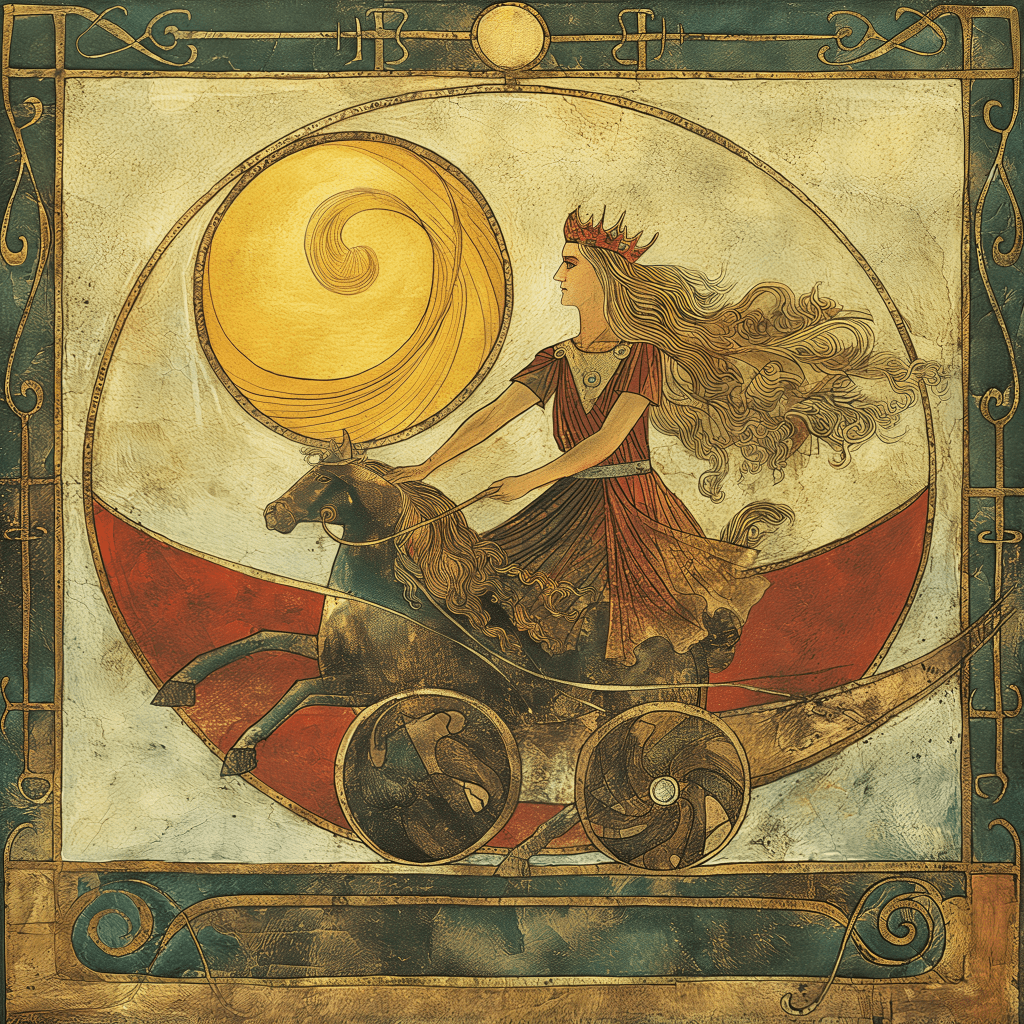
Sowilo is the rune of the Sun. In nearly all Indo-European languages, you will find this word in some form, all originating from the Proto-Indo-European root sóh₂wl̥, meaning “Sun.” This cosmic body represents one of humanities oldest “gods” or divinities, being associated with power, glory, triumph, health, and life. In most Germanic cultures, the Sun was viewed as a goddess, while the Moon represented a god. In the North, this goddess went by the name of Sunna (Sun) and was drawn across the sky by a chariot, chased by the great wolf Sköll (treachery). In other cultures, such as Greek, the Sun was viewed as masculine, residing under the name Hḗlios, which means “Sun, east, day, and sunshine.”
In Latin and in Old Norse, the word for the Sun deified is sól/sōl. The difference is in gender association, as the Roman Sun-god was masculine and the Norse Sun-god(dess) was female in nature. In ancient Vedic, Persian, and Celtic culture, the Sun-god was revered as a masculine force under the various names of (Sanskrit) Surya, (Persian) Mithra, or (Celtic) Lugh. In the Baltic region, we find the Sun revered as goddess under the name Saule, representing the Sun, life and fertility.
When looking at the rune poems, we get a glimpse into common cross-cultural themes surrounding this rune. We see words like “hope, steer, light, holy, shield, and glory” arise, bestowing upon this rune many positive and powerful connotations. The “Old English Rune Poem”
“Sun for seamen is ever a source of hope,
When they ferry over the fish’s bath,
Until they steer their surf-steed to land.”
This poem alludes to sailors and the act of faring across the sea. Sun is “hope” on these voyages, guiding us across the seas as the ancient golden compass. In the gloomy North, they used mysterious “sun-stones” for guidance under the Icelandic name sólarsteinn. These were used for navigation and direction, as they were able to detect sunlight even through the clouds. This was their only means of navigation across the dark northern sea or landscape, pointing them in the right direction whether they could see the Sun or not. Until the voyage was complete, one relied on the sign of the Sun.
In reference to the word “sign,” we can look to another name for this rune in Old English, that being siġel, meaning “Sun.” This word would later evolve into our modern English word sigil, meaning “occult sign, seal, signature, pattern, symbol or design.” This, I believe, references the purely metaphysical and symbolic aspect of this rune, as the Sun is one of humanities oldest symbols, found cross culturally in the form of the wheel or swastika.
In the “Old Norwegian Rune Rhyme,” it is said:
“Sun is the lands’ light;
I bow to holy judgement.”
We see this poem take a more “terrestrial” tone, referring to the Sun more objectively as “land’s light.” The light-side of Sowilo is on the forefront here, echoed further in the second line, as one can clearly see the connotations held in the poem. The Sun is viewed as holy; a divine being able to bestow judgement upon man. This “bowing” to the Sun can be found in Armanen rune yoga and in varying names for the Sowilo rune in later Icelandic sources. One name is kné sýn, translating to “knee-sun,” referring to bowing or praying to the Sun.
The “Old Icelandic Rune Poem” states:
“Sun is the shield of the clouds, and gleaming glory,
And ice’s age-old anguish.”
This poem touches on many elements and aspects of life, the first being Sun as a “shield” to the clouds. This rings strangely, as the Sun resides over the clouds, giving insight into what the Pagan Icelanders thought they needed to be shielded from; perhaps enemies from above? Line two holds similar meaning to the other poems, linking the powers of glory to the Sun. The last line describes the destructive powers of the Sun, referencing it as the “age-old” anguish of ice, a nod to the myth of creation, where fire and ice collided to create the known universe.
In relation to Odin, this rune can be viewed as his “lighter” side, being attributed to his retained eye; the “solar” awareness. Evidence for this can be found in his epithet Báleygr, meaning “flaming eyed.” This type of philosophy can be found further in the Old Irish word súil, which means “eye, hope, expectation,” but also, is a reference to the Sun as well, as the Old Irish believed the Sun to be the “eye of the sky.” One last word-connection to Odin and the Sun is the word solitary, stemming from this sol- root, meaning “one who lives alone in solitude.” This can absolutely be attributed to the Sun, which is a solitary being, but also to Odin, as he is the solitary wanderer, ever-moving like the wind. Sowilo falls under the rule of “Odin’s 9” as well, having the same form whether upside down or right side up. I leave the reader to decide the importance of that connection.
This holy power of the Sun is one of healing, but also, as one can learn from the Thursatru tradition, is a power of cataclysmic destruction. In their tradition, Sowilo represents the fire-sword of Surt, guardian of Muspelheim: the primordial realm of fire. This force of fire is distinct in power when compared to the other fire rune, Kenaz. Sowilo is the ultimate force of cosmic fire and not the metaphysical, inner fires of creation. Sowilo is rather the inward and outward powers of destruction. This destructive energy does not necessarily carry negative connotations, but holy ones; the purifying and purging force of fire. At the end of Ragnarök, Surt will cover the earth in flames and all will be destroyed. However, the offspring of the gods return, Baldr at their helm, as a symbol of the reborn son/Sun. This cycle is mirrored in many traditions, as a constant flux and flow between creation and destruction.
To conclude, the Sowilo rune applies not only to the Sun, but also, conceptions of glory, guidance, sanctity, hope, and light. On a deeper level, it can be used to vanquish impurities and clean slates, representing a purifying, holy, cosmic fire or shield. The Sun and Moon have been viewed as gods for as long as mankind has been able to name them, representing core functions of not only the physical structure of the world, but the structure of sentient beings as well, being linked intrinsically to one another; the holy light of Heaven above and the holy light within man.
-Wandering the Runic Path: Esoteric Analysis of the Germanic Runes
The Summer Solstice is the time of year when the daylight is longest, the power of the Sun is at its peak, and the solar cycle reaches its apex, tipping the scales towards the dark half of the year once again. After this turning point, the sunlight begins to wane, shortening the daylight minute by minute until the Winter Solstice. Typically, this was a time to celebrate the Sun, spend time outdoors, and enjoy the bliss of good weather. Mead, wine, and other beverages would be consumed, and great feasts would be enjoyed.
In “Teutonic Mythology” by Grimm, it is said:
“Twice in the year the sun changes his course, in summer to sink, in winter to rise. These turning-points of the sun were celebrated with great pomp in ancient times, and our St. John’s or Midsummer fires are a relic of the summer festival. The higher North, the stronger must have been the impression produced by either solstice, for at the time of the summer one there reigns almost perpetual day, and at the winter one perpetual night.”
Games and various competitions would be hosted along with other festivities such as dancing and music. Entertainment would be lively and abundant, encouraging joy and merriment among the community. In the Germanic context, many people honor the god Baldr during this time as a god of light and/or personification of the light of the Sun, which in a mythological context, “dies” and beings to decline after this time, mirrored by Baldr’s death and descent into Hel. Because of these connections, a common blot/ritual focus during the Summer Solstice is the death (or funeral) of Baldr, the god of light. Stone ships are erected, abundant offerings are made, and various sacrificial items are thrown into fire. These offerings are meant to aid Baldr in his journey on the long road of the underworld.
In “Celtic Mythology and Religion” by Macbain, he says:
“The midsummer festival, christianised into St John’s Eve and Day, for the celebration of the summer solstice, is not especially Celtic, as it is a Teutonic, feast. The wheels of wood, wrapped round with straw, set on fire, and sent rolling from a hillock summit, to end their course in some river or water, which thus typified the descending course of the sun onward till next solstice, is represented on Celtic ground by the occasional use of a wheel for producing the tinegin, but more especially by the custom in some districts of rolling the Beltane bannocks from the hill summit down its side. Shaw remarks – “They made the Deas-sail [at Midsummer] about their fields of corn with burning torches of wood in their hands, to obtain a blessing on their corn. This I have often seen, more, indeed, in the Lowlands than in the Highlands. On Midsummer Eve, they kindle fires near their cornfields, and walk round them with burning torches.” In Cornwall last century they used to perambulate the villages carrying lighted torches, and in Ireland the Eve of Midsummer was honoured with bonfires round which they carried torches.”
Large bonfires and “Sun-wheels” are made during this time, reflecting the power and glory of the Sun. Special attention was given to the goddess during this time as well, whether as a deification of the Sun itself, the Earth, the Mother, or a mix of the 3. Offerings such as flowers, cakes, milk, honey, and blood are given to the gods and spirits, a ritual exchange of abundance for abundance. As observed in the above quote, it was (and is) common practice to bring the energy of the Sun down to Earth in the form of a torch, then parade it through the fields, groves, or temples in order to bless them with this powerful energy.
In “A History of Pagan Europe” by Jones & Pennick, it says:
“…But the summer solstice, under its statutory date of 25 June, became a popular festivity early in Germanic history. The German word Sonnenwende always refers, in medieval texts, to the summer solstice, not to the winter solstice. At the end of the first century CE some German troops in the Roman army at Chesterholme listed their supplies for the celebration in a record which has come down to us. In the early seventh century, Bishop Eligius of Noyon in Flanders criticised the chants, carols and leaping practised by his flock on 24.”
Here we are given examples of some ancient Germanic practices revolving around the Summer Solstice. We are told of singing, chanting, and competitive games like “leaping”. Clearly, the Christian Romans were disturbed by this revelry, showing its clear Pagan origins. This turning point in the year was extremely important to observe, as it strikes a pivotal moment in the Sun’s lifecycle, affecting every aspect of our lives.
 Ansuz Society