
Subscribe to continue reading
Subscribe to get access to the rest of this post and other subscriber-only content.

Subscribe to get access to the rest of this post and other subscriber-only content.
Imbolc Snow Moon hails!
Sunny weather today (Feb.1) implies the Winter Goddess Cailleach is out collecting more firewood and that Winter is to be prolonged. This observation would have been common to the various Celtic peoples of the British Isles and would have given them insight into what to prepare and plan for.
In America, this tradition is carried over in the form of Groundhog Day. This observance is identical to the Celtic Winter Goddess tradition because it is said that if the groundhog sees his shadow on Feb.2 (implying the sun is shining), we can expect six more weeks of Winter. If he does not see his shadow, it’s because the weather is poor and it is believed that Winter will end early. This tradition was brought over by German immigrants who used to observe the shadows of badgers or hedgehogs to judge the remaining duration of Winter.
You can see why this time of year is observed as significant, as it is the beginning of the transition into Spring, which holds many spiritual connotations for animistic religions and those who work the land or raise animals.
For us here in Western New York, it looks like Winter is not going anywhere anytime soon. So, we will plan accordingly!
Good Imbolc to all!
Subscribe to get access to the rest of this post and other subscriber-only content.
Jera marks the midway point of the Elder Futhark, meaning “year” or “season” in Proto-Germanic. This word is the ancestor of our own English word year, representing the time it takes the Earth to make a full rotation around the Sun. Jera is associated with rewards, harvests, and seasonal cycles; representing the time when we get to reap what we have sown. Many attribute this rune to the fall when our ancestors would celebrate the fruitful year and bountiful harvests. We can also attribute sacrifice and the blood of slain livestock to this rune, as this is the time animals were killed in preparation for winter.
In Old Norse, this rune/word is called ár (ᛅ), meaning “year, abundance, plenty.” This rune, according to the “Old Norwegian Rune Rhyme,” is associated directly with the god Fróði, another epithet of Freyr, stating:
“Harvest tide is a blessing to men;
I know that Fróði was openhanded.”
Fróði was a mythical king of the Danes who was associated with prosperity and a golden age of peace. Many have theorized this is just another name for Freyr, who we can feel comfortable associating this rune with. The poem directly invokes harvests and blessings, enforcing our connection of Jera with autumn and the gods of plenty.
In Old English this rune is called ġēr, which also means “year.” In the “Old English Rune Poem,” it is stated:
“Harvest is the hope of men, when God allows,
Heaven’s holy king, the earth to bring forth
Bright fruits for both nobleman and needy.”
Here it shows that these early Anglo-Saxon Christians associated the harvest with God’s blessing, even stating that he “allows” the earth to bear fruit. This poem shows how much the world view was different by this point, as the “Earth Mother” concept had already been diminished in favor of monotheism. All powers over fate were now in God’s hands.
The “Old Icelandic Rune Poem” has a light tone to it, stating:
“Bounty is a boon for men,
and a splendid summer,
and a full-green field.”
This poem invokes relaxing and rewarding images; those of green fields and grand summers. Again, we see hints of harvests and fall, the time after summer when we reap our benefits. Lastly, we have the “Early Modern Swedish Rune Poem,” where one simple line clarifies yet again that this rune is associated with the harvest.
“Harvest is when leaf is longest.”
When approaching this specific piece, I was already convinced and aware of its previously mentioned associations. However, when digging deeper into the word and its origins, I was given yet another angle to view this rune from. The Proto-Indo-European root word yóh₁r̥ means “year” but also “spring,” opening another doorway into the Jera rune. This has further evidence in the Proto-Slavic jaro which means “spring.” One last word I found relevant was the Ancient Greek hṓrā, meaning “any defined period of time, season, year, hour,” but also, meaning “youth” or “the springtime of life.” Of course, we can see now this is where we get the English word and concept of the hour. With this evidence, we can attribute the very notion and phenomenon of “time” to Jera.
When I began to think about Jera as being also a “spring” rune, I first looked at its form. When looking at Jera, one could argue they were seeing two Kenaz (ᚲ) runes facing each other, or in other words, two fires. This brought forth images of the Celtic Beltane festival of May, where cattle and other livestock were driven between two fires to ward off bad luck, disease, and any other ill omens that may affect their year. This perhaps links this rune in someway to this Celtic festival, who their Germanic neighbors would have certainly been familiar with. However, when looking for etymological links to any Celtic language and the word jera, there was nothing to connect them together, that is, until exploring further the Ancient Greek hṓrā.
In Middle Irish we have the related word úar which means “hour, time, occasion,” but in Old Irish meant simply, “cold.” This can be applied to many times of year, however, and may not allude to spring or fall in particular. Another reference I thought was interesting was via the Latin word hornus, meaning “grown this year, this year.” This, to me, reflects the Proto-Germanic word hurnaz, which means “horn.” This horn is symbolized by the antler, which first begins to grow between late winter and spring. Thus, we can see how this rune can be applied to this pivotal time of year. This can also connect Jera to the mythical “Horn of Plenty” from the myths of the Mediterranean, representing the blessings of profusion.
Jera is a rune that reminds us of the cycle we are a part of, as spring and fall are transitional periods. These are times when temperatures, lifestyles, and priorities are changing; Jera as the “year” rune embodies these recurring and sentimental times of year that humans have grown so familiar with. Jera reminds us that we are locked in a cycle, one that exists inside as much as outside. In fact, the “outside” (cosmos, matter, nature) was often viewed as the mirror of our “inside” (spirit, consciousness, awareness) for most ancient peoples. This is best summarized by the old phrase “as above, so below.”
With Jera we are given another of the so-called “Odin’s 9” runes, meaning a rune that does not have alternative energies. Jera is existing in a constant state, endless and infinite. This can be attributed to Odin, as he is the current within all that breathes. He is the god of breath, the force of life. Jera can also be associated with the Sun and Moon, which have been said to be the eyes of Odin.
To conclude, when we approach the Jera rune, we are given images of the Sun, healthy fields, harvests, livestock, and an awareness of the seasonal cycle. We can feel confident in using this rune as a representation of not only fall, but spring as well. Jera represents rewards and growth; the reaping of wealth from the Earth. Jera can be associated with the wheel and with the cosmos, as well as with time and seasonal bonfires. The Jera rune marks the halfway point in our journey through the Elder Futhark runes, a perfect metaphor for this pivotal moment.
-Wandering the Runic Path: Esoteric Analysis of the Germanic Runes
Isa is among the most powerful of runes, although, easily overlooked due to its simple form. On the outside, this rune represents ice and the powers inherent within “frozen” states of being; nearly removed from the degradation of time. When looking for etymological clues during the research of this rune, I was unable to break free from the “ice,” so to speak. No matter where I searched, there wasn’t much material stretching this rune out. So, most of what we can say about Isa is largely subjective, although, some basic core concepts have been generally accepted as interpretations, such as focus, patience, and stillness. These ideas we will explore more as we dive further into this mysterious rune.
Isa is a word that hasn’t changed much since its’ theoretical use in Iron Age Germania. We still see it quite clearly in the English word ice and German eis, even loaning itself to Japanese in the form of aisu. At the root of Isa is the Proto-Indo-European h₁eyH- meaning “ice, hoarfrost, rime,” most likely referring to the icy residue left upon sprawling steppe landscape in cold months. Later, this would evolve into the Old Norse íss, which also means “ice.” This word, likewise, is used as a kenning or poetic reference to a sword, which clearly resembles the long, sharp icicles that hang from roofs and rafters in the winter.
The “Old English Rune Poem” gives us a beautiful description of this rune, stating:
“Ice is extra cold and immensely slick,
It glistens clear as glass, most gemlike,
A frost-wrought floor, fair to behold.”
The first line seems to have a precautionary feeling to it, expressing the obvious physical qualities of the rune. The second line starts to unfold the more metaphysical associations that the Anglo-Saxons attached to it, as ice can have a “mesmerizing” effect on the observer; clear like glass and mimicking the beauty of a fine gemstone. The final line shows that the ice was held in reverence by our ancestors, as the force held in Isa is one of beauty, radiance, and power. It is in this sense that we can attribute qualities like focus, stillness, and even a sense of “peace” to Isa.
Isa represents meditation, concentration, and patience. Isa is still and quiet, as one who is meditating. Isa is concentrated matter; power focused inward. Isa is a force of patience, taking long periods of “human time” to affect its surroundings. We can attribute a great energy and power to Isa, the same force inherent in continents of ice and gargantuan glaciers that carve the face of the Earth. This is an unseen and long-lasting power, extremely “dense” and focused; opposite to the quick and clearly observable power of fire which consumes all. It is with this evidence that we can grant this rune half of the powers fundamental in the Norse creation myth.
With Isa, we can invoke the now familiar concept of “Odin’s 9,” being a rune that is unchanged whether right side up or inverted. In relation to Odin, it is said that he is the offspring of the ice giant Bestla and the primordial being Borr, connecting him and the giants/jötunns directly to this rune. This evidence enforces theories about Isa regarding the past and its’ association with memory. Ice freezes and “locks” matter within it, encasing things and moments in a space beyond time. Essentially, ice holds the memories of the past within it. This has been further reinforced in modern science, as it has been proven that water can actually carry information within it. Isa slows and halts the forces of change.
This brings up the god/giant Mímir. Mímir translates to “memory” and further connects to Proto-Indo-European (s)mer- which means “to fall into thinking, remember, care for,” or essentially, meditation. This applies connection to Isa and to Odin, as meditation and the unlocking of “memories” is one of Odin’s most sought-after goals, consulting often the head of Mimir for advice and counsel. It is with this evidence that, I would argue, Isa is synonymous with the traditional symbol of the “crystal ball” that magicians, wizards, and various occultists have been said to consult throughout history. Mimir’s head could very well be associated with a large, clear gemstone or crystal, one which Odin uses for prophecy, wisdom, and focus.
Within Isa we also have a key to creation, as this rune represents a building block of design; the ancient and primordial ice that met with the all-encompassing “heat” or furious fire in the middle expanse of Ginnungagap (yawning abyss). With Isa we can see the ancient concept of Germanic “duality.” Not as one dealing necessarily with good and evil, but with “fire and ice”; chaos and order, change and stillness.
The ”Old Norwegian Rune Rhyme” gives us two rather obscure lines regarding Isa, stating :
“Ice we call a broad bridge;
A blind man needs to be led.”
Surely the Norwegians experienced a difference in form and force of ice than their ancestors from the steppe, as the first line alludes to massive and expansive “bridges” of ice. The second line seems to me to indicate that if one is “blind” or inexperienced that he will need to be led safely over these “bridges of ice.” Here we can see this rune is able to be applied to many circumstances in life where one is potentially “blind,” making this rune a more practically applicable concept.
Lastly, we will refer to the “Old Icelandic Rune Poem,” where it is said:
“Ice is the rind on a river, and a wave’s roof,
And a danger for doomed men.”
Here we have a more objective picture of this rune. We see its form as the “rind” or crust/peel of the river, referring to the layer of ice upon the top of bodies of water. We also have a reference to oceanic ice as the “wave’s roof,” something the Icelanders would have had an intimate relationship with. Lastly, the obvious is stated as a warning, that this rune is danger for men who are “doomed.” On land or sea, if you are unprepared for ice, indeed you will likely be doomed.
To conclude, it is without a doubt evident that Isa holds immeasurable power within it. Although it is arguably the “quietest” of all the runes, I think as with people, this is a sign of a different type of power; one that is slow, focused, precise, calm, and internalized. Cunningness as opposed to a purely aggressive, outward force. Isa is mastery over the forces within, a “silence” that is akin to serenity. With Isa we can associate deep and focused acts of meditation, a Shiva-like “stillness” that deeply reverberates within, radiating a crystal brilliance internally. This is the clear awareness of Odin; clear, bright, and entirely concentrated.
-Wandering the Runic Path: Esoteric Analysis of the Germanic Runes
Subscribe to get access to the rest of this post and other subscriber-only content.
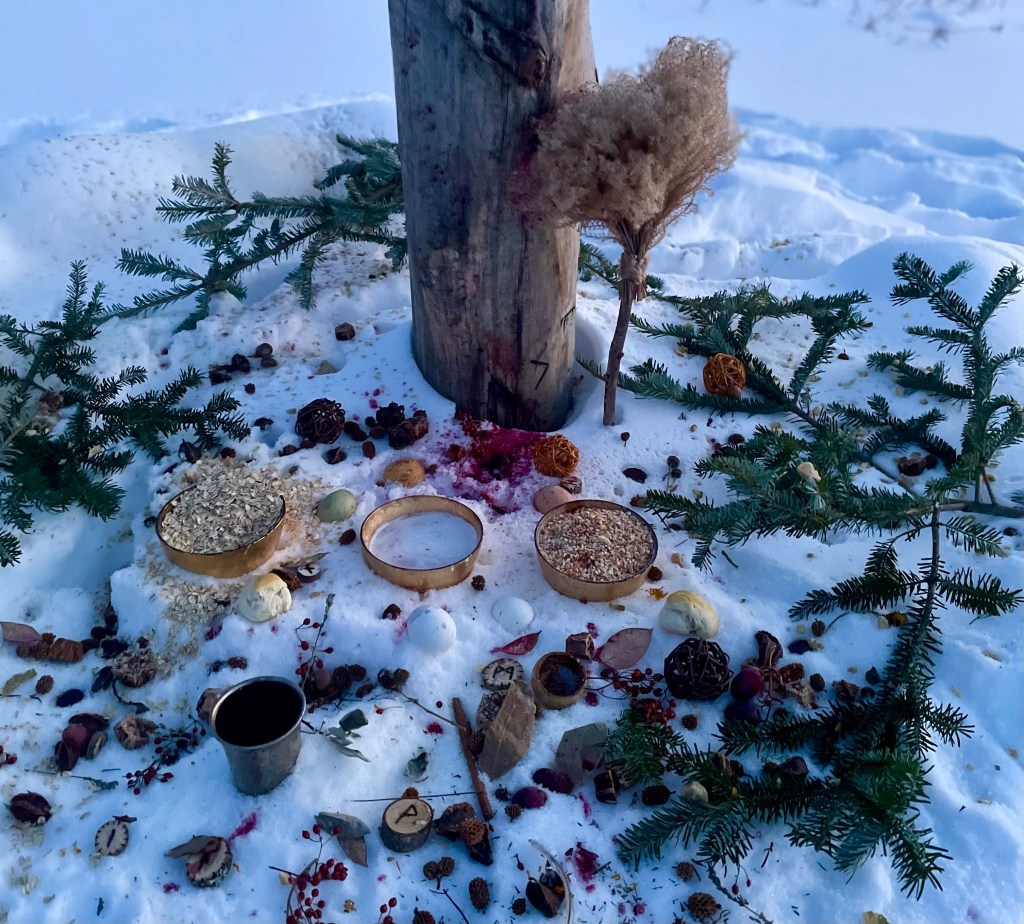
Imbolc, an Old Irish word meaning “in the belly”, is the time of year when we eagerly await the changing weather in order to judge the remaining duration of Winter. On this day, if it snows or is very harsh outside, we rejoice, because according to ancient Irish Celtic tradition, it means that the Winter Goddess, Cailleach (Veiled One), is asleep and Winter will likely end soon. However, if the weather is fair and fine, we can expect Cailleach to be out collecting more firewood and supplies, ensuring a longer and more treacherous Winter ahead. So, during this time, we hope for harsh weather and make offerings to various deities, generally Cailleach (Hel), Odin, and the local spirits in order to gain their favor. It is wise to be cautious of one’s noise production on this day so as to not wake the sleeping Crone.
Jones and Pennick give us a glimpse into these ancient Celtic customs:
“…the goddess known as Brighde in Ireland, Bride in Scotland and possibly Brigantia in the north of Britain. She had to do with warmth, fire, summer and possibly the Sun, since an Irish legend tells that in winter she was imprisoned in an icy mountain by a one-eyed hag.’ In some places she presided over thermal springs, presumably as the underground Sun, and in Scotland until the mid-twentieth century she was welcomed in at Imbolc (1 February) by the symbolic rekindling of the hearth fire after the house had been springcleaned from top to bottom.”
Reverence for fire and the Sun are important during this day, as soon the warmth of Spring will be arriving, bringing in longer days. Some European tribes marked Imbolc as their official beginning of Spring, but most considered it a celebration (and observation) of the ending Winter and the new beginning that lay ahead. Cleaning of the house and hearth would be essential during this time, preparing the living area for the next year of activities. Animal pens and beds would be changed and laundry would be washed. For those further North or in higher elevations, this day would have likely been celebrated differently, as we will see in the later quoted material.
In “Celtic Mythology and Religion,” Macbain writes:
“Candlemas day is known as La Fheill-Brighde, St Brigit’s day, who is really the canonised fire-goddess, the Vesta of the heathen Gaels. Some customs in regard to her worship were mentioned already, and Martin relates an interesting custom in the Western Isles on Candlemas, showing St Brigit clearly on the aspect of Vesta, the hearth and home goddess. The mistress and servants of each family take a sheaf of oats and dress it up in women’s apparel, put it in a large basket and lay a wooden club by it, and this they call Briid’s-bed, and then they cry thrice, “Briid is come, Briid is welcome.” Next morning they look in the ashes to see the impression of Briid’s club there, and if they do they reckon it a true presage of a good crop and prosperous year, and the contrary they regard an ill omen.”
As with the divination of ashes described above, various other means of prophecy would be undertaken to gather as much insight into the current (and future) situation as possible. Divination is a window into the workings of fate, a way to receive information directly from the wide Web of Wyrd. These cryptic bits of insight would be deciphered by a seer or seeress, sometimes a traveling witch, priestess, or the man of the household (priest). This would be their compass for how to focus their attention and energy as the year unfolded.
In “Sorcery and Religion in Ancient Scandinavia,” Vikernes writes:
“The 7th Sunday before Easter, usually the 1st of Þrúðheimr, was known as Washing, known from Gaelic as Imbolc or Imbolg (“washing”), and was regarded as the first day of spring. Washing lasted for a full week. The Sunday of Washing was called Pork Sunday, and this was the day Hel’s horse arrived with the news that Baldr would return. Everyone therefore gave thanks to Hel on this day. Pork Sunday was the day they transferred the fertility of spring to the women, by whipping their behinds with fresh birch branches. This custom survived well into the age of gods, and a form of this is in fact still practised in parts of Scandinavia.”
Common themes regarding this time of year include fire reverence, goddess worship, special recognition of the Sun, and special veneration to the Winter Crone Cailleach (Hel). Exceptional attention was paid to washing and cleaning, as well as creating a new fire in the hearth of the home. Offerings were made to various deities in order to be blessed with a prosperous year and good health. With Imbolc came the glimmer of Spring and the glorious days of plenty that lie ahead. In many ways, this celebration started the people off on a clean slate.

The Spring Equinox marks the traditional Easter celebration, the moment when the Sun crosses the equator from south to north. This is when animals like rabbits, deer, chipmunks, and other creatures of the forest begin to have their offspring. Various flora also emerge around this time, dotting the landscape with hints of color. During the Spring Equinox we pay special attention to the great Goddess in her youthful form of Ostara, Goddess of the Dawn. Ostara is associated with the rising Sun in the East, fertility, and light; a beacon of joy and good fortune. To many ancient Germanic Pagans, Ostara was credited with Springs deliverance. From her name we derive the modern word Easter, nodding to the Pagan origins of this holiday. To Ostara we make offerings and pray for a good year, thanking her for the return of the light. In one particular myth, Ostara transforms a bird into a rabbit who would then lay colorful eggs for her, showing us where the core symbolism of our modern holiday came from.
Hailaz Austra!
#ostara #spring #equinox #paganism

 Ansuz Society