Constructing and Maintaining an Altar for Odin

This process is something that is done differently by almost everyone, as there has never existed a pan-Pagan dogma regarding this type of activity. However, most would agree that when constructing an altar in the Germanic fashion, there are 4 main pieces to consider. These 4 pieces we will cover here along with other ideas for what one can add to their setup. Having an altar dedicated to spiritual activity is important, as it gives one a place to conduct work that is vital to the human experience.

First, one must find a location that one is drawn to, perhaps isolated in the forest at the foot of a particularly powerful tree, a secret natural site, or inside one’s home in a secluded area. Second, it is recommended that an organic “table” be present in the location to conduct exchanges and make offerings, such as a stump or flat stone. If there is not, one should build something for this purpose. This can be a simple platform, or it can be an entire temple, this all depends on the person’s means and dedication. Third, the deity with which one wishes to communicate (in this case Odin) needs a home or place to inhabit on the altar. This can take the form of a special tree, stone, idol, statue, image, or in some cases, the skull of an animal or human. Generally, the deity is thought to reside in this location indefinitely, although, some will argue that they are only meant as temporary dwellings for the gods and spirits to reside in while the operant conducts their business. The fourth piece, especially important in the case of Odin (but also relevant to any Pagan altar), would be the drinking vessel in which we offer libations.

Once one has completed these 4 tasks, the altar is ready to be blessed and put into immediate use. Blessings include fumigation, galdr, and various invocations to protect the space. Some other things to consider placing on the altar are offering bowls, incense vessels, candles, a set of runes, and a place to leave meat or gifts intended for Odin’s ravens and wolves. Aside from these things, it is up to one’s discretion what they choose to exchange with the High One.  When it comes to maintaining this space, one must keep things fairly organized and clean. This shows respect to the deity and helps one stay disciplined.

Strive to replace the rune set every year, if made of wood. If the runes are made of stone, they should be washed, cleansed and re-consecrated through galdr and one’s own blood. Last, libations should be made according to your means, but it is recommended to refresh the drinking vessel either every 3 days, 9 days, 45 days, and/or on full Moons. When throwing out the old libation, it should be offered to a tree or local spirit, never put into the drain or trash.

May this be of use to new and current practitioners.

Hailaz!

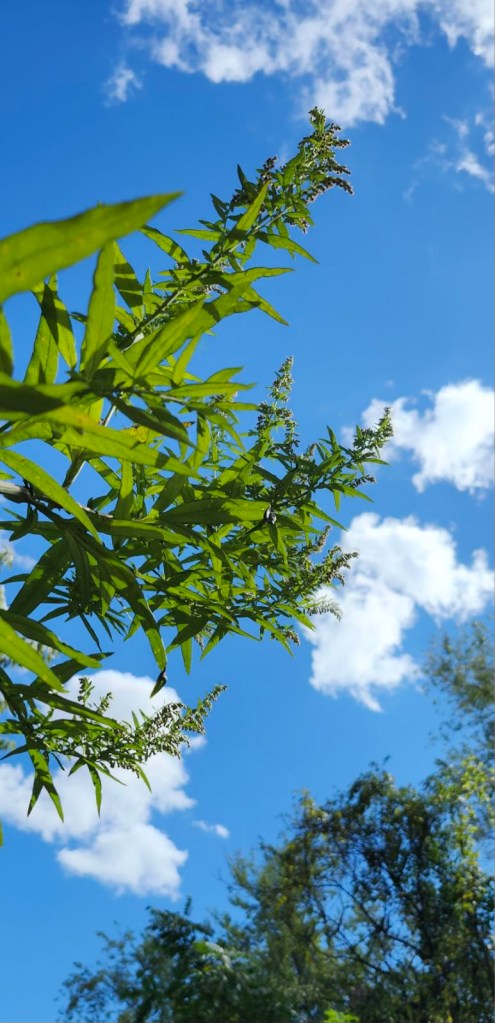
Mugwort (Artemisia Vulgaris) History and Uses

The beginning of Spring is a magical time. Everything starts to wake up from Winter’s sleep, the air becomes perfumed by unfurling buds and shoots of green, birthed under sky and warming Sun. The birds start to unleash their full songs, filling the landscape with sound. In short, pure magic. What better time than now for one of the most magical plants to start its ascent skyward. Mugwort is now lining roads and walkways, growing unchecked in fields. I’ve taken the plunge into the world of Mugwort and would love to take you with me.

Mugwort (Artemisia Vulgaris) is one of the oldest herbs referenced in Anglo-Saxon plant wisdom. Some of its earliest known uses were to help regulate menstrual cycles, as well as with divination and dreamwork. There is also evidence of Mugwort smoke as an offering to Isis in Ancient Egypt. It has been mentioned in poems dating back as far as 3 B.C. in China, such as the the Shi King/Jing Poetry Classic. It is also mentioned in the poem “Hortulus” by Walafrid Strabo (808 AD – 849 AD), as ‘the Mother of Herbs’. Mugwort’s roots pre-date modern history.

The name Mugwort comes from the Greek Goddess Artemis, Lady of the Moon. She is the Goddess of hunting and fertility, also assisting in the cultivation of willpower and self-reliance. She is a comforter to women in labor, a helper to midwives, and protector of young girls. Mugwort is ruled by the planet Venus, lending it even more feminine energy. Hippocrates and Dioscorides even endorsed the use of Mugwort to help ease childbirth, their works having influenced modern medicine. The “Hippocratic Oath” that says “First do no harm” is from, well, Hippocrates.

The herb has many healing properties, both physical and spiritual. Physically, Mugwort may help stimulate menstruation, keeping from stagnation. It can be used for help in treating rashes, sore joints, bruises, and bug bites. Mugwort has benefits for pain relief, especially from arthritis. It has powerful nervine qualities, nervines being things that help relieve stress on your nervous system, which can be very helpful when treating anxiety, depression, and stress. Mugwort also contains things like iron, phosphorus, potassium, zinc, and tannin. It’s also a nutrient dense plant found most everywhere.

Personally, Mugwort is one of my favorite herbs. It has the ability to induce incredibly vivid dreams and the ability to bring about lucid dreaming experiences. Those are two of the main reasons why I love mugwort. Dream work is an important part of my spiritual practice, and Mugwort has been the best tool I’ve used. It can be taken as a tincture in tea, smoked, or put in dream sachets and bundles for burning. Being an herb so deeply entrenched in feminine energies, it is perfect for those that want to connect to the divine feminine, bond with their personal intuition, and enhance sensitivity. It can help open yourself to being more empathetic and patient.    

Stagnation in body and mind can cause all sorts of problems. Mugwort increases circulation and warms the blood, helping a stagnating body. A stagnating mind will lead to frustration, detachment, and anxiety, just to name a few. Mugwort opens the mind, allowing for deep meditation and vision work. It can help with opening thoughts and deeper spiritual meanings. It moves the things in us which have lain dormant. It’s an herb for gentle but serious action.

Any phase of the Moon will work when using Mugwort for lunar practices, as it is a lunar herb. However, the best and most interesting time to use it would be during the Balsamic moon or when the moon is fully waned. The Balsamic moon is a time of going inward and recharging. This is the phase right before the new moon, making this moon perfect for meditation and really digging into the self. The Balsamic moon is the time to find what intentions you want to set and why you are trying to set that intention. Using Mugwort to explore your inner world will really help you bring your intentions to the surface; the perfect time to put your plans into action.

Rahu, Ketu, and the Eclipse

In Vedic astrology, eclipses are seen as a symbol of revenge or as a bad omen.

According to mythology, eclipses are caused by the Chaya Graha (shadow planets) Rahu and Ketu, who were once part of a divine serpent. The story is traced back to a time before creation in the tale of the churning of the ocean, known as the Samudra Manthan. The churning of the ocean represents our consciousness. After an awful and lengthy war, the devas (gods) and asuras (demons) cooperated to churn the galactic material called the Milk Ocean. The churning poured forth several gifts and treasures. They included the goddess of wealth Lakshmi, the wish-fulfilling tree Kalpavriksha, the wish-fulfilling cow Kamadhenu, and Dhanvantari, who carries a pot of amrita and a book of medicine called Ayurveda. Amrita is a Sanskrit word that means “immortality” and is a drink (or nectar) intended only for the gods.

A serpent demon (Svarabhānu) aspired to become invincible. Sitting between Surya (the Sun) and Chandra (the Moon), Svarabhānu disguised himself as a deva and managed to take a sip of Amrita during Samudra Manthan. Surya and Chandra recognized the imposter and informed Mohini (the female form of Lord Vishnu), preserver of life and order, who quickly decapitated him. As they were now immortal, Lord Vishnu needed to find a place for them, so he put them in two specific points in the sky.

The head of the serpent demon (without the body) became Ratu, who fell on one side of the sun. The tail without the head that fell on the opposite side of the sun became Ketu. The sun stopped all movement in order to keep Rahu and Ketu from meeting one another. Twice a year they can create confusion and exact revenge by consuming the Sun and Moon causing the world to suffer from darkness.Rahu swallows the Sun, and Ketu, the Moon. But only for a short while as the Sun and Moon have also taken in the amrita. Offerings of coal, mustard, sesame, saffron and lead are made to appease Rahu. For Ketu, offerings of lead, sugar, saffron and sesame are made along with offering food to a dog with black and white fur.

As seen above, eclipses can be seen as highly inauspicious. Light and power diminish which corrupts their positive qualities and creates disturbances in the natural order of things. It is believed that auspicious work should only be started in the light. Because of this, beginning any new ventures during this period of darkness is not recommended, as it can bring upheavals, obstacles, and turmoil.

#eclipse #vedic #astrology #rahu #ketu

Om Mani Padme Hum

The six-syllable mantra Om Mani Padme Hum (Tib. Om Mani Peme Hung) is the most popular mantra in Tibetan Buddhism and has been chanted for over 1500 years. The mantra can originally be found in the Kāraṇḍavyūha Sūtra and is associated with the deity Avalokiteśvara (Tbt. Chenrezig) whose name means something like “Lord of the World.” The mantra itself has many different meanings associated with it, but most commonly it is translated as something like “Hail the Jewel in the Lotus.” This phrase is an homage to the great “jewel” of primordial awareness (Buddhanature) that exists within the hearts of all sentient beings. May all beings thrive under the watchful eyes of compassion.

ॐ मणि पद्मे हूँ / Om Mani Padme Hum

#ommanipadmehum #avalokiteshvara #buddhism #mantra #meditation

Om Mahakala Hum Phat

Mahakala, black in color and fearsome in appearance, represents spiritual activity beyond our comprehension; the true consciousness that is unseen. His name means “Beyond Time/Great Black One” because he is all pervasive and unmanifested in material form, free of the shackles of tangibility. As a presence beyond matter, he remains untouched by Samsara, residing in the very fabric of space (consciousness) that permeates the entirety of the cosmos. Mahakala, like all Yidam (Ishtadevata) deities, represents the Vajra mind, fixed and indestructible; the primordial state of sentient awareness. Surrounded by the flames of wisdom, he is beyond the reach of times’ destruction. Mahakala is the foundation of conscious reality; a force of gravity that pulls beings towards the practice and service of the Dharma.

“…Such undeluded energy, like a windblown fire, can burn away the dross.
Mahakala has strong legs and Mahakala has sure feet;
They are well able to trample down demonic thoughts and deeds!…”

Mahamrityunjaya Mantra

We have recorded a rendition of the Mahamrityunjaya mantra with a new affiliate @kshatriyacowboy. This verse can be found in the Rigveda (RV 7.59.12) and is devoted to the great Rudra-Shiva in his form of Tryambakam or “The Three Eyed One.”

त्र्य॑म्बकं यजामहे सु॒गन्धिं॑ पुष्टि॒वर्ध॑नम्
उ॒र्वा॒रु॒कमि॑व॒ बन्ध॑नान् मृ॒त्योर्मु॑क्षीय॒ माऽमृता॑त् ।।

oṃ tryámbakaṃ yajāmahe sugandhíṃ puṣṭi-vardhánam
urvārukam íva bandhánān mṛtyor mukṣīya mā ‘mṛtā́t

There are many translations of this mantra, but it is generally referred to as the “Great Conquest Over Death” or “Death Destroying” mantra.

The Mahamrityunjaya mantra is a request to be separated from the clutches of death; a longing to be free of attachments to samsara and one’s inherent ignorance regarding the perception of self. The mantra expresses a specific wish to not be removed from the possibility of immortality; requesting to have one’s attachment to samsara be broken (the suffering of bodily/individual bondage) but for one’s consciousness (Self/Atman) to remain intact for eternity; completely overwhelmed and overflowing with devotion for the primeval essence. This is requested as a means to continue worshiping the divine Shiva for all of infinity, who is none other than the progenitor of primordial consciousness; the true state of one’s being. The mantra describes this metaphorically as a cucumber (or melon) being separated from its vine but continuing to live on as an emanation of its source (Shiva). This request is for consciousness to become free from the shackles of the flesh (vine) associated with the experience of samsara (change), ego, and death. Through this process, one’s true Self may live on forever in constant reverence of the primordial source; the original state of awareness from which one’s perception comes and to what one’s consciousness is inseparable from, no matter how obscured or hidden by one’s mundane delusions.

Oh Three Eyed one, great Shiva,

Fragrant (blissful, aromatic) sustainer of prosperity,

As the cucumber is removed from its vine (bondage),

May I be relinquished from death (attachment to samsara) but not from immortality.

Om Namah Shivaya

-Ansuz Society

Journey to the Sun (New Song!)

This is our last song for the Summer and a celebration of all the experiences of the year thus far.

We hope your Summer was full of great experiences and new lessons learned.

May all beings thrive under the Sun.

May all beings rise to new heights.

Hailaz / Namaste

-Ansuz Society

sun #summer #music #travel

Dharma Practice

“Think of the simplest thing you do, such as making a cup of tea. You know that in order to do something as easy and simple as making a cup of tea, you must acquire all the necessary conditions and ingredients. You need a source of heat and you need a source of water. You need a container in which to boil the water, you need tea leaves, and you need a cup to drink the tea in. If you do not have those things, you cannot make tea. When it comes to making tea, we take all of these things for granted. We think of it as a very simple process. Yet somehow when it comes to the practice of Dharma, we are unwilling to go through the process of accumulating what is necessary. 

Furthermore, when you make tea you have to know what your are doing. You have to know how to use the stove. If you do not know what you are doing, you are going to burn your house down. When it comes to practicing Dharma, you think that you do not need to know what you are doing; you do not need to know anything, and you do not need to study. This is incorrect.”

-MD Vol. 3 (The Dispelling of Impediments or Obstructions) 

It is important that we approach our practice in this simple and straight forward way, making sure to acquire and assemble all of the ingredients of a practice (physically and mentally) before attempting to accomplish it. If we expect fruition of a practice without doing any preliminaries to ensure our accomplishment, we will likely fail and discontinue, or worse, lose our faith altogether. Be diligent and disciplined with your routine, take things step by step. Don’t be afraid to ask for help or advice from those who embody the qualities you want to develop or achieve. This is crucial on our path towards awakening. 

May all beings be liberated.