May Day/Beltane

May Day marks the true climax of Spring and transition into Summer in the Northern regions. During this month, lots of plants and herbs begin to emerge after the long winter, bringing a plethora of flora and fauna to the land. On May Day, many Pagans resurrect (uncover) their idols of fertility and parade them through the towns and fields, blessing them for the upcoming agricultural year. In the past, this idol would have been housed in a cart or wagon and was presided over by specific individuals. Sometimes, these exclusive ritual participants were killed after laying eyes on the goddess in the wagon.

Jones & Pennick refer to this in “A History of Pagan Europe,” stating:

“The tribes around the mouth of the Elbe and in the south of modern Denmark are the ones who, as is now well known, worshiped Nerthus, Mother Earth. They saw her as intervening in human affairs and riding among her people in a wagon drawn by cows. The priest of Nerthus would sense when she was ready to leave her island shrine, and then with deep reverence would follow the wagon on its tour through the lands of her people, which would be the occasion for a general holiday, the only time when these warlike people put down their arms. At the end of the perambulation, the wagon and its contents would be washed in a lake by slaves who were then drowned. Noone was allowed to see the goddess on pain of death.”

In many cases, this idol was a goddess, and in others, a god would have taken its place, most notably Freyr. The idol that represented the god/goddess/spirit would be housed in the wagon, other times, a living person was chosen to embody the specific deity. Everyone would treat the person as if he/she was the actual deity themselves, dressing them in flowers and other pleasant things, parading them around in reverence.

Bonfires are customary during this time. Many people perform purification rituals using smoke and various other substances to cleanse themselves for the new year. Birch wood was most commonly used for these purposes and the smoke created would thus be walked through or “bathed” in. This was done to cleanse oneself and family of evil, sickness, and bad luck. Not only people, but livestock were said to be paraded through a pair of fires, ensuring a prosperous year, good health, and good harvests.

In “Celtic Mythology and Religion”, Macbain refers to the writings of Cormac:

“Most authorities hold, with Cormac, that there were two fires, between which and through which they passed their cattle and even their children. Criminals were made to stand between the two fires, and hence the proverb, in regard to a person in extreme danger, as the Rev. D Macqueen gives it, “He is betwixt two Beltein fires.”

Beltane bonfires are also referenced in “A History of Pagan Europe” by Jones & Pennick, where it says:

“The second great festival of the year was Beltane or Cétshamhain (1 May, May Day). This was the beginning of the summer half of the year, also a pastoralist festival. As at Samhain, the lighting of bonfires was an important rite. Cattle were driven through the smoke to protect them in the coming season. Beltane may be connected with the Austrian deity Belenos, who was particularly associated with pastoralism, or it may simply take its name from the bright (bel) fires which were part of its celebration. Beltane is the only festival recorded in the ninth-century Welsh tales, a time when the Otherworld communicates with the world of humans, either through portents such as the dragon fight in the tale of Lludd and Llevelys, or through apparitions such as the hero Pwyll’s sighting of the goddess Rhiannon.”

Later, around the 12th century, “May Baskets” became common practice in Germanic culture, which involved hanging flowers on strangers’ doorknobs or delivering flowers to friends, family, and the local community. This is still done today in many parts of the world, where people will anonymously leave flowers on people’s doorsteps in honor of the season. Essentially, May Day revolves around life, youth, and the beauty of the natural world around us. Through the blessing and beauty of the May Queen, we are propelled into the new farming season with inspiration and vigor.

As we can see from these various historical accounts, this particular event was of significant importance to not only Germanic and Celtic Pagans, but a pan-European celebration centered around a specific goddess, ritual cleansing, and Sun worship. Plenty of other cultures outside of Europe celebrate this occasion as well, such as some Native Americans, Persians, and Hindus. This renewal of life has been central to human experience for most of its history, promising us the glory of Summer and the proliferation of life.

In “Sorcery and Religion in Ancient Scandinavia,” Vikernes writes:

“On White Queen Monday they travelled the land to collect bacon, flour, eggs and other white food items for the large bride’s race. Dressed in white and wearing ribbons and wreaths of flowers they danced and sang all the way, from farm to farm, women and men, girls and boys, led by the king (alias the May King) and the queen (alias the May Queen), whether they were sorcerers or deities. The king and queen sat in a carriage, drawn by horses or the others in the procession. The queen did all the talking and the ladies and girls sang “Bride, bride, most beautiful bride”, to invite to the race all the women who believed they stood a chance at winning the bride’s race. The females in the procession wore men’s clothes on their upper bodies, and the men wore dresses, because they represented the hermaphroditic spirits. This custom remained even after the belief in spirits was supplemented with a belief in deities.”

On our homestead, May Day generally consists of uncovering our Freyr idol and walking him through the gardens and fields, either in a small mock-wagon or by hand. Once we have visited all the necessary areas, we return the idol to his altar and leave generous offerings for his blessings and fortune. Two fires are built in front of the altar and each ritual participant walks between them, purifying themselves of yearly baggage and giving personal thanks to the great Yngvi-Freyr. By doing this, each person can shed negative, dark, detrimental energies; inspiring wellbeing, clarity, and positive development.
Mugwort: Stepping Towards the Divine Feminine

An herb as powerful as Mugwort is an invaluable way to connect and learn more about Goddesses of not only Greek, but Norse and Celtic mythology. Mugwort and its association with women, those who protect and champion women, as well as those seeking to expand their metaphysical world through dream and deity work, is as important today as it was thousands of years ago. 

Artemis, the namesake of Mugwort, is the logical starting point. Artemis is a goddess of the hunt, the moon, and especially of female initiation and protection. She is associated with girls and women, but is also a goddess to boys and men in rites of initiation and the hunt. All who wish to learn more and work with her are welcome, as she is a goddess for everyone. Mugwort, having derived its name from her, is the mother herb mirroring her mothering prowess. 

However, in the Greek mythos, she was not a goddess to suffer fools gladly. She vehemently defended her virginity and reputation as the greatest of hunters. Some sources suggest she was the patron goddess of the fearsome women warrior tribe, the Amazonians. A passionate and ferocious fighter for what she believes is right, a beacon for those who need strength.

Of everything that Artemis is known for, Mugwort is most closely related to her powers as midwife, a deity for both comforting women in labor and the newborn. Mugwort is also an important herb for dream and trance work, lending itself nicely to moon rituals, as Artemis was also a goddess of the moon. Using Mugwort in its tincture form, or burning as a smudge stick, will help to expand consciousness and enter a trance state for magical work. Adding Mugwort into your meditation on Artemis during the moon, especially the full moon, will greatly enhance communication.

In Norse mythology, Frigg, the most powerful volva, was believed to be the first practitioner of seidr magic. Frigg is the wife of Odin and a fiercely protective mother of Baldur. She is the goddess of family, motherhood, fertility and the balance of love and wisdom. Mugwort works perfectly with Frigg as it is an herb whose main use has been for assistance in prophetic dreaming and the overall health of women. 

Runes that can be used when invoking Frigg are Fehu, Pertho and Berkano. Fehu, when related to Frigg, is a female rune for fertility concerned with livestock, and especially newly born cattle in spring. Fehu is always a rune of productivity. It can also be used for spiritual or artistic creativity, carrying a fiery power within. Fehu can also represent certain aspects of the life force.

Freya Aswin correlates Pertho with birth. Pertho can also be used to help find hidden aspects within yourself. The joining of these attributes with Frigg, who governs birth and is involved with weaving fate (through work as a volva and through seidr magic), very nicely encapsulates the magic of Mugwort. 

The Berkano rune indicates birth, being rooted, and the feminine, has been called a rune of ‘bringing into being’, the first protection given to children at birth. Both Artemis and Frigg were known as unrelenting defenders of children and women. Incorporating Mugwort when working with Frigg can be very beneficial.

The goddess of Celtic mythology most closely associated with Mugwort is Brigid. Brigid is known as a goddess of fire, poetry, and healing; a maternal goddess who embodies the divine feminine. She is like spring, representing new beginnings.

As a goddess of fire and hearth, she was said to watch over all the fires in the homes of Ireland. She was closely associated with the sun and the warmth of spring, the time of renewal and rebirth. Mugwort is also an herb closely associated with fertility, the goddess, and of womanhood. Brigid, as a goddess that protected the flame (which was so important for ancient people’s survival), is like a mother radiating maternal compassion. 

Poetry (and creativity) have always had close ties with the metaphysical and dream world, a world that Mugwort works so well in. Brigid was called upon to help with creativity and inspiration, especially with bards, who held a very high position in Celtic society. Bards were the keepers of history and culture, and Brigid was often invoked to help inspire creativity. 

Brigid was also a goddess of healing. She was often called upon to help cure sickness and injury, as her touch was said to have healing powers. In addition to being a healer of sickness and injury, she was a goddess of childbirth, watching over women in labor. Her presence helped ease pain and ensured a safe delivery. She was also a protector of children and was asked by parents to watch over children’s safety and health. Brigid and her divine energies align well with Mugwort and its properties. 

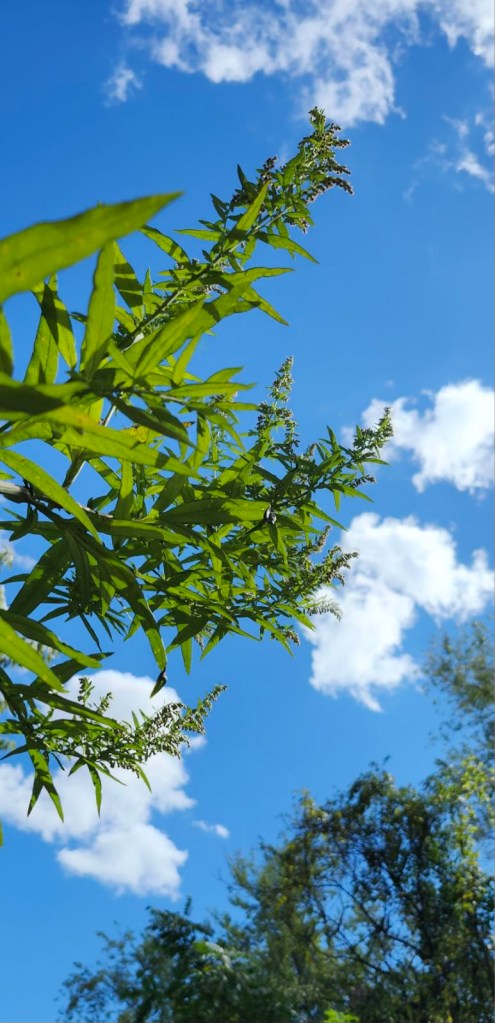
Mugwort (Artemisia Vulgaris) History and Uses

The beginning of Spring is a magical time. Everything starts to wake up from Winter’s sleep, the air becomes perfumed by unfurling buds and shoots of green, birthed under sky and warming Sun. The birds start to unleash their full songs, filling the landscape with sound. In short, pure magic. What better time than now for one of the most magical plants to start its ascent skyward. Mugwort is now lining roads and walkways, growing unchecked in fields. I’ve taken the plunge into the world of Mugwort and would love to take you with me.

Mugwort (Artemisia Vulgaris) is one of the oldest herbs referenced in Anglo-Saxon plant wisdom. Some of its earliest known uses were to help regulate menstrual cycles, as well as with divination and dreamwork. There is also evidence of Mugwort smoke as an offering to Isis in Ancient Egypt. It has been mentioned in poems dating back as far as 3 B.C. in China, such as the the Shi King/Jing Poetry Classic. It is also mentioned in the poem “Hortulus” by Walafrid Strabo (808 AD – 849 AD), as ‘the Mother of Herbs’. Mugwort’s roots pre-date modern history.

The name Mugwort comes from the Greek Goddess Artemis, Lady of the Moon. She is the Goddess of hunting and fertility, also assisting in the cultivation of willpower and self-reliance. She is a comforter to women in labor, a helper to midwives, and protector of young girls. Mugwort is ruled by the planet Venus, lending it even more feminine energy. Hippocrates and Dioscorides even endorsed the use of Mugwort to help ease childbirth, their works having influenced modern medicine. The “Hippocratic Oath” that says “First do no harm” is from, well, Hippocrates.

The herb has many healing properties, both physical and spiritual. Physically, Mugwort may help stimulate menstruation, keeping from stagnation. It can be used for help in treating rashes, sore joints, bruises, and bug bites. Mugwort has benefits for pain relief, especially from arthritis. It has powerful nervine qualities, nervines being things that help relieve stress on your nervous system, which can be very helpful when treating anxiety, depression, and stress. Mugwort also contains things like iron, phosphorus, potassium, zinc, and tannin. It’s also a nutrient dense plant found most everywhere.

Personally, Mugwort is one of my favorite herbs. It has the ability to induce incredibly vivid dreams and the ability to bring about lucid dreaming experiences. Those are two of the main reasons why I love mugwort. Dream work is an important part of my spiritual practice, and Mugwort has been the best tool I’ve used. It can be taken as a tincture in tea, smoked, or put in dream sachets and bundles for burning. Being an herb so deeply entrenched in feminine energies, it is perfect for those that want to connect to the divine feminine, bond with their personal intuition, and enhance sensitivity. It can help open yourself to being more empathetic and patient.    

Stagnation in body and mind can cause all sorts of problems. Mugwort increases circulation and warms the blood, helping a stagnating body. A stagnating mind will lead to frustration, detachment, and anxiety, just to name a few. Mugwort opens the mind, allowing for deep meditation and vision work. It can help with opening thoughts and deeper spiritual meanings. It moves the things in us which have lain dormant. It’s an herb for gentle but serious action.

Any phase of the Moon will work when using Mugwort for lunar practices, as it is a lunar herb. However, the best and most interesting time to use it would be during the Balsamic moon or when the moon is fully waned. The Balsamic moon is a time of going inward and recharging. This is the phase right before the new moon, making this moon perfect for meditation and really digging into the self. The Balsamic moon is the time to find what intentions you want to set and why you are trying to set that intention. Using Mugwort to explore your inner world will really help you bring your intentions to the surface; the perfect time to put your plans into action.

Yarrow Lore (Achillea millefolium)

The scientific name for the common yarrow plant (Achillea millefolium) translates to ‘a thousand leaves’, in reference to the tiny, lacy, fern-like leaves. It is also called plumajillo (“little feather”) due to the shape and wispy characteristics of the leaves. Other names include chipmunk tail, milfoil, bloodwort, nosebleed plant, woundwort and field hops. The common name of yarrow may be derived from the Celtic word garw, which means “rough” and could be associated with yarrow’s ability to thrive in inhospitable conditions.

Yarrow was (scientifically) named after the Greek warrior Achilles, whose longevity in battle was credited to being dipped in a warm bath of yarrow shortly after birth. Later, it’s said that he used yarrow leaves to heal the wounds of his men. In keeping with this heroic legacy, yarrow is one of our strongest allies for heavy or hemorrhagic bleeding and first-aid herbalism.

Yarrow has long been associated with the occult and divination practice. It was considered an “herb of witches” due to its outstanding healing power. This could also have given rise to some of the common names for yarrow, such as bad man’s plaything, elf’s herb, devil’s plaything, devil’s herb and devil’s nettle. The Druids selected stems of yarrow to forecast weather for the season. The Irish included this as one of the herbs of St. John and hung it on houses as protection from sickness. In Celtic folklore, yarrow was used in handfasting and wedding rituals. It is said that yarrow keeps a newly married couple happy and at peace for seven years. I am not sure what happens after those seven years! Yarrow was also used by the Chinese as an oracle for foretelling the future.

Yarrow has been used in old European love charms for millennia. This plant is said to be a cure for heartache and has been used as a love charm. When the herb is pressed into a small sachet and placed under one’s pillow, it provokes dreams that can reveal the identity of one’s true love.
One Gaelic incantation that is recited when plucking yarrow goes like this: “I will pluck the smooth yarrow that my figure may be sweeter, that my lips may be warmer, that my voice may be gladder. May my voice be like a sunbeam, may my lips be like the juice of the strawberry…”
The Farmer’s Almanac published an article in 1986 that included an article titled “How to Find the Perfect Mate”. Several superstitious acts were listed, beginning with “Pluck a stalk of yarrow and stick it up your nose. If a drop of blood appears, your love is true.”

Yarrow was used by the Saxons as an amulet. These served as protection from all sorts of ailments and robbery. While it was used for security purposes, at the same time it could serve evil intents as well. Other legends state that when going on a journey, one should pull ten stalks of yarrow, keep nine, and throw the tenth away (as an offering to the spirits), place the nine under your right heel and evil spirits would have no power over you.

Amidst all the lore and practical uses, yarrow is also a ceremonial and mind-altering medicine. It is mildly psychotropic, and many herbalists have reported shifts in consciousness after taking high doses. When fermented in ale or mead, yarrow’s intoxicating effects seem to be enhanced. You won’t experience these effects if you’re taking yarrow in standard medicinal doses.