
Subscribe to continue reading
Subscribe to get access to the rest of this post and other subscriber-only content.

Subscribe to get access to the rest of this post and other subscriber-only content.
One of our weekend practices is a full recitation of the Bellows translation of the Völuspá/Voluspo.
The Völuspá is one of the most well-known poems that emerged from the Pagan North during the Middle Ages. The title translates to “Prophecy of the Seeress” or “The Wise-Woman’s Prophecy,” consisting of various tales regarding the creation, destruction, and rebirth of the world. This is told from the perspective of a dead Volva (Witch/Seeress) to the god Odin who has temporarily brought her back to life in order to gain wisdom of the past, present, and future.
Although heavily criticized by some Pagans for containing seemingly Christian influences, we can see through the comparative study of other Indo-European religions that most of the primary subject matter inherent in the poem is authentic and does in fact give us insight into pre-Christian Pagan thought. A few themes of the poem that are echoed in other Indo-European myths are the being Ymir, the primordial bovine Auðumbla, and the battle between the serpent (Jörmungandr) and the thunder god (Thor). If anything, any added “Christian” elements are fairly subtle.
We hope this will be useful to your practice.
Hailaz
Subscribe to get access to the rest of this post and other subscriber-only content.
Subscribe to get access to the rest of this post and other subscriber-only content.
This process is something that is done differently by almost everyone, as there has never existed a pan-Pagan dogma regarding this type of activity. However, most would agree that when constructing an altar in the Germanic fashion, there are 4 main pieces to consider. These 4 pieces we will cover here along with other ideas for what one can add to their setup. Having an altar dedicated to spiritual activity is important, as it gives one a place to conduct work that is vital to the human experience.
First, one must find a location that one is drawn to, perhaps isolated in the forest at the foot of a particularly powerful tree, a secret natural site, or inside one’s home in a secluded area. Second, it is recommended that an organic “table” be present in the location to conduct exchanges and make offerings, such as a stump or flat stone. If there is not, one should build something for this purpose. This can be a simple platform, or it can be an entire temple, this all depends on the person’s means and dedication. Third, the deity with which one wishes to communicate (in this case Odin) needs a home or place to inhabit on the altar. This can take the form of a special tree, stone, idol, statue, image, or in some cases, the skull of an animal or human. Generally, the deity is thought to reside in this location indefinitely, although, some will argue that they are only meant as temporary dwellings for the gods and spirits to reside in while the operant conducts their business. The fourth piece, especially important in the case of Odin (but also relevant to any Pagan altar), would be the drinking vessel in which we offer libations.
Once one has completed these 4 tasks, the altar is ready to be blessed and put into immediate use. Blessings include fumigation, galdr, and various invocations to protect the space. Some other things to consider placing on the altar are offering bowls, incense vessels, candles, a set of runes, and a place to leave meat or gifts intended for Odin’s ravens and wolves. Aside from these things, it is up to one’s discretion what they choose to exchange with the High One. When it comes to maintaining this space, one must keep things fairly organized and clean. This shows respect to the deity and helps one stay disciplined.
Strive to replace the rune set every year, if made of wood. If the runes are made of stone, they should be washed, cleansed and re-consecrated through galdr and one’s own blood. Last, libations should be made according to your means, but it is recommended to refresh the drinking vessel either every 3 days, 9 days, 45 days, and/or on full Moons. When throwing out the old libation, it should be offered to a tree or local spirit, never put into the drain or trash.
May this be of use to new and current practitioners.
Hailaz!
Lughnasadh is named after the Celtic Sun god Lugh. This is a time when the first harvests of the year would be brought in and prosperity would begin to be felt amongst the community. Summer is fully in bloom and the golden fields and vibrant flowers mirror the glory of the powerful Sun above. During this time, people would feast and make offerings to the gods with the first fruits of the year. During Lughnasadh, there would be singing, music, games, competitions, and much more, as the people could finally begin to enjoy the rewards of their hard work so far that year. Traditionally, Lughnasadh is the first of the 3 great harvest celebrations, kicking off the sacred celebrations when humans reap the results of what they have sown.
In “Celtic Mythology and Religion,” Macbain writes:
“It is called in Scottish Gaelic “Lunasduinn,” in Irish “Lunasd,” old Irish “Lugnasad,” the fair of Lug. The legend says that Luga of the Long Arms, the Tuatha De Danann king, instituted this fair in honour of his foster-mother Tailtiu, queen of the Firbolgs. Hence the place where it was held was called Tailtiu after her, and is the modern Teltown. The fair was held, however, in all the capitals of ancient Ireland on that day. Games and manly sports characterised the assemblies. Luga, it may be noted, is the sun-god, who thus institutes the festival, and it is remarkable that at ancient Lyons, in France, called of old Lug-dunum, a festival was held on this very day, which was famous over all Gaul.”
Wrestling tournaments, races, and various games would have been held during this time in honor of the god Lugh, who is known for being highly skilled in many different areas. Archery, stone lifting, and weight throwing contests were said to have occurred, continuing into the modern day with summer events like the Highland Games. Sacrifices were also common in Pagan times, generally of a bull, and a feast would be made from its flesh, while a portion of the blood and other pieces were given to the gods.
In “A History of Pagan Europe” by Jones & Pennick, it is said:
“Lughnasadh (1 August, also called Bron Trograin) appears to have been imported into Ireland at a later date, perhaps by continental devotees of Lugh, who in the Irish pantheon is a latecomer, the ildánach, master of all skills, more modern in character than the other goddesses and gods. Correspondingly, Lughnasadh differs from the other three festivals in being agrarian in character, marking the harvest, and baking of the first loaf from the new grain. The deity honoured at Lughnasadh was Lugh, who was said to have instituted the games in honour of his foster-mother, Tailtiu. Tailtiu (Teltown) is in fact the name of the site of the festival in Tara. It is an ancient burial ground, and its name is thought to mean ‘fair’ or ‘lovely’, so if it ever was associated with a presiding goddess of that name, like Demeter in Greece she would have ruled both the Underworld and the fruits which sprang from it.”
In modern Germanic Pagan practice, Lughnasadh is recognized as Freyfaxi or “Frey Day,” replacing the Celtic Lugh with the Norse Freyr. Special and careful thanks are given to Lord Ingwaz/Yngvi/Freyr during this time to honor his power and acknowledge his benevolence. A general sense of peace should be felt on this day as well as an internal feeling of gratitude for all one has in life. As a god of wealth, Freyr makes us reflect on the things that make us feel a sense of prosperity in our lives.
In “Sorcery and Religion in Ancient Scandinavia” by Vikernes, it says:
“The 15th day of Alfheimr was Harvest Sacrifice (No. Slatteblot), also known as Wake-Up-Day, known from Gaelic as the festival of Lugh (“light”). The day marked the beginning of harvest. Before harvest could begin the grain spirit was killed and burned, or it was – in the shape of a goat made from last year’s straw – cut into bits and pieces and buried in the field’s four corners and in the field itself. By the time of the Bronze Age the spirit of light and grain had become a goddess and a god, Sibijo and Fraujaz, known from the Scandinavian mythology as Sif and Freyr respectively. The grain deity was still represented by a straw figure in animal form – usually a goat. In addition to this, the god was cut down with a sax, sickle or scythe in a sword dance. Finally, a symbol of the god, usually a loaf of bread or (in the most ancient of times) a cone, was cut into bits and pieces and buried with the straw animal in the field/meadow. The grain spirit had to die and be buried in the ground for new grain to come. They took the first straw harvested and made a new animal of it, then stored it in a safe place for next year’s Harvest Sacrifice.”
In summary, whether celebrating Lughnasadh or Freyfaxi, this is a time when the first fruits of the year are reaped and specific rituals are undertaken to ensure the fertility of the land. Skills are put on display and the community is brought together under a common aim: prosperity, happiness, and peace. It is important to give thanks to natural and local spirits for their blessings, and to the gods for their gifts. During Lughnasadh, we revel in the light, we feast, and we celebrate our good fortune.

The Chanterelle is an edible mushroom with medicinal perks.
You can find this golden treasure living in symbiosis with pine, spruce, oak and hornbeam.
They will reappear in the same places year after year so long as the mycelium in the soil is not disturbed. One patch can produce fungi for generations.
Some of the benefits of Chanterelles include:
• Rich source of several vitamins and minerals including vitamin D which supports bone health
• Known to help reduce inflammation
• Great immunity boosters
We like to pickle our excess Chanterelles for later use.
Let us know if you have any favorite Chanterelle recipes or other uses!

Back at headquarters after a very busy and powerful weekend at KTD.
Two empowerments were given (Stainless Ushnisha and Stainless Light Rays), both related to the construction of stupas, the consecration of the items therein, and the clearing away of obstacles. These were given by Khenpo Lodrö Dönyö Rinpoche, abbot of the Mirik Monastery. This is something we would like to sponsor here at some point in the future.
After that, the monks began a 7 day Chakrasamvara puja at the request of the Karmapa, whose father passed away.
It is always rejuvenating to visit this holy site, but, it is also hard to leave. If you find yourself in the area, you should certainly stop by.
May all beings thrive.
“There is an old saying that the path is the goal and goal is the path. You make your journey, you get to your destination, and arriving at your destination brings on another question: how to proceed from there? In that way each goal itself becomes the path. Particularly from the tantric point of view, you don’t achieve anything except path. Discovery of the path is achieving.”
-Trungpa Rinpoche

The Spring Equinox marks the traditional Easter celebration, the moment when the Sun crosses the equator from south to north. This is when animals like rabbits, deer, chipmunks, and other creatures of the forest begin to have their offspring. Various flora also emerge around this time, dotting the landscape with hints of color. During the Spring Equinox we pay special attention to the great Goddess in her youthful form of Ostara, Goddess of the Dawn. Ostara is associated with the rising Sun in the East, fertility, and light; a beacon of joy and good fortune. To many ancient Germanic Pagans, Ostara was credited with Springs deliverance. From her name we derive the modern word Easter, nodding to the Pagan origins of this holiday. To Ostara we make offerings and pray for a good year, thanking her for the return of the light. In one particular myth, Ostara transforms a bird into a rabbit who would then lay colorful eggs for her, showing us where the core symbolism of our modern holiday came from.
Hailaz Austra!
#ostara #spring #equinox #paganism

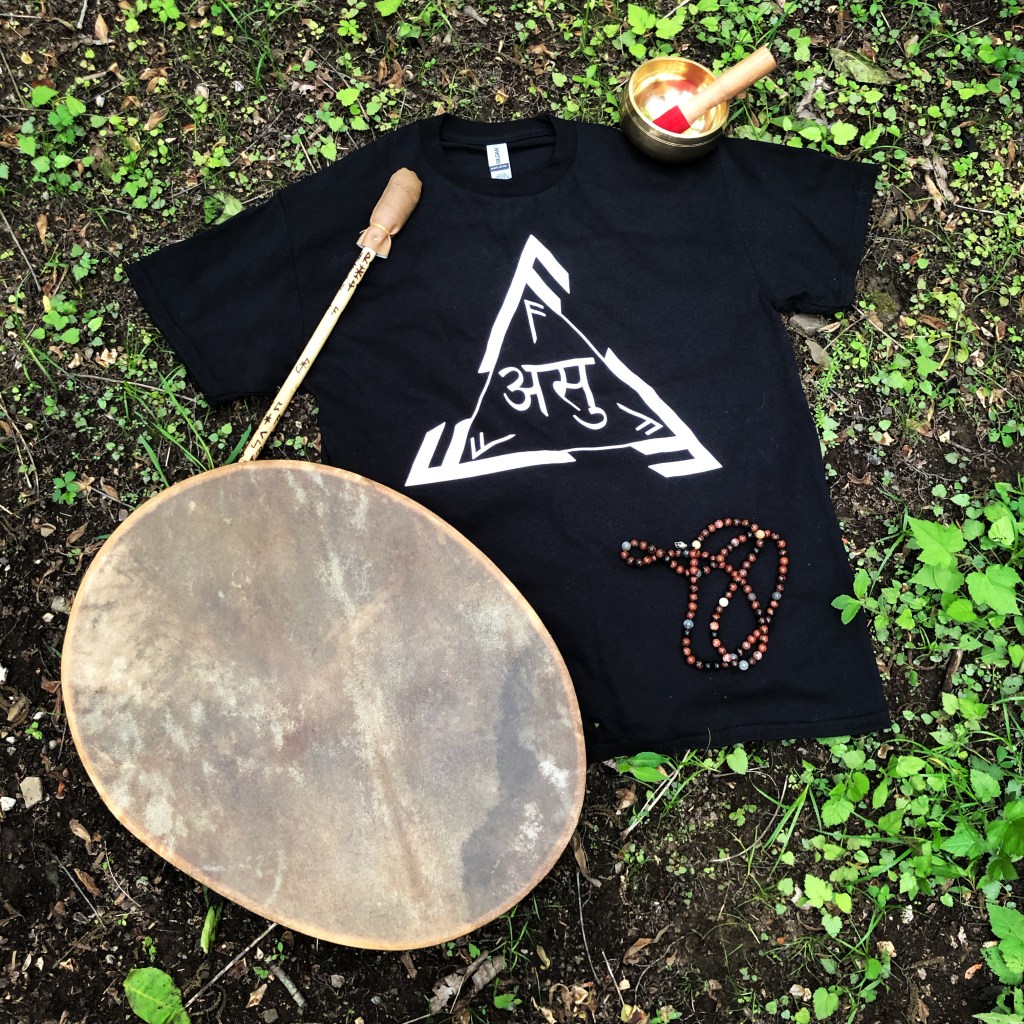
Our first batch of shirts have arrived and look awesome.
These will be given out to members, donors, volunteers and collaborators in order to spread not only the sign, but the culture of the Ansuz Society.
Our hope is that these will be worn with modesty, positivity, and respect.
For those who would like to purchase a shirt directly, they can be ordered for $20 with free shipping in the USA. Please use the contact form to order. Sizes available are small, medium, and large. Very limited quantity available.
While we invite everyone to interpret these symbols as they see fit, we would like to offer a brief overview of the design:
-3 Ansuz runes representing the gods Odin (soul), Vili (will), and Ve (body); the 3 components necessary for human life.
-the related Sanskrit word ásu, meaning “breath, spirit, life force, life.”
In regards to the triangular shape, we have a strong emphasis on the fire element, hence one interpretation of the triangle as fire. This fire is being propagated by the breath or wind represented by the Ansuz runes. The upward triangle also has associations with the air element, and therefore, is another representation of the breath, wind, and soul of which Odin is said to have given to mankind. With these connections in mind, this sign can be viewed as an internal flame driven by the winds of inspiration, or, Odin.
We also believe that all matter is a form of the Great Mother who strives for union with the Great Father (source of consciousness). That said, another interpretation of the upward triangle is to represent the male aspect of primordial awareness; the unmovable, foundational consciousness which exists in all sentient life. Because of this connection, the upward triangle can also be perceived of as representing Shiva, as his half of the Shatkona is the △ shape, while Shakti is symbolized by the ▽ shape. This primordial awareness, associated with male energy, is called by many names across the world and seen in deities such as Odin, Shiva, and Vajradhara.
May all beings benefit from these signs.
Hailaz / Namaste
-Ansuz Society
 Ansuz Society