
Subscribe to continue reading
Subscribe to get access to the rest of this post and other subscriber-only content.

Subscribe to get access to the rest of this post and other subscriber-only content.
Isa is among the most powerful of runes, although, easily overlooked due to its simple form. On the outside, this rune represents ice and the powers inherent within “frozen” states of being; nearly removed from the degradation of time. When looking for etymological clues during the research of this rune, I was unable to break free from the “ice,” so to speak. No matter where I searched, there wasn’t much material stretching this rune out. So, most of what we can say about Isa is largely subjective, although, some basic core concepts have been generally accepted as interpretations, such as focus, patience, and stillness. These ideas we will explore more as we dive further into this mysterious rune.
Isa is a word that hasn’t changed much since its’ theoretical use in Iron Age Germania. We still see it quite clearly in the English word ice and German eis, even loaning itself to Japanese in the form of aisu. At the root of Isa is the Proto-Indo-European h₁eyH- meaning “ice, hoarfrost, rime,” most likely referring to the icy residue left upon sprawling steppe landscape in cold months. Later, this would evolve into the Old Norse íss, which also means “ice.” This word, likewise, is used as a kenning or poetic reference to a sword, which clearly resembles the long, sharp icicles that hang from roofs and rafters in the winter.
The “Old English Rune Poem” gives us a beautiful description of this rune, stating:
“Ice is extra cold and immensely slick,
It glistens clear as glass, most gemlike,
A frost-wrought floor, fair to behold.”
The first line seems to have a precautionary feeling to it, expressing the obvious physical qualities of the rune. The second line starts to unfold the more metaphysical associations that the Anglo-Saxons attached to it, as ice can have a “mesmerizing” effect on the observer; clear like glass and mimicking the beauty of a fine gemstone. The final line shows that the ice was held in reverence by our ancestors, as the force held in Isa is one of beauty, radiance, and power. It is in this sense that we can attribute qualities like focus, stillness, and even a sense of “peace” to Isa.
Isa represents meditation, concentration, and patience. Isa is still and quiet, as one who is meditating. Isa is concentrated matter; power focused inward. Isa is a force of patience, taking long periods of “human time” to affect its surroundings. We can attribute a great energy and power to Isa, the same force inherent in continents of ice and gargantuan glaciers that carve the face of the Earth. This is an unseen and long-lasting power, extremely “dense” and focused; opposite to the quick and clearly observable power of fire which consumes all. It is with this evidence that we can grant this rune half of the powers fundamental in the Norse creation myth.
With Isa, we can invoke the now familiar concept of “Odin’s 9,” being a rune that is unchanged whether right side up or inverted. In relation to Odin, it is said that he is the offspring of the ice giant Bestla and the primordial being Borr, connecting him and the giants/jötunns directly to this rune. This evidence enforces theories about Isa regarding the past and its’ association with memory. Ice freezes and “locks” matter within it, encasing things and moments in a space beyond time. Essentially, ice holds the memories of the past within it. This has been further reinforced in modern science, as it has been proven that water can actually carry information within it. Isa slows and halts the forces of change.
This brings up the god/giant Mímir. Mímir translates to “memory” and further connects to Proto-Indo-European (s)mer- which means “to fall into thinking, remember, care for,” or essentially, meditation. This applies connection to Isa and to Odin, as meditation and the unlocking of “memories” is one of Odin’s most sought-after goals, consulting often the head of Mimir for advice and counsel. It is with this evidence that, I would argue, Isa is synonymous with the traditional symbol of the “crystal ball” that magicians, wizards, and various occultists have been said to consult throughout history. Mimir’s head could very well be associated with a large, clear gemstone or crystal, one which Odin uses for prophecy, wisdom, and focus.
Within Isa we also have a key to creation, as this rune represents a building block of design; the ancient and primordial ice that met with the all-encompassing “heat” or furious fire in the middle expanse of Ginnungagap (yawning abyss). With Isa we can see the ancient concept of Germanic “duality.” Not as one dealing necessarily with good and evil, but with “fire and ice”; chaos and order, change and stillness.
The ”Old Norwegian Rune Rhyme” gives us two rather obscure lines regarding Isa, stating :
“Ice we call a broad bridge;
A blind man needs to be led.”
Surely the Norwegians experienced a difference in form and force of ice than their ancestors from the steppe, as the first line alludes to massive and expansive “bridges” of ice. The second line seems to me to indicate that if one is “blind” or inexperienced that he will need to be led safely over these “bridges of ice.” Here we can see this rune is able to be applied to many circumstances in life where one is potentially “blind,” making this rune a more practically applicable concept.
Lastly, we will refer to the “Old Icelandic Rune Poem,” where it is said:
“Ice is the rind on a river, and a wave’s roof,
And a danger for doomed men.”
Here we have a more objective picture of this rune. We see its form as the “rind” or crust/peel of the river, referring to the layer of ice upon the top of bodies of water. We also have a reference to oceanic ice as the “wave’s roof,” something the Icelanders would have had an intimate relationship with. Lastly, the obvious is stated as a warning, that this rune is danger for men who are “doomed.” On land or sea, if you are unprepared for ice, indeed you will likely be doomed.
To conclude, it is without a doubt evident that Isa holds immeasurable power within it. Although it is arguably the “quietest” of all the runes, I think as with people, this is a sign of a different type of power; one that is slow, focused, precise, calm, and internalized. Cunningness as opposed to a purely aggressive, outward force. Isa is mastery over the forces within, a “silence” that is akin to serenity. With Isa we can associate deep and focused acts of meditation, a Shiva-like “stillness” that deeply reverberates within, radiating a crystal brilliance internally. This is the clear awareness of Odin; clear, bright, and entirely concentrated.
-Wandering the Runic Path: Esoteric Analysis of the Germanic Runes
Subscribe to get access to the rest of this post and other subscriber-only content.
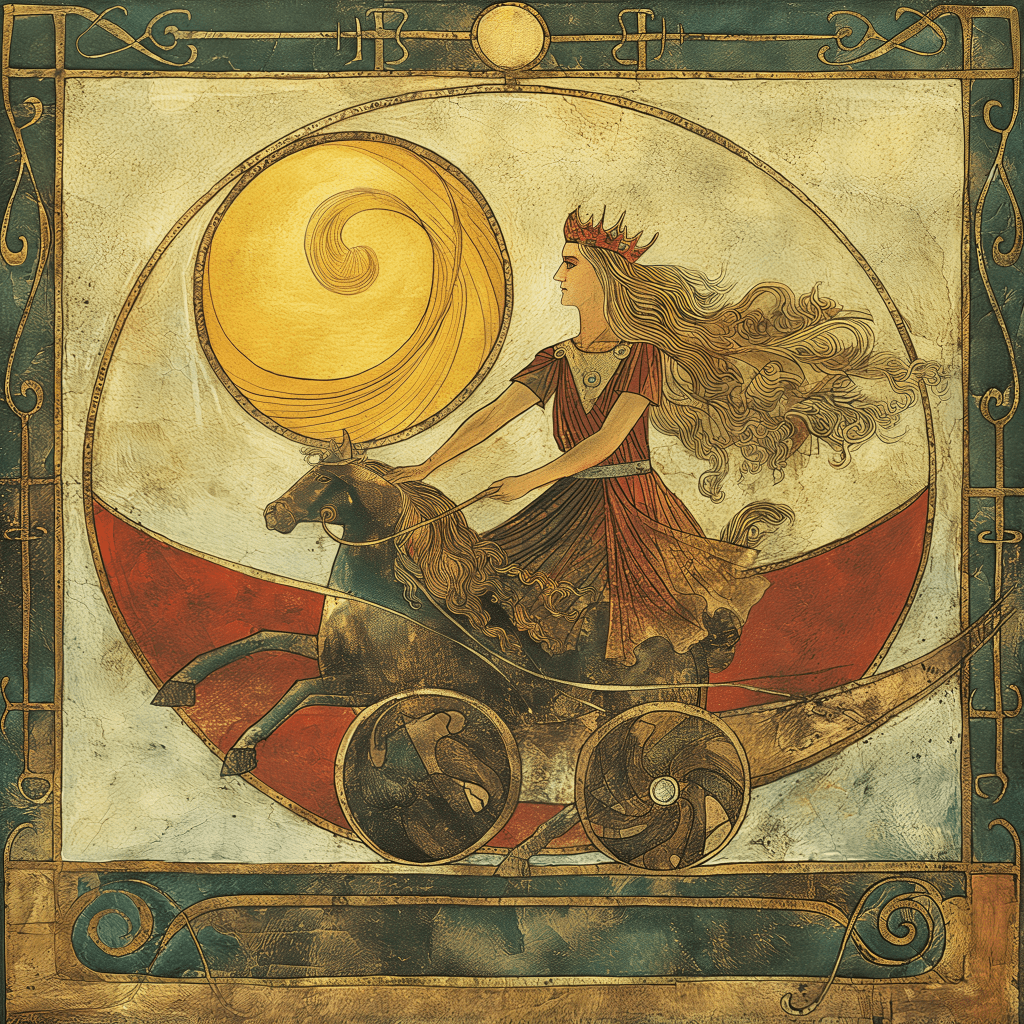
The Summer Solstice is the time of year when the daylight is longest, the power of the Sun is at its peak, and the solar cycle reaches its apex, tipping the scales towards the dark half of the year once again. After this turning point, the sunlight begins to wane, shortening the daylight minute by minute until the Winter Solstice. Typically, this was a time to celebrate the Sun, spend time outdoors, and enjoy the bliss of good weather. Mead, wine, and other beverages would be consumed, and great feasts would be enjoyed.
In “Teutonic Mythology” by Grimm, it is said:
“Twice in the year the sun changes his course, in summer to sink, in winter to rise. These turning-points of the sun were celebrated with great pomp in ancient times, and our St. John’s or Midsummer fires are a relic of the summer festival. The higher North, the stronger must have been the impression produced by either solstice, for at the time of the summer one there reigns almost perpetual day, and at the winter one perpetual night.”
Games and various competitions would be hosted along with other festivities such as dancing and music. Entertainment would be lively and abundant, encouraging joy and merriment among the community. In the Germanic context, many people honor the god Baldr during this time as a god of light and/or personification of the light of the Sun, which in a mythological context, “dies” and beings to decline after this time, mirrored by Baldr’s death and descent into Hel. Because of these connections, a common blot/ritual focus during the Summer Solstice is the death (or funeral) of Baldr, the god of light. Stone ships are erected, abundant offerings are made, and various sacrificial items are thrown into fire. These offerings are meant to aid Baldr in his journey on the long road of the underworld.
In “Celtic Mythology and Religion” by Macbain, he says:
“The midsummer festival, christianised into St John’s Eve and Day, for the celebration of the summer solstice, is not especially Celtic, as it is a Teutonic, feast. The wheels of wood, wrapped round with straw, set on fire, and sent rolling from a hillock summit, to end their course in some river or water, which thus typified the descending course of the sun onward till next solstice, is represented on Celtic ground by the occasional use of a wheel for producing the tinegin, but more especially by the custom in some districts of rolling the Beltane bannocks from the hill summit down its side. Shaw remarks – “They made the Deas-sail [at Midsummer] about their fields of corn with burning torches of wood in their hands, to obtain a blessing on their corn. This I have often seen, more, indeed, in the Lowlands than in the Highlands. On Midsummer Eve, they kindle fires near their cornfields, and walk round them with burning torches.” In Cornwall last century they used to perambulate the villages carrying lighted torches, and in Ireland the Eve of Midsummer was honoured with bonfires round which they carried torches.”
Large bonfires and “Sun-wheels” are made during this time, reflecting the power and glory of the Sun. Special attention was given to the goddess during this time as well, whether as a deification of the Sun itself, the Earth, the Mother, or a mix of the 3. Offerings such as flowers, cakes, milk, honey, and blood are given to the gods and spirits, a ritual exchange of abundance for abundance. As observed in the above quote, it was (and is) common practice to bring the energy of the Sun down to Earth in the form of a torch, then parade it through the fields, groves, or temples in order to bless them with this powerful energy.
In “A History of Pagan Europe” by Jones & Pennick, it says:
“…But the summer solstice, under its statutory date of 25 June, became a popular festivity early in Germanic history. The German word Sonnenwende always refers, in medieval texts, to the summer solstice, not to the winter solstice. At the end of the first century CE some German troops in the Roman army at Chesterholme listed their supplies for the celebration in a record which has come down to us. In the early seventh century, Bishop Eligius of Noyon in Flanders criticised the chants, carols and leaping practised by his flock on 24.”
Here we are given examples of some ancient Germanic practices revolving around the Summer Solstice. We are told of singing, chanting, and competitive games like “leaping”. Clearly, the Christian Romans were disturbed by this revelry, showing its clear Pagan origins. This turning point in the year was extremely important to observe, as it strikes a pivotal moment in the Sun’s lifecycle, affecting every aspect of our lives.
 Ansuz Society