Sunny weather today (Feb.1) implies the Winter Goddess Cailleach is out collecting more firewood and that Winter is to be prolonged. This observation would have been common to the various Celtic peoples of the British Isles and would have given them insight into what to prepare and plan for.
In America, this tradition is carried over in the form of Groundhog Day. This observance is identical to the Celtic Winter Goddess tradition because it is said that if the groundhog sees his shadow on Feb.2 (implying the sun is shining), we can expect six more weeks of Winter. If he does not see his shadow, it’s because the weather is poor and it is believed that Winter will end early. This tradition was brought over by German immigrants who used to observe the shadows of badgers or hedgehogs to judge the remaining duration of Winter.
You can see why this time of year is observed as significant, as it is the beginning of the transition into Spring, which holds many spiritual connotations for animistic religions and those who work the land or raise animals.
For us here in Western New York, it looks like Winter is not going anywhere anytime soon. So, we will plan accordingly!
Kali is a wrathful emanation of the great Mother Durga and the consort of Lord Shiva.
Kali is destruction and time. She is representative of the cycles of samsara, specifically birth, death, and rebirth. Despite this association, she is also a symbol of moksha (liberation), as she encourages effort (shakti) and action in one’s life to overcome obstacles and suffering.
Kali is nature and matter, everything that changes in existence. She is that which primordial, unchanging consciousness (Shiva) is thrust into. This duality is the core of what we see in the famous image of Kali dancing on Shiva, as she is the play (dance) of nature and he rests motionless beneath her as the foundation of reality (consciousness/space).
Although Kali seems fearsome, this aspect of the goddess has immense motherly love for her devotees. She gladly removes tribulations and gives boons to her followers as long as they remain strong and diligent. Negative thoughts and emotions are offered to Kali who purifies them instantly. The mantra “Om Krim Kalikaye Namah” is an invocation and homage of the glorious goddess Kali Ma, who chooses carefully her disciples according to their endurance and diligence.
“The powerful black Hindu goddess Kali effortlessly slays an eight-armed spotted green demon with an impossibly long trident. His chariot horses and two minions lie incapacitated below. Kali’s tongue lolls out, indicating her ability to catch blood before it touches the ground: one of her demonic enemies has blood that generates another demon every time one drop comes in contact with the earth. The demon is a metaphor for wicked thoughts that give rise to more evil thoughts; Kali aids her followers in eradicating them all.”
The Younger Futhark (Futhorc) emerged around the 8th century C.E. in Scandinavia and is comprised of 16 runes. These runes were developed from the older 24 rune system we now call the Elder Futhark. Because of this reduction in symbols, some runes inevitably absorbed others in the process, making the system more cryptic. This also made reading and writing more complicated, as now some runes could supply a wider array of sounds. We see this for instance in the Tyr (ᛏ) rune, which indicates the “t” sound, now symbolizing the “d” sound as well, or in the Bjarkan (ᛒ) rune, which represents the “b” sound, now including the “p” sound as well. However, the rune with the most sounds is the Ur (ᚢ) rune, which includes over 5 different phonetic values such as U/W/V/Y/O.
This galdr track includes 16 repetitions of the Younger Futhorc, intended to help with meditation, memorization, and focus.
May it be of use to practitioners and anyone wanting to learn the runes.
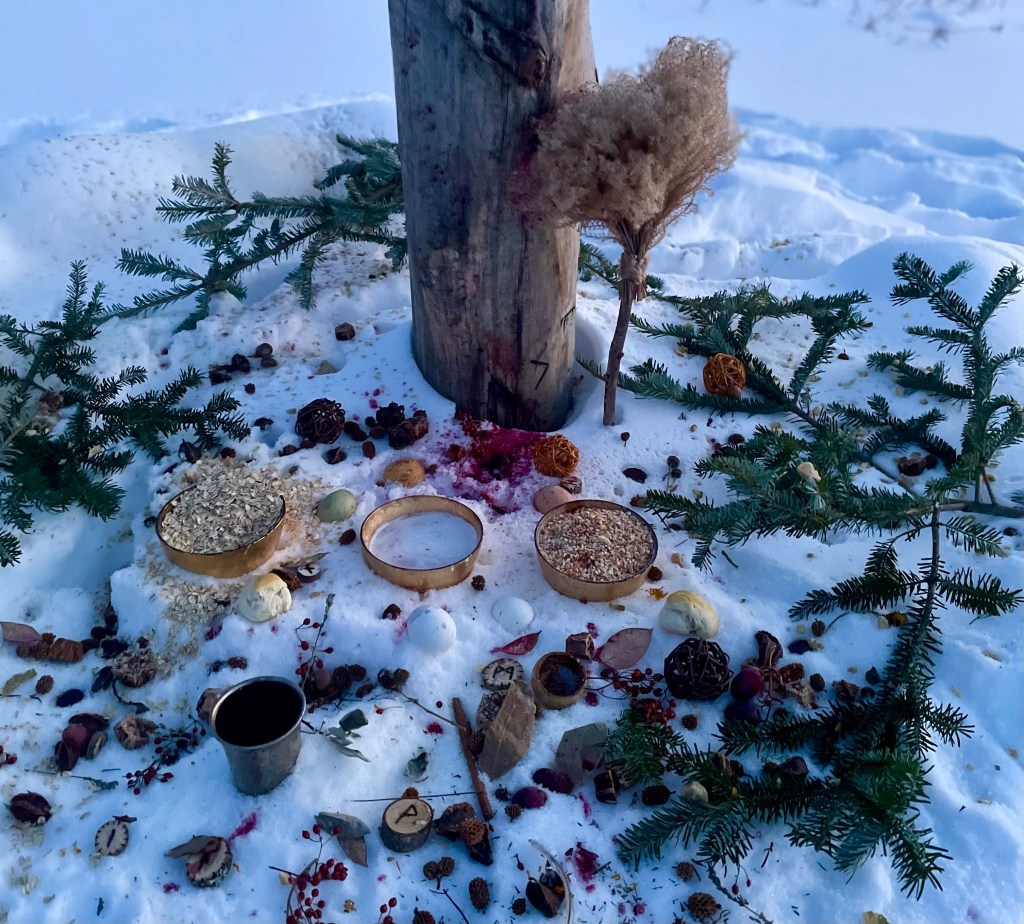
Imbolc, an Old Irish word meaning “in the belly”, is the time of year when we eagerly await the changing weather in order to judge the remaining duration of Winter. On this day, if it snows or is very harsh outside, we rejoice, because according to ancient Irish Celtic tradition, it means that the Winter Goddess, Cailleach (Veiled One), is asleep and Winter will likely end soon. However, if the weather is fair and fine, we can expect Cailleach to be out collecting more firewood and supplies, ensuring a longer and more treacherous Winter ahead. So, during this time, we hope for harsh weather and make offerings to various deities, generally Cailleach (Hel), Odin, and the local spirits in order to gain their favor. It is wise to be cautious of one’s noise production on this day so as to not wake the sleeping Crone.
Jones and Pennick give us a glimpse into these ancient Celtic customs:
“…the goddess known as Brighde in Ireland, Bride in Scotland and possibly Brigantia in the north of Britain. She had to do with warmth, fire, summer and possibly the Sun, since an Irish legend tells that in winter she was imprisoned in an icy mountain by a one-eyed hag.’ In some places she presided over thermal springs, presumably as the underground Sun, and in Scotland until the mid-twentieth century she was welcomed in at Imbolc (1 February) by the symbolic rekindling of the hearth fire after the house had been springcleaned from top to bottom.”
Reverence for fire and the Sun are important during this day, as soon the warmth of Spring will be arriving, bringing in longer days. Some European tribes marked Imbolc as their official beginning of Spring, but most considered it a celebration (and observation) of the ending Winter and the new beginning that lay ahead. Cleaning of the house and hearth would be essential during this time, preparing the living area for the next year of activities. Animal pens and beds would be changed and laundry would be washed. For those further North or in higher elevations, this day would have likely been celebrated differently, as we will see in the later quoted material.
In “Celtic Mythology and Religion,” Macbain writes:
“Candlemas day is known as La Fheill-Brighde, St Brigit’s day, who is really the canonised fire-goddess, the Vesta of the heathen Gaels. Some customs in regard to her worship were mentioned already, and Martin relates an interesting custom in the Western Isles on Candlemas, showing St Brigit clearly on the aspect of Vesta, the hearth and home goddess. The mistress and servants of each family take a sheaf of oats and dress it up in women’s apparel, put it in a large basket and lay a wooden club by it, and this they call Briid’s-bed, and then they cry thrice, “Briid is come, Briid is welcome.” Next morning they look in the ashes to see the impression of Briid’s club there, and if they do they reckon it a true presage of a good crop and prosperous year, and the contrary they regard an ill omen.”
As with the divination of ashes described above, various other means of prophecy would be undertaken to gather as much insight into the current (and future) situation as possible. Divination is a window into the workings of fate, a way to receive information directly from the wide Web of Wyrd. These cryptic bits of insight would be deciphered by a seer or seeress, sometimes a traveling witch, priestess, or the man of the household (priest). This would be their compass for how to focus their attention and energy as the year unfolded.
In “Sorcery and Religion in Ancient Scandinavia,” Vikernes writes:
“The 7th Sunday before Easter, usually the 1st of Þrúðheimr, was known as Washing, known from Gaelic as Imbolc or Imbolg (“washing”), and was regarded as the first day of spring. Washing lasted for a full week. The Sunday of Washing was called Pork Sunday, and this was the day Hel’s horse arrived with the news that Baldr would return. Everyone therefore gave thanks to Hel on this day. Pork Sunday was the day they transferred the fertility of spring to the women, by whipping their behinds with fresh birch branches. This custom survived well into the age of gods, and a form of this is in fact still practised in parts of Scandinavia.”
Common themes regarding this time of year include fire reverence, goddess worship, special recognition of the Sun, and special veneration to the Winter Crone Cailleach (Hel). Exceptional attention was paid to washing and cleaning, as well as creating a new fire in the hearth of the home. Offerings were made to various deities in order to be blessed with a prosperous year and good health. With Imbolc came the glimmer of Spring and the glorious days of plenty that lie ahead. In many ways, this celebration started the people off on a clean slate.
We’ve just released another mantra track on our channel, may it benefit all beings.
Tara is a prominent goddess in both Hindu and Buddhist traditions, representing the feminine aspects of the Supreme, whether as an emanation (Mahavidya) of the great Durga or as a female embodiment of the Buddha. Tara has an exceptionally wide array of forms depending on which religious pantheon one is focusing on, varying from entirely wrathful forms to completely peaceful ones. These different emanations are necessary according to each individuals’ particular inclinations (due to karmic imprints) or specific school of practice.
In Vajrayana Buddhism, Tara is believed to have 21 forms with varying attributes, colors, and characteristics. She is invoked for protection and liberation from obstacles, to dispel poisons and bad dreams, and to destroy demons or other harmful spirits. Tara is revered as a loving mother and is often referred to as the “Mother of All Buddhas.” She guards sentient beings against fear, anxiety, and disease. Tara is often Green in color, representing all the activities of the Buddha, but white is also common, used for achieving long life and longevity. Other forms and colors exist as well. The seed syllable of Tara is TAM.
The Sanskrit word tā́rā means “star”, stemming from the Proto-Indo-European word h₂stḗr, which refers to stars (or planets) and means “shiner or glower.” Her mantra is OM TARE TUTTARE TURE SVAHA which means “Praise to Tara the Swift Liberator, Hail!” Above her sits Amitabha, Buddha of Boundless Light.
“…Homage to her whose face is like one hundred full autumn moons
And who blazes with light like that of thousands of stars…
…Homage to her whom Indra, Agni, Brahma, Vayudeva,
An herb as powerful as Mugwort is an invaluable way to connect and learn more about Goddesses of not only Greek, but Norse and Celtic mythology. Mugwort and its association with women, those who protect and champion women, as well as those seeking to expand their metaphysical world through dream and deity work, is as important today as it was thousands of years ago.
Artemis, the namesake of Mugwort, is the logical starting point. Artemis is a goddess of the hunt, the moon, and especially of female initiation and protection. She is associated with girls and women, but is also a goddess to boys and men in rites of initiation and the hunt. All who wish to learn more and work with her are welcome, as she is a goddess for everyone. Mugwort, having derived its name from her, is the mother herb mirroring her mothering prowess.
However, in the Greek mythos, she was not a goddess to suffer fools gladly. She vehemently defended her virginity and reputation as the greatest of hunters. Some sources suggest she was the patron goddess of the fearsome women warrior tribe, the Amazonians. A passionate and ferocious fighter for what she believes is right, a beacon for those who need strength.
Of everything that Artemis is known for, Mugwort is most closely related to her powers as midwife, a deity for both comforting women in labor and the newborn. Mugwort is also an important herb for dream and trance work, lending itself nicely to moon rituals, as Artemis was also a goddess of the moon. Using Mugwort in its tincture form, or burning as a smudge stick, will help to expand consciousness and enter a trance state for magical work. Adding Mugwort into your meditation on Artemis during the moon, especially the full moon, will greatly enhance communication.
In Norse mythology, Frigg, the most powerful volva, was believed to be the first practitioner of seidr magic. Frigg is the wife of Odin and a fiercely protective mother of Baldur. She is the goddess of family, motherhood, fertility and the balance of love and wisdom. Mugwort works perfectly with Frigg as it is an herb whose main use has been for assistance in prophetic dreaming and the overall health of women.
Runes that can be used when invoking Frigg are Fehu, Pertho and Berkano. Fehu, when related to Frigg, is a female rune for fertility concerned with livestock, and especially newly born cattle in spring. Fehu is always a rune of productivity. It can also be used for spiritual or artistic creativity, carrying a fiery power within. Fehu can also represent certain aspects of the life force.
Freya Aswin correlates Pertho with birth. Pertho can also be used to help find hidden aspects within yourself. The joining of these attributes with Frigg, who governs birth and is involved with weaving fate (through work as a volva and through seidr magic), very nicely encapsulates the magic of Mugwort.
The Berkano rune indicates birth, being rooted, and the feminine, has been called a rune of ‘bringing into being’, the first protection given to children at birth. Both Artemis and Frigg were known as unrelenting defenders of children and women. Incorporating Mugwort when working with Frigg can be very beneficial.
The goddess of Celtic mythology most closely associated with Mugwort is Brigid. Brigid is known as a goddess of fire, poetry, and healing; a maternal goddess who embodies the divine feminine. She is like spring, representing new beginnings.
As a goddess of fire and hearth, she was said to watch over all the fires in the homes of Ireland. She was closely associated with the sun and the warmth of spring, the time of renewal and rebirth. Mugwort is also an herb closely associated with fertility, the goddess, and of womanhood. Brigid, as a goddess that protected the flame (which was so important for ancient people’s survival), is like a mother radiating maternal compassion.
Poetry (and creativity) have always had close ties with the metaphysical and dream world, a world that Mugwort works so well in. Brigid was called upon to help with creativity and inspiration, especially with bards, who held a very high position in Celtic society. Bards were the keepers of history and culture, and Brigid was often invoked to help inspire creativity.
Brigid was also a goddess of healing. She was often called upon to help cure sickness and injury, as her touch was said to have healing powers. In addition to being a healer of sickness and injury, she was a goddess of childbirth, watching over women in labor. Her presence helped ease pain and ensured a safe delivery. She was also a protector of children and was asked by parents to watch over children’s safety and health. Brigid and her divine energies align well with Mugwort and its properties.
The beginning of Spring is a magical time. Everything starts to wake up from Winter’s sleep, the air becomes perfumed by unfurling buds and shoots of green, birthed under sky and warming Sun. The birds start to unleash their full songs, filling the landscape with sound. In short, pure magic. What better time than now for one of the most magical plants to start its ascent skyward. Mugwort is now lining roads and walkways, growing unchecked in fields. I’ve taken the plunge into the world of Mugwort and would love to take you with me.
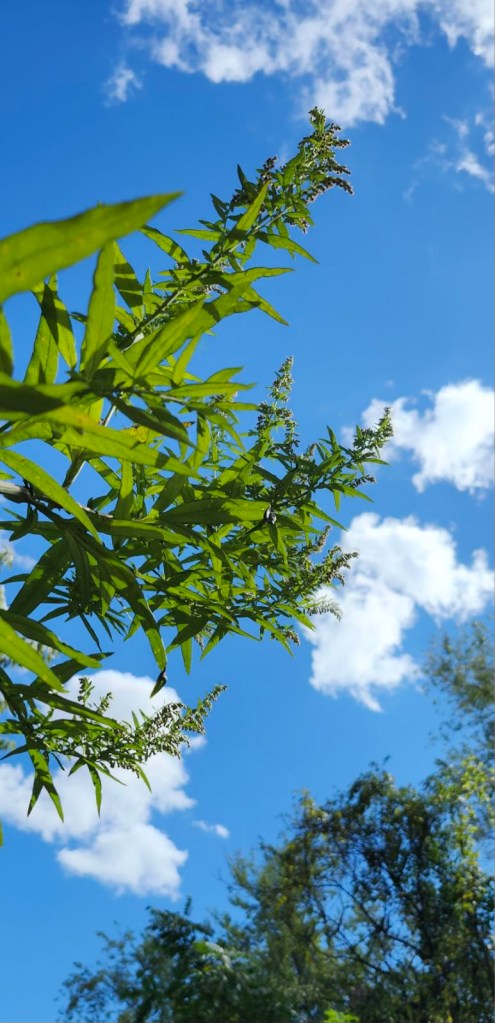
Mugwort (Artemisia Vulgaris) is one of the oldest herbs referenced in Anglo-Saxon plant wisdom. Some of its earliest known uses were to help regulate menstrual cycles, as well as with divination and dreamwork. There is also evidence of Mugwort smoke as an offering to Isis in Ancient Egypt. It has been mentioned in poems dating back as far as 3 B.C. in China, such as the the Shi King/Jing Poetry Classic. It is also mentioned in the poem “Hortulus” by Walafrid Strabo (808 AD – 849 AD), as ‘the Mother of Herbs’. Mugwort’s roots pre-date modern history.
The name Mugwort comes from the Greek Goddess Artemis, Lady of the Moon. She is the Goddess of hunting and fertility, also assisting in the cultivation of willpower and self-reliance. She is a comforter to women in labor, a helper to midwives, and protector of young girls. Mugwort is ruled by the planet Venus, lending it even more feminine energy. Hippocrates and Dioscorides even endorsed the use of Mugwort to help ease childbirth, their works having influenced modern medicine. The “Hippocratic Oath” that says “First do no harm” is from, well, Hippocrates.
The herb has many healing properties, both physical and spiritual. Physically, Mugwort may help stimulate menstruation, keeping from stagnation. It can be used for help in treating rashes, sore joints, bruises, and bug bites. Mugwort has benefits for pain relief, especially from arthritis. It has powerful nervine qualities, nervines being things that help relieve stress on your nervous system, which can be very helpful when treating anxiety, depression, and stress. Mugwort also contains things like iron, phosphorus, potassium, zinc, and tannin. It’s also a nutrient dense plant found most everywhere.
Personally, Mugwort is one of my favorite herbs. It has the ability to induce incredibly vivid dreams and the ability to bring about lucid dreaming experiences. Those are two of the main reasons why I love mugwort. Dream work is an important part of my spiritual practice, and Mugwort has been the best tool I’ve used. It can be taken as a tincture in tea, smoked, or put in dream sachets and bundles for burning. Being an herb so deeply entrenched in feminine energies, it is perfect for those that want to connect to the divine feminine, bond with their personal intuition, and enhance sensitivity. It can help open yourself to being more empathetic and patient.
Stagnation in body and mind can cause all sorts of problems. Mugwort increases circulation and warms the blood, helping a stagnating body. A stagnating mind will lead to frustration, detachment, and anxiety, just to name a few. Mugwort opens the mind, allowing for deep meditation and vision work. It can help with opening thoughts and deeper spiritual meanings. It moves the things in us which have lain dormant. It’s an herb for gentle but serious action.
Any phase of the Moon will work when using Mugwort for lunar practices, as it is a lunar herb. However, the best and most interesting time to use it would be during the Balsamic moon or when the moon is fully waned. The Balsamic moon is a time of going inward and recharging. This is the phase right before the new moon, making this moon perfect for meditation and really digging into the self. The Balsamic moon is the time to find what intentions you want to set and why you are trying to set that intention. Using Mugwort to explore your inner world will really help you bring your intentions to the surface; the perfect time to put your plans into action.




 Ansuz Society