
Subscribe to continue reading
Subscribe to get access to the rest of this post and other subscriber-only content.

Subscribe to get access to the rest of this post and other subscriber-only content.
This process is something that is done differently by almost everyone, as there has never existed a pan-Pagan dogma regarding this type of activity. However, most would agree that when constructing an altar in the Germanic fashion, there are 4 main pieces to consider. These 4 pieces we will cover here along with other ideas for what one can add to their setup. Having an altar dedicated to spiritual activity is important, as it gives one a place to conduct work that is vital to the human experience.
First, one must find a location that one is drawn to, perhaps isolated in the forest at the foot of a particularly powerful tree, a secret natural site, or inside one’s home in a secluded area. Second, it is recommended that an organic “table” be present in the location to conduct exchanges and make offerings, such as a stump or flat stone. If there is not, one should build something for this purpose. This can be a simple platform, or it can be an entire temple, this all depends on the person’s means and dedication. Third, the deity with which one wishes to communicate (in this case Odin) needs a home or place to inhabit on the altar. This can take the form of a special tree, stone, idol, statue, image, or in some cases, the skull of an animal or human. Generally, the deity is thought to reside in this location indefinitely, although, some will argue that they are only meant as temporary dwellings for the gods and spirits to reside in while the operant conducts their business. The fourth piece, especially important in the case of Odin (but also relevant to any Pagan altar), would be the drinking vessel in which we offer libations.
Once one has completed these 4 tasks, the altar is ready to be blessed and put into immediate use. Blessings include fumigation, galdr, and various invocations to protect the space. Some other things to consider placing on the altar are offering bowls, incense vessels, candles, a set of runes, and a place to leave meat or gifts intended for Odin’s ravens and wolves. Aside from these things, it is up to one’s discretion what they choose to exchange with the High One. When it comes to maintaining this space, one must keep things fairly organized and clean. This shows respect to the deity and helps one stay disciplined.
Strive to replace the rune set every year, if made of wood. If the runes are made of stone, they should be washed, cleansed and re-consecrated through galdr and one’s own blood. Last, libations should be made according to your means, but it is recommended to refresh the drinking vessel either every 3 days, 9 days, 45 days, and/or on full Moons. When throwing out the old libation, it should be offered to a tree or local spirit, never put into the drain or trash.
May this be of use to new and current practitioners.
Hailaz!
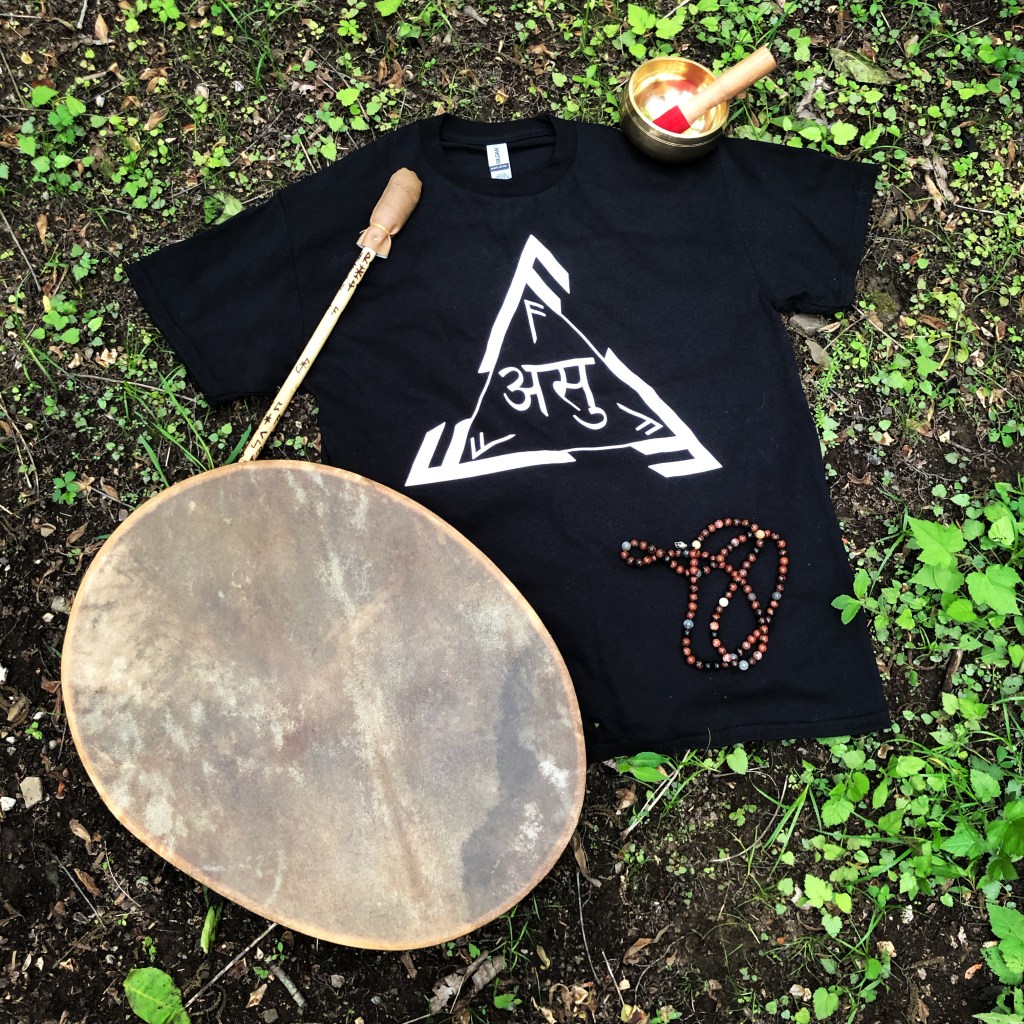
Our first batch of shirts have arrived and look awesome.
These will be given out to members, donors, volunteers and collaborators in order to spread not only the sign, but the culture of the Ansuz Society.
Our hope is that these will be worn with modesty, positivity, and respect.
For those who would like to purchase a shirt directly, they can be ordered for $20 with free shipping in the USA. Please use the contact form to order. Sizes available are small, medium, and large. Very limited quantity available.
While we invite everyone to interpret these symbols as they see fit, we would like to offer a brief overview of the design:
-3 Ansuz runes representing the gods Odin (soul), Vili (will), and Ve (body); the 3 components necessary for human life.
-the related Sanskrit word ásu, meaning “breath, spirit, life force, life.”
In regards to the triangular shape, we have a strong emphasis on the fire element, hence one interpretation of the triangle as fire. This fire is being propagated by the breath or wind represented by the Ansuz runes. The upward triangle also has associations with the air element, and therefore, is another representation of the breath, wind, and soul of which Odin is said to have given to mankind. With these connections in mind, this sign can be viewed as an internal flame driven by the winds of inspiration, or, Odin.
We also believe that all matter is a form of the Great Mother who strives for union with the Great Father (source of consciousness). That said, another interpretation of the upward triangle is to represent the male aspect of primordial awareness; the unmovable, foundational consciousness which exists in all sentient life. Because of this connection, the upward triangle can also be perceived of as representing Shiva, as his half of the Shatkona is the △ shape, while Shakti is symbolized by the ▽ shape. This primordial awareness, associated with male energy, is called by many names across the world and seen in deities such as Odin, Shiva, and Vajradhara.
May all beings benefit from these signs.
Hailaz / Namaste
-Ansuz Society
We’ve added a new song to the channel titled “Lord of the Wind.”
This is a devotional song to the All-Father, Odin.
“…Holding wisdom old as time,
Elder god of masks and rhymes,
Flames rise to lick the sky,
Send our gifts to those on high…”
May all beings benefit.
Hailaz / Namaste
-Ansuz Society
 Ansuz Society