Wandering the Runic Path: Esoteric Analysis of the Germanic Runes (New Book Coming Soon!)

We are wrapping up the final edits for the second rune book by Hrukjan titled “Wandering the Runic Path: Esoteric Analysis of the Germanic Runes.” 

These will be published early next month and copies will be available from us around Samhain. 

For those interested in the book, we’d like to share some information from the introduction:

“This book is meant to help guide the runic adept through various untrodden paths regarding the runes and their use in esoteric Pagan practice. Through many avenues such as language, myth, religious comparison, and thorough analysis, one can expand the dimensions of each rune into the endless fathoms of space and time. Each rune of the Elder Futhark has been dissected and tirelessly studied so that no stone is left unturned in their usability and ultimate meaning. Along with in-depth study, each “aett” of runes has also been given a set of common themes that one can ponder in association to their roles within the entirety of the Futhark. Not only this, but it is speculated throughout the book that the order of the runes is not only important, but carefully tells a unique story regarding life, death, rebirth, and the ultimate truth of existence as expressed by the people who created and used them.

While much of this book is speculative in nature, offering a deeply subjective analysis of these symbols, there is also much concrete and objective information regarding their history, etymology, and journey through time. From their many connections to Sanskrit and other Indo-European languages, the reader can form a thorough understanding of these symbols based on thousands of years of transformation. The reader will see how these runes transcend culture and relate to the natural surroundings of the different tribes that used them as they migrated across much of Europe, Asia, and beyond. Through this approach, one will see that the use of the runes is not only universally applicable, but also, not restrained to a certain “folk” or people. By realizing the scope of their use, one can see them as a divine tool for Self-development and transformation, as each rune is a key to ultimate realization.

If you are looking for a book that is not just informative, but also applicable to religious and spiritual practice, then this book should offer you many avenues towards your own purified understanding of these ancient symbols as used by the greatest of sages and magicians of the past. My hope is that this book will act as a compass for the devoted reader as they traverse the dark and endless paths laid before them by these ancient symbols. By doing so, one does not get lost or steered in detrimental directions by those who would rather see you confused and reliant on outside influences. Runic knowledge and the wisdom inherent within them are present in every sentient being, especially those who have the memories of these signs within their very soul. These secret symbols mirror that which exists within us and each rune is a key to unlocking the mysteries that lie dormant within our experience of reality. May this book help you transcend the limitations of individual existence and soar into the ether as Odin once did upon the great World Tree.”

May all sentient beings embrace the runes.

-Ansuz Society

Fall and Winter Rune Classes

Rune classes will resume this Fall/Winter both in person and online via zoom.

Classes will range from basic introduction to advanced theory and practice.

In person group classes will be limited to 3 people at a time to ensure each person is given proper attention.

More details will be posted next month.

If you have any questions, please feel free to reach out.

If you are interested in teaching a class either in person or online, let us know!

May all beings thrive.

Hailaz / Namaste

Wunjo

Wunjo is closely related to the feeling of love, whether intimate or familial. We see this in the proto-Indo-European root word wenh₁-, which means “to love, win” and “to wish.”Many words have come from this root and it seems this sound denotes a sort of happiness, kindness, and affection. We see another related word in the Latin venia meaning “kindness, mercy, grace” and in the modern English/Old French word venial meaning “able to be forgiven, worthy of forgiveness.”

We see connections associated with Wunjo in both words, as during the process of forgiveness one shows great love. Other words derived from these roots are the proto-Germanic word wanjaną which means “to make accustomed to,” indicating an act of extreme care and kindness to guests.

Wunjo is this process, formula, and understanding; the living phenomenon of the Wish, of love, and kindness. Wunjo is the creation of bliss, joy, and satisfaction in life.May all beings thrive and experience great love.

Hailaz / Namaste

Fuþark

We are very pleased to bring you a new sound offering in honor of this particularly auspicious full moon. Through these songs, we strive to bring together Pagan voices from all over the world, spreading a network of support, positivity, and spiritual action. We would like to thank Desert Rose Arts, Marble Mountain Woodworks, and Dodssang Tempel for their excellent vocal contributions. Other voices have asked to remain anonymous. This track is meant for quick practice as opposed to our longer version of the Elder Futhark. By listening to this brief galdr, one can quickly memorize the names and order of the Elder Futhark runes with ease; solidifying them internally for use at any moment of need. The Ansuz Society family tree is growing. With deep roots, we stretch towards the sky. May all sentient beings thrive under the guidance of the ancient runes.

Ending the Futhark with Dagaz

We end the Futhark with Dagaz (ᛞ) because we believe that after one realizes the true Self, represented by Othala (ᛟ), one can then “break the cycle” of saṃsāra, like the breaking of dawn on a new day. 

This process of enlightenment is represented by Dagaz.

In reality, whether you end with Othala or Dagaz, one can theoretically come to the same conclusions either way. 

These choices are not meant to be dogmatic, but philosophical. Make the decision on your own, based on research and practice. 

Hailaz / Namaste 

What is Ansuz?

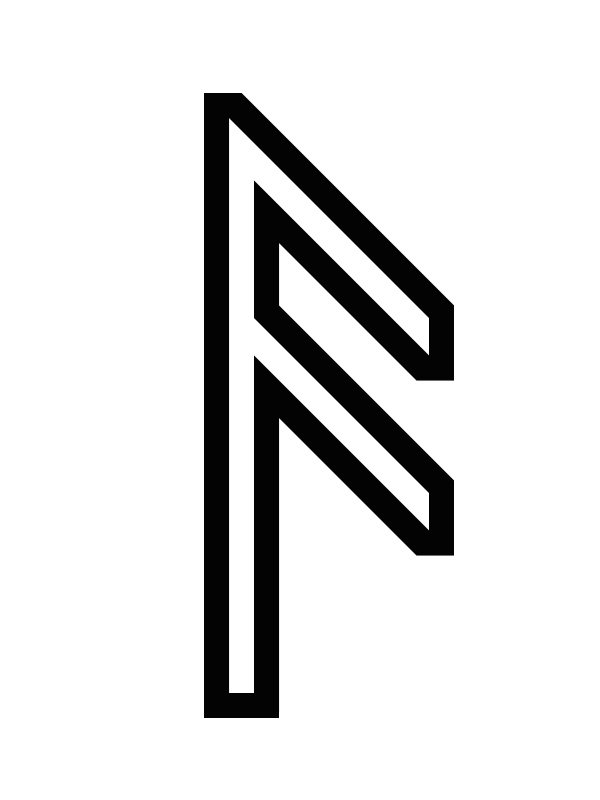
Ansuz is that which gives animation to the otherwise lifeless body. Ancient man associated the breath with life, and likewise, associated it with the spirit or soul. We are given insight into this rune in the very word animation. To “animate” means to “give life or spirit,” something the god Odin is known for gifting mankind with. It is said in ‘Voluspo’ verses 17 and 18:

“17. Then from the throng, did three come forth,

From the home of the gods, the mighty and gracious;

Two without fate, on the land they found,

Ask (man) and Embla (woman), empty of might.

18. Soul they had not, sense they had not,

Heat nor motion, nor goodly hue;

Soul gave Othin, sense gave Honir,

Heat gave Lothur, and goodly hue.”

Here we see mention of Othin as the “soul giving” god; one that grants the Self, the breath, and the life within us. Odin is the force that animates life as one would consider Chi or Prana. Ansuz can be related to the wind in this way, as the wind is the same as the breath. When we reach back into antiquity, we find the proto-Indo-European word hems- meaning “to engender, beget, give birth to,” eluding to this life-giving, all-encompassing force associated with the breath. The ancient man knew he was much more than just the physical workings of his body or impulses of the mind, therefore, the idea of the breath took on the utmost sacred context, as this is something that happens within us, invisible to the eye save the movement of the chest.

In Sanskrit, we have the relative words ásu meaning “life force, breath, spirit” and ásura meaning “godlike and powerful.” This word would evolve to become related to demons or foreign tribes in later Hinduism, similar to the Thurs of Germanic tradition. The original Asura can be equated with their cognate family of gods in the Norse pantheon, the Aesir, who were essentially Sky Gods. Ansuz encompasses this family of gods and ultimately represents the chief of the pantheon, Odin/Wotan/Wodanaz. 

In Old English, the word ōs means “god,” which gives us insight as to what this word might have meant to a pre-Christian pagan. It would be fair to say this idea of god was entirely wrapped up with the concept of the breath, the mouth, and sounds that are created from within it.

Another connection we find is in the word animism, meaning “a belief that an immaterial force animates the universe,” and “a belief that spirits inhabit some or all classes of natural objects or phenomena.” Here, we are clearly looking at this belief as a fully established religious understanding, the oldest of what we have currently been able to uncover when discussing the long history of human spiritual practice. With absolute clarity, we can see this ancient system and secret was carried through time and culture into the North in the form of Odin and through this particular rune, which carries enormous weight in the entirety of the Futhark. Ansuz represents this encompassing force, which has been utilized and studied as an occult science for thousands of years in countless forms of yoga and meditation; the breath is the bellows of the forge within.

In the ‘Old Icelandic Rune Poem’ it is said:

“Oss is the old Gaut,

and Asgards prince,

and Valhalla’s leader.”

Here it is clear that this rune is connected to Odin and further to the ancient “Gaut,” Odin’s title in the Gothic tongue, the oldest recorded Germanic language.

Of course, when discussing all of this, it would be wrong to not include speech, wisdom, and poetry in our analysis of Ansuz and its’ god form of Odin. In both the “Old Norwegian Rune Rhyme” and the “Old English Rune Poem” this rune is associated specifically with the mouth. In the ‘Old Norwegian Rune Rhyme” it is said:

“Oss is the way of most journeys;

But a sheath is that for swords.”

Here I think we are seeing another allusion to Gaut, which is a title meaning “to pour or flow out of.” This may mean that most journeys were undertaken on water as opposed to on foot; as the sail goes “the way” of the wind. It can also mean that one must cultivate good speech, as “the way” here most certainly pertains to a type of heathen dharma system. One must follow the way of wisdom on most journeys. The mouth (as the pen wasn’t exactly a means for these people yet) was the tool and portrayer of wisdom, expressing the ideas, memories, and inner workings of the human being. The second line could be referring to those who hold their tongue too often or treat their mouth as a sheath, as one who stays silent may often not be viewed as the wisest or most able.  The “Old English Rune Poem” reinforces these theories:

“Os is the source of all speech,

Wisdom’s upholder, and a comfort to counselors;

For every earl, happiness and hope.”

We must remember that the Germanic tribes prior to Roman conquest were a mostly illiterate and orally maintained people and culture. All of their stories and mythologies were encased and crystallized in poetry, song, and the runic system. With this in mind, we can understand why speech and it’s use, function, and manipulation, was of the most importance if one was to attain any merit in the realms of wisdom. Ansuz, in this way, is one of the most crucial runes for us to understand and incorporate if we are to learn the true secret beneath the layers of conscious existence.

-Ansuz Society