This galdr track was created for prayer, meditation, and ritual purposes.
Through the rhythm and words, one is encouraged to dissolve into space and time, traveling with the spirits of the Wild Hunt surrounded by a myriad of runes. Short prayers to Odin and the Norns are recited to gain favor, prosperity, and divine inspiration.
This poem was composed around the Winter Solstice of 2024.
We’ve just released another mantra track on our channel, may it benefit all beings.
Tara is a prominent goddess in both Hindu and Buddhist traditions, representing the feminine aspects of the Supreme, whether as an emanation (Mahavidya) of the great Durga or as a female embodiment of the Buddha. Tara has an exceptionally wide array of forms depending on which religious pantheon one is focusing on, varying from entirely wrathful forms to completely peaceful ones. These different emanations are necessary according to each individuals’ particular inclinations (due to karmic imprints) or specific school of practice.
In Vajrayana Buddhism, Tara is believed to have 21 forms with varying attributes, colors, and characteristics. She is invoked for protection and liberation from obstacles, to dispel poisons and bad dreams, and to destroy demons or other harmful spirits. Tara is revered as a loving mother and is often referred to as the “Mother of All Buddhas.” She guards sentient beings against fear, anxiety, and disease. Tara is often Green in color, representing all the activities of the Buddha, but white is also common, used for achieving long life and longevity. Other forms and colors exist as well. The seed syllable of Tara is TAM.
The Sanskrit word tā́rā means “star”, stemming from the Proto-Indo-European word h₂stḗr, which refers to stars (or planets) and means “shiner or glower.” Her mantra is OM TARE TUTTARE TURE SVAHA which means “Praise to Tara the Swift Liberator, Hail!” Above her sits Amitabha, Buddha of Boundless Light.
“…Homage to her whose face is like one hundred full autumn moons
And who blazes with light like that of thousands of stars…
…Homage to her whom Indra, Agni, Brahma, Vayudeva,
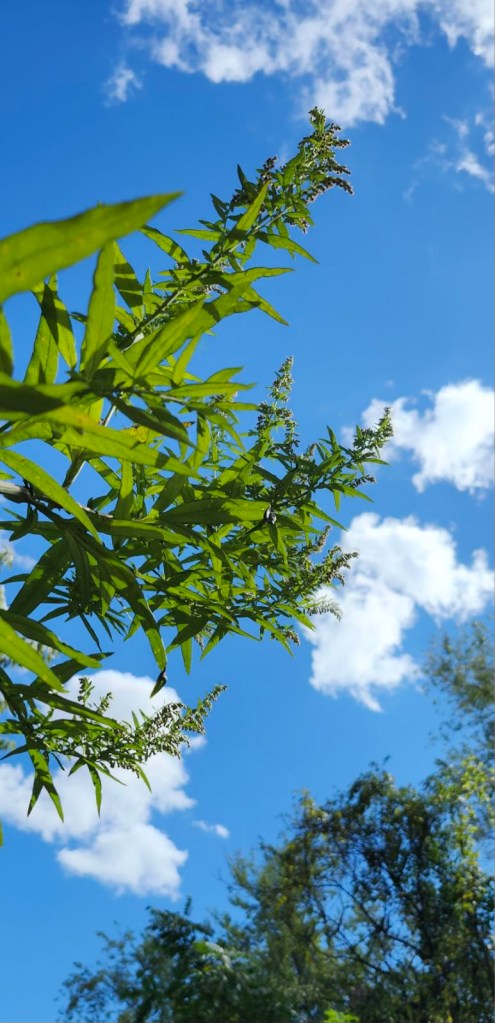
An herb as powerful as Mugwort is an invaluable way to connect and learn more about Goddesses of not only Greek, but Norse and Celtic mythology. Mugwort and its association with women, those who protect and champion women, as well as those seeking to expand their metaphysical world through dream and deity work, is as important today as it was thousands of years ago.
Artemis, the namesake of Mugwort, is the logical starting point. Artemis is a goddess of the hunt, the moon, and especially of female initiation and protection. She is associated with girls and women, but is also a goddess to boys and men in rites of initiation and the hunt. All who wish to learn more and work with her are welcome, as she is a goddess for everyone. Mugwort, having derived its name from her, is the mother herb mirroring her mothering prowess.
However, in the Greek mythos, she was not a goddess to suffer fools gladly. She vehemently defended her virginity and reputation as the greatest of hunters. Some sources suggest she was the patron goddess of the fearsome women warrior tribe, the Amazonians. A passionate and ferocious fighter for what she believes is right, a beacon for those who need strength.
Of everything that Artemis is known for, Mugwort is most closely related to her powers as midwife, a deity for both comforting women in labor and the newborn. Mugwort is also an important herb for dream and trance work, lending itself nicely to moon rituals, as Artemis was also a goddess of the moon. Using Mugwort in its tincture form, or burning as a smudge stick, will help to expand consciousness and enter a trance state for magical work. Adding Mugwort into your meditation on Artemis during the moon, especially the full moon, will greatly enhance communication.
In Norse mythology, Frigg, the most powerful volva, was believed to be the first practitioner of seidr magic. Frigg is the wife of Odin and a fiercely protective mother of Baldur. She is the goddess of family, motherhood, fertility and the balance of love and wisdom. Mugwort works perfectly with Frigg as it is an herb whose main use has been for assistance in prophetic dreaming and the overall health of women.
Runes that can be used when invoking Frigg are Fehu, Pertho and Berkano. Fehu, when related to Frigg, is a female rune for fertility concerned with livestock, and especially newly born cattle in spring. Fehu is always a rune of productivity. It can also be used for spiritual or artistic creativity, carrying a fiery power within. Fehu can also represent certain aspects of the life force.
Freya Aswin correlates Pertho with birth. Pertho can also be used to help find hidden aspects within yourself. The joining of these attributes with Frigg, who governs birth and is involved with weaving fate (through work as a volva and through seidr magic), very nicely encapsulates the magic of Mugwort.
The Berkano rune indicates birth, being rooted, and the feminine, has been called a rune of ‘bringing into being’, the first protection given to children at birth. Both Artemis and Frigg were known as unrelenting defenders of children and women. Incorporating Mugwort when working with Frigg can be very beneficial.
The goddess of Celtic mythology most closely associated with Mugwort is Brigid. Brigid is known as a goddess of fire, poetry, and healing; a maternal goddess who embodies the divine feminine. She is like spring, representing new beginnings.
As a goddess of fire and hearth, she was said to watch over all the fires in the homes of Ireland. She was closely associated with the sun and the warmth of spring, the time of renewal and rebirth. Mugwort is also an herb closely associated with fertility, the goddess, and of womanhood. Brigid, as a goddess that protected the flame (which was so important for ancient people’s survival), is like a mother radiating maternal compassion.
Poetry (and creativity) have always had close ties with the metaphysical and dream world, a world that Mugwort works so well in. Brigid was called upon to help with creativity and inspiration, especially with bards, who held a very high position in Celtic society. Bards were the keepers of history and culture, and Brigid was often invoked to help inspire creativity.
Brigid was also a goddess of healing. She was often called upon to help cure sickness and injury, as her touch was said to have healing powers. In addition to being a healer of sickness and injury, she was a goddess of childbirth, watching over women in labor. Her presence helped ease pain and ensured a safe delivery. She was also a protector of children and was asked by parents to watch over children’s safety and health. Brigid and her divine energies align well with Mugwort and its properties.
The Autumn Equinox is the turning point in the year when daylight and darkness are equal once again, tipping the scales towards the darkest period of the year when the nights grow longer and the weather gets colder. Traditionally, harvests would be reaped during this time and various rituals were conducted for the gods and spirits residing over abundance. Attention was given to the wights and ancestors, as it was believed that this time was liminal and that other realms were accessible. At the cusp of Equinox, the dark half of the year begins to slowly gain dominance.
Bonfires are especially common as well as sacrifices, whether physical or symbolic. People give thanks and ask for future harvests, ensuring a healthy stock of goods for the upcoming Winter months. Much depended on this pivotal time of year and many rites were undertaken to guarantee success. Feasts would be widespread as well as games, echoing other Summer and Fall festivals in atmosphere. For us here in the Northeastern United States, many crops are ripening during this time such as squash, corn, and apples. With this comes canning and drying goods to stock pantries for the Winter.
In “Teutonic Mythology” by Grimm, it says:
“In some parts of northern England, in Yorkshire, especially Hallamshire, popular customs show remnants of the worship of Frieg. In the neighborhood of Dent, at certain seasons of the year, especially autumn, the country folk hold a procession and perform old dances, one called the giant’s dance: the leading giant they name Woden, and his wife Frigga, the principal action of the play consisting in two swords being swung and clashed together about the neck of a boy without hurting him.”
As seen above, many early English (and Germanic) peoples would honor the god/goddess Frieg (Frigga) and Woden (Odin) during this time. Woden/Wotan in early Germanic belief was sometimes associated with wheat fields, where offerings were left for his horse Sleipnir during pivotal moments of the year. Certain epithets of Odin give reason to believe that he has been worshipped as a benevolent god to some extent, reigning over wealth, fate, and general prosperity. Names like this include Farmatýr (Lord of Cargoes) and Óski (God of Wishes).
Regarding Odin and continental Pagan belief, Grimm also states:
“As these names [Woden/Mercury/Hermes], denoting the wagon and the mountain of the old god, have survived chiefly in Lower Germany, where heathenism maintained itself longest; a remarkable custom of the people in Lower Saxony at harvest-time points the same way. It is usual to leave a clump of standing corn in afield to Woden for his horse.”
Of all the ancient celebrations, the Autumn Equinox was the most difficult one to find any references for. My belief is that it was a lesser celebratory event and more centralized in each community, where the harvest would be brought in and the local spirits offered to. People were likely working hard and didn’t have time to prepare for anything extravagant like they would during the last harvest of the year (Samhain), which certainly would have taken the forefront in terms of importance, at least to the Pagan Celts.
In “The One-Eyed God” by Kershaw, it says:
“These times of transition are strange times, whether the transition is from month to month, or season to season, or year to year; they are times which are not quite one thing or the other. They are like boundary lines, which are not quite my property or yours, or doorways, which are not quite inside or outside. As Eitrem said, it is at these dividing lines of time and space that the dead and Hermes are particularly active.”
It was common to not only focus on the harvest at this time, but to also give special attention to the dead and gods (or spirits) associated with death. The year was about to start its descent into darkness and the deified Sun/Light was to begin the darkest part of its journey through the underworld. Because of this, symbolic bonfires are lit to emulate the Sun and prolong the light.
In “Sorcery and Religion in Ancient Scandinavia” by Vikernes, it says:
“Odinn placed his eye in the grave, in the well of the past, every year, in order to learn from the past. This might sound strange, but his eye was the Sun, Baldr, that lost its power every autumn and therefore had to spend the winter in the world of the dead. In other words, Odinn had one eye in the world of the living and one eye in the world of the dead.”
Aside from the various gods, goddesses, and spirits of prosperity, it is clear that Odin and Frigga took a central role in (Germanic) Equinox observances in some areas of Pagan Europe. Odin (Woden) was recognized as a god of wishes, death, darkness, gifts, and clairvoyance, mirroring the exoteric liminality of the period between light and dark invoked by the Equinox. This external event is to also be reflected internally, as darkness begins to gain supremacy after this transition. We begin to look inward and conduct deeper spiritual work, creating light within to combat the impending darkness of Winter.
This process is something that is done differently by almost everyone, as there has never existed a pan-Pagan dogma regarding this type of activity. However, most would agree that when constructing an altar in the Germanic fashion, there are 4 main pieces to consider. These 4 pieces we will cover here along with other ideas for what one can add to their setup. Having an altar dedicated to spiritual activity is important, as it gives one a place to conduct work that is vital to the human experience.
First, one must find a location that one is drawn to, perhaps isolated in the forest at the foot of a particularly powerful tree, a secret natural site, or inside one’s home in a secluded area. Second, it is recommended that an organic “table” be present in the location to conduct exchanges and make offerings, such as a stump or flat stone. If there is not, one should build something for this purpose. This can be a simple platform, or it can be an entire temple, this all depends on the person’s means and dedication. Third, the deity with which one wishes to communicate (in this case Odin) needs a home or place to inhabit on the altar. This can take the form of a special tree, stone, idol, statue, image, or in some cases, the skull of an animal or human. Generally, the deity is thought to reside in this location indefinitely, although, some will argue that they are only meant as temporary dwellings for the gods and spirits to reside in while the operant conducts their business. The fourth piece, especially important in the case of Odin (but also relevant to any Pagan altar), would be the drinking vessel in which we offer libations.
Once one has completed these 4 tasks, the altar is ready to be blessed and put into immediate use. Blessings include fumigation, galdr, and various invocations to protect the space. Some other things to consider placing on the altar are offering bowls, incense vessels, candles, a set of runes, and a place to leave meat or gifts intended for Odin’s ravens and wolves. Aside from these things, it is up to one’s discretion what they choose to exchange with the High One. When it comes to maintaining this space, one must keep things fairly organized and clean. This shows respect to the deity and helps one stay disciplined.
Strive to replace the rune set every year, if made of wood. If the runes are made of stone, they should be washed, cleansed and re-consecrated through galdr and one’s own blood. Last, libations should be made according to your means, but it is recommended to refresh the drinking vessel either every 3 days, 9 days, 45 days, and/or on full Moons. When throwing out the old libation, it should be offered to a tree or local spirit, never put into the drain or trash.
May this be of use to new and current practitioners.
Lughnasadh is named after the Celtic Sun god Lugh. This is a time when the first harvests of the year would be brought in and prosperity would begin to be felt amongst the community. Summer is fully in bloom and the golden fields and vibrant flowers mirror the glory of the powerful Sun above. During this time, people would feast and make offerings to the gods with the first fruits of the year. During Lughnasadh, there would be singing, music, games, competitions, and much more, as the people could finally begin to enjoy the rewards of their hard work so far that year. Traditionally, Lughnasadh is the first of the 3 great harvest celebrations, kicking off the sacred celebrations when humans reap the results of what they have sown.
In “Celtic Mythology and Religion,” Macbain writes:
“It is called in Scottish Gaelic “Lunasduinn,” in Irish “Lunasd,” old Irish “Lugnasad,” the fair of Lug. The legend says that Luga of the Long Arms, the Tuatha De Danann king, instituted this fair in honour of his foster-mother Tailtiu, queen of the Firbolgs. Hence the place where it was held was called Tailtiu after her, and is the modern Teltown. The fair was held, however, in all the capitals of ancient Ireland on that day. Games and manly sports characterised the assemblies. Luga, it may be noted, is the sun-god, who thus institutes the festival, and it is remarkable that at ancient Lyons, in France, called of old Lug-dunum, a festival was held on this very day, which was famous over all Gaul.”
Wrestling tournaments, races, and various games would have been held during this time in honor of the god Lugh, who is known for being highly skilled in many different areas. Archery, stone lifting, and weight throwing contests were said to have occurred, continuing into the modern day with summer events like the Highland Games. Sacrifices were also common in Pagan times, generally of a bull, and a feast would be made from its flesh, while a portion of the blood and other pieces were given to the gods.
In “A History of Pagan Europe” by Jones & Pennick, it is said:
“Lughnasadh (1 August, also called Bron Trograin) appears to have been imported into Ireland at a later date, perhaps by continental devotees of Lugh, who in the Irish pantheon is a latecomer, the ildánach, master of all skills, more modern in character than the other goddesses and gods. Correspondingly, Lughnasadh differs from the other three festivals in being agrarian in character, marking the harvest, and baking of the first loaf from the new grain. The deity honoured at Lughnasadh was Lugh, who was said to have instituted the games in honour of his foster-mother, Tailtiu. Tailtiu (Teltown) is in fact the name of the site of the festival in Tara. It is an ancient burial ground, and its name is thought to mean ‘fair’ or ‘lovely’, so if it ever was associated with a presiding goddess of that name, like Demeter in Greece she would have ruled both the Underworld and the fruits which sprang from it.”
In modern Germanic Pagan practice, Lughnasadh is recognized as Freyfaxi or “Frey Day,” replacing the Celtic Lugh with the Norse Freyr. Special and careful thanks are given to Lord Ingwaz/Yngvi/Freyr during this time to honor his power and acknowledge his benevolence. A general sense of peace should be felt on this day as well as an internal feeling of gratitude for all one has in life. As a god of wealth, Freyr makes us reflect on the things that make us feel a sense of prosperity in our lives.
In “Sorcery and Religion in Ancient Scandinavia” by Vikernes, it says:
“The 15th day of Alfheimr was Harvest Sacrifice (No. Slatteblot), also known as Wake-Up-Day, known from Gaelic as the festival of Lugh (“light”). The day marked the beginning of harvest. Before harvest could begin the grain spirit was killed and burned, or it was – in the shape of a goat made from last year’s straw – cut into bits and pieces and buried in the field’s four corners and in the field itself. By the time of the Bronze Age the spirit of light and grain had become a goddess and a god, Sibijo and Fraujaz, known from the Scandinavian mythology as Sif and Freyr respectively. The grain deity was still represented by a straw figure in animal form – usually a goat. In addition to this, the god was cut down with a sax, sickle or scythe in a sword dance. Finally, a symbol of the god, usually a loaf of bread or (in the most ancient of times) a cone, was cut into bits and pieces and buried with the straw animal in the field/meadow. The grain spirit had to die and be buried in the ground for new grain to come. They took the first straw harvested and made a new animal of it, then stored it in a safe place for next year’s Harvest Sacrifice.”
In summary, whether celebrating Lughnasadh or Freyfaxi, this is a time when the first fruits of the year are reaped and specific rituals are undertaken to ensure the fertility of the land. Skills are put on display and the community is brought together under a common aim: prosperity, happiness, and peace. It is important to give thanks to natural and local spirits for their blessings, and to the gods for their gifts. During Lughnasadh, we revel in the light, we feast, and we celebrate our good fortune.
The Chanterelle is an edible mushroom with medicinal perks.
You can find this golden treasure living in symbiosis with pine, spruce, oak and hornbeam.
They will reappear in the same places year after year so long as the mycelium in the soil is not disturbed. One patch can produce fungi for generations.
Some of the benefits of Chanterelles include:
• Rich source of several vitamins and minerals including vitamin D which supports bone health
• Known to help reduce inflammation
• Great immunity boosters
We like to pickle our excess Chanterelles for later use.
Let us know if you have any favorite Chanterelle recipes or other uses!
Back at headquarters after a very busy and powerful weekend at KTD.
Two empowerments were given (Stainless Ushnisha and Stainless Light Rays), both related to the construction of stupas, the consecration of the items therein, and the clearing away of obstacles. These were given by Khenpo Lodrö Dönyö Rinpoche, abbot of the Mirik Monastery. This is something we would like to sponsor here at some point in the future.
After that, the monks began a 7 day Chakrasamvara puja at the request of the Karmapa, whose father passed away.
It is always rejuvenating to visit this holy site, but, it is also hard to leave. If you find yourself in the area, you should certainly stop by.
May all beings thrive.
“There is an old saying that the path is the goal and goal is the path. You make your journey, you get to your destination, and arriving at your destination brings on another question: how to proceed from there? In that way each goal itself becomes the path. Particularly from the tantric point of view, you don’t achieve anything except path. Discovery of the path is achieving.”
The Summer Solstice is the time of year when the daylight is longest, the power of the Sun is at its peak, and the solar cycle reaches its apex, tipping the scales towards the dark half of the year once again. After this turning point, the sunlight begins to wane, shortening the daylight minute by minute until the Winter Solstice. Typically, this was a time to celebrate the Sun, spend time outdoors, and enjoy the bliss of good weather. Mead, wine, and other beverages would be consumed, and great feasts would be enjoyed.
In “Teutonic Mythology” by Grimm, it is said:
“Twice in the year the sun changes his course, in summer to sink, in winter to rise. These turning-points of the sun were celebrated with great pomp in ancient times, and our St. John’s or Midsummer fires are a relic of the summer festival. The higher North, the stronger must have been the impression produced by either solstice, for at the time of the summer one there reigns almost perpetual day, and at the winter one perpetual night.”
Games and various competitions would be hosted along with other festivities such as dancing and music. Entertainment would be lively and abundant, encouraging joy and merriment among the community. In the Germanic context, many people honor the god Baldr during this time as a god of light and/or personification of the light of the Sun, which in a mythological context, “dies” and beings to decline after this time, mirrored by Baldr’s death and descent into Hel. Because of these connections, a common blot/ritual focus during the Summer Solstice is the death (or funeral) of Baldr, the god of light. Stone ships are erected, abundant offerings are made, and various sacrificial items are thrown into fire. These offerings are meant to aid Baldr in his journey on the long road of the underworld.
In “Celtic Mythology and Religion” by Macbain, he says:
“The midsummer festival, christianised into St John’s Eve and Day, for the celebration of the summer solstice, is not especially Celtic, as it is a Teutonic, feast. The wheels of wood, wrapped round with straw, set on fire, and sent rolling from a hillock summit, to end their course in some river or water, which thus typified the descending course of the sun onward till next solstice, is represented on Celtic ground by the occasional use of a wheel for producing the tinegin, but more especially by the custom in some districts of rolling the Beltane bannocks from the hill summit down its side. Shaw remarks – “They made the Deas-sail [at Midsummer] about their fields of corn with burning torches of wood in their hands, to obtain a blessing on their corn. This I have often seen, more, indeed, in the Lowlands than in the Highlands. On Midsummer Eve, they kindle fires near their cornfields, and walk round them with burning torches.” In Cornwall last century they used to perambulate the villages carrying lighted torches, and in Ireland the Eve of Midsummer was honoured with bonfires round which they carried torches.”
Large bonfires and “Sun-wheels” are made during this time, reflecting the power and glory of the Sun. Special attention was given to the goddess during this time as well, whether as a deification of the Sun itself, the Earth, the Mother, or a mix of the 3. Offerings such as flowers, cakes, milk, honey, and blood are given to the gods and spirits, a ritual exchange of abundance for abundance. As observed in the above quote, it was (and is) common practice to bring the energy of the Sun down to Earth in the form of a torch, then parade it through the fields, groves, or temples in order to bless them with this powerful energy.
In “A History of Pagan Europe” by Jones & Pennick, it says:
“…But the summer solstice, under its statutory date of 25 June, became a popular festivity early in Germanic history. The German word Sonnenwende always refers, in medieval texts, to the summer solstice, not to the winter solstice. At the end of the first century CE some German troops in the Roman army at Chesterholme listed their supplies for the celebration in a record which has come down to us. In the early seventh century, Bishop Eligius of Noyon in Flanders criticised the chants, carols and leaping practised by his flock on 24.”
Here we are given examples of some ancient Germanic practices revolving around the Summer Solstice. We are told of singing, chanting, and competitive games like “leaping”. Clearly, the Christian Romans were disturbed by this revelry, showing its clear Pagan origins. This turning point in the year was extremely important to observe, as it strikes a pivotal moment in the Sun’s lifecycle, affecting every aspect of our lives.
The Spring Equinox marks the traditional Easter celebration, the moment when the Sun crosses the equator from south to north. This is when animals like rabbits, deer, chipmunks, and other creatures of the forest begin to have their offspring. Various flora also emerge around this time, dotting the landscape with hints of color. During the Spring Equinox we pay special attention to the great Goddess in her youthful form of Ostara, Goddess of the Dawn. Ostara is associated with the rising Sun in the East, fertility, and light; a beacon of joy and good fortune. To many ancient Germanic Pagans, Ostara was credited with Springs deliverance. From her name we derive the modern word Easter, nodding to the Pagan origins of this holiday. To Ostara we make offerings and pray for a good year, thanking her for the return of the light. In one particular myth, Ostara transforms a bird into a rabbit who would then lay colorful eggs for her, showing us where the core symbolism of our modern holiday came from.




 Ansuz Society