We recorded another version of the popular mantra OM CHAM CHANDRAYA NAMAHA this Spring and are happy to share it with you.
This mantra is dedicated to the Moon god Chandra, also known as Soma, and can be translated many ways, such as “Homage! I Drink/Eat of the Moon!”.
The word cham comes from the Proto-Indo-European word kʷem which means “to swallow,” implying that one absorbs the energy of the Moon as one does when drinking water or eating food.
Chandra means “glittering/shining” and is a word used for the Moon personified. This light (or shine) is what we take in during meditation, transforming it into clarity of mind and peace in spirit.
Namaha comes from the Proto-Indo-Iranian word námas (respect, homage) which derives from the Proto-Indo-European word némos, meaning “to bend, sacrifice, worship.”
As this is chanted and visualized, one gives reverence with each repetition for the illuminating clarity that is given by the great Shining One, filling one’s consciousness with calm images of crystals, water, and moonlight.
In Vedic astrology, eclipses are seen as a symbol of revenge or as a bad omen.
According to mythology, eclipses are caused by the Chaya Graha (shadow planets) Rahu and Ketu, who were once part of a divine serpent. The story is traced back to a time before creation in the tale of the churning of the ocean, known as the Samudra Manthan. The churning of the ocean represents our consciousness. After an awful and lengthy war, the devas (gods) and asuras (demons) cooperated to churn the galactic material called the Milk Ocean. The churning poured forth several gifts and treasures. They included the goddess of wealth Lakshmi, the wish-fulfilling tree Kalpavriksha, the wish-fulfilling cow Kamadhenu, and Dhanvantari, who carries a pot of amrita and a book of medicine called Ayurveda. Amrita is a Sanskrit word that means “immortality” and is a drink (or nectar) intended only for the gods.
A serpent demon (Svarabhānu) aspired to become invincible. Sitting between Surya (the Sun) and Chandra (the Moon), Svarabhānu disguised himself as a deva and managed to take a sip of Amrita during Samudra Manthan. Surya and Chandra recognized the imposter and informed Mohini (the female form of Lord Vishnu), preserver of life and order, who quickly decapitated him. As they were now immortal, Lord Vishnu needed to find a place for them, so he put them in two specific points in the sky.
The head of the serpent demon (without the body) became Ratu, who fell on one side of the sun. The tail without the head that fell on the opposite side of the sun became Ketu. The sun stopped all movement in order to keep Rahu and Ketu from meeting one another. Twice a year they can create confusion and exact revenge by consuming the Sun and Moon causing the world to suffer from darkness.Rahu swallows the Sun, and Ketu, the Moon. But only for a short while as the Sun and Moon have also taken in the amrita. Offerings of coal, mustard, sesame, saffron and lead are made to appease Rahu. For Ketu, offerings of lead, sugar, saffron and sesame are made along with offering food to a dog with black and white fur.
As seen above, eclipses can be seen as highly inauspicious. Light and power diminish which corrupts their positive qualities and creates disturbances in the natural order of things. It is believed that auspicious work should only be started in the light. Because of this, beginning any new ventures during this period of darkness is not recommended, as it can bring upheavals, obstacles, and turmoil.
“…We tend to think of Mara as something ferocious that is going to come along and cut us up or drag us off; it is not necessarily that dramatic or that overtly unpleasant. Mara is anything that obstructs the practice of Dharma and seduces you into abandoning the practice of Dharma and favoring worldly activities…”
-K.K.R.
Mara is a Sanskrit word meaning “death” and has relation to the Vedic god of death Mrtyu. This word stems from a more archaic Indo-European root mer-, which means “to die.” With this in mind, and in the context of Buddhism, we can associate Mara with anything that makes our focus on the Dharma “die”, become distracted, or diminish.
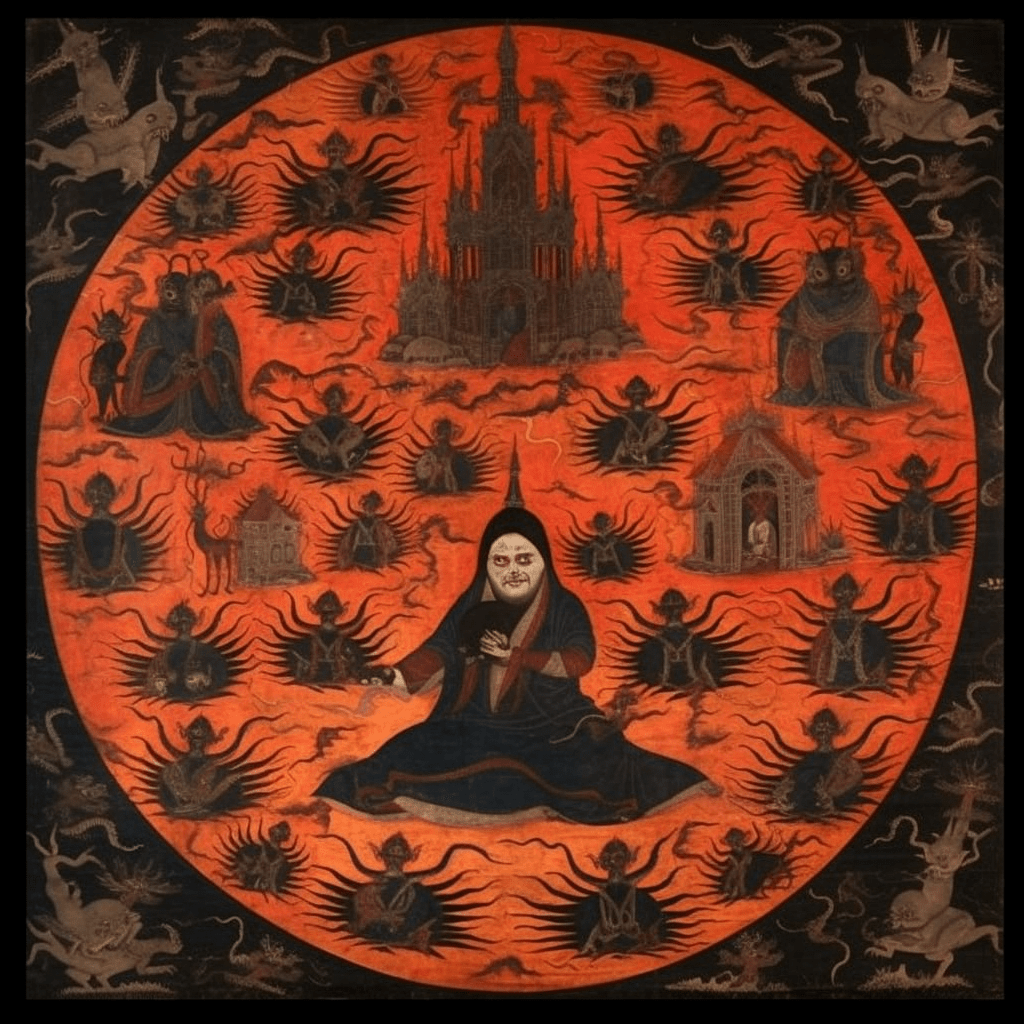
It is important that we consider all distractions in our practice as potential incarnations and activities of Mara. If it is more applicable to your vocabulary, viewing these distractions as demons can be equally beneficial. However, this concept isn’t to be externalized in meaning, as the root of Mara lies within us and not on the outside. Even in the case of a wild animal devouring us, we cannot view the animal as Mara, but instead, our attachment to our own body as the essence of Mara’s activity.
Mara(s) can generally be classified into four different categories. The first applies to our “unskillful” emotions such as greed, hate, and ignorance. The second applies to death and the circumstances that cause death. The third applies to conditioned existence and its symptoms. The fourth applies to the being Mara and his daughters, who tried to prevent Gautama Buddha from attaining liberation on the night of his enlightenment.
Although some of these have “external” sounding features, it is important to remember that all phenomenon we experience as Mara can be associated with our own ignorance in perception, and therefor, exist within us as obscurities. For instance, during meditation, a barking dog only exists as a Mara/demon in the sense that our perception is being disturbed by it, due (most likely) to our attachments to silence, control, and comfort. If one shifts their perception to pure emptiness, one makes their mind like the space inside a cave, where sound may enter and echo, but ultimately, moves through like wind and attaches to nothing.
If our mind rests in this realization of emptiness, then all external phenomenon move through it like clouds in the sky or waves in the ocean.
May all sentient beings conquer the Maras that obstruct their Dharma practices.
In science, one applies approved methods to achieve a certain outcome. If one wants to develop new methods, they experiment until they find what works, then relay the information to others.
Tantra is an identical process, although it works on the plane that science struggles to grasp, the spiritual or metaphysical plane of conscious beings.
If you practice a certain tantric technique in the correct way, you will generally be able to achieve the results that the tantra describes, as long as you understand and have crossed the thresholds present in any preliminary practices.
In this way, one doesn’t usually follow the path out of blind faith, but rather, does so because of the direct experience of that which the tantra describes. Without putting the methods into practice and without direct experience, there can be no hope of achieving the described outcome of a tantric text or teaching.
No matter how much one reads about a topic of activity like meditation or tantra, if the material is not practiced and experienced, it will remain a distant, exotic fancy for one to flirt with.
May all sentient beings look inward and experience mind in its raw state.


 Ansuz Society