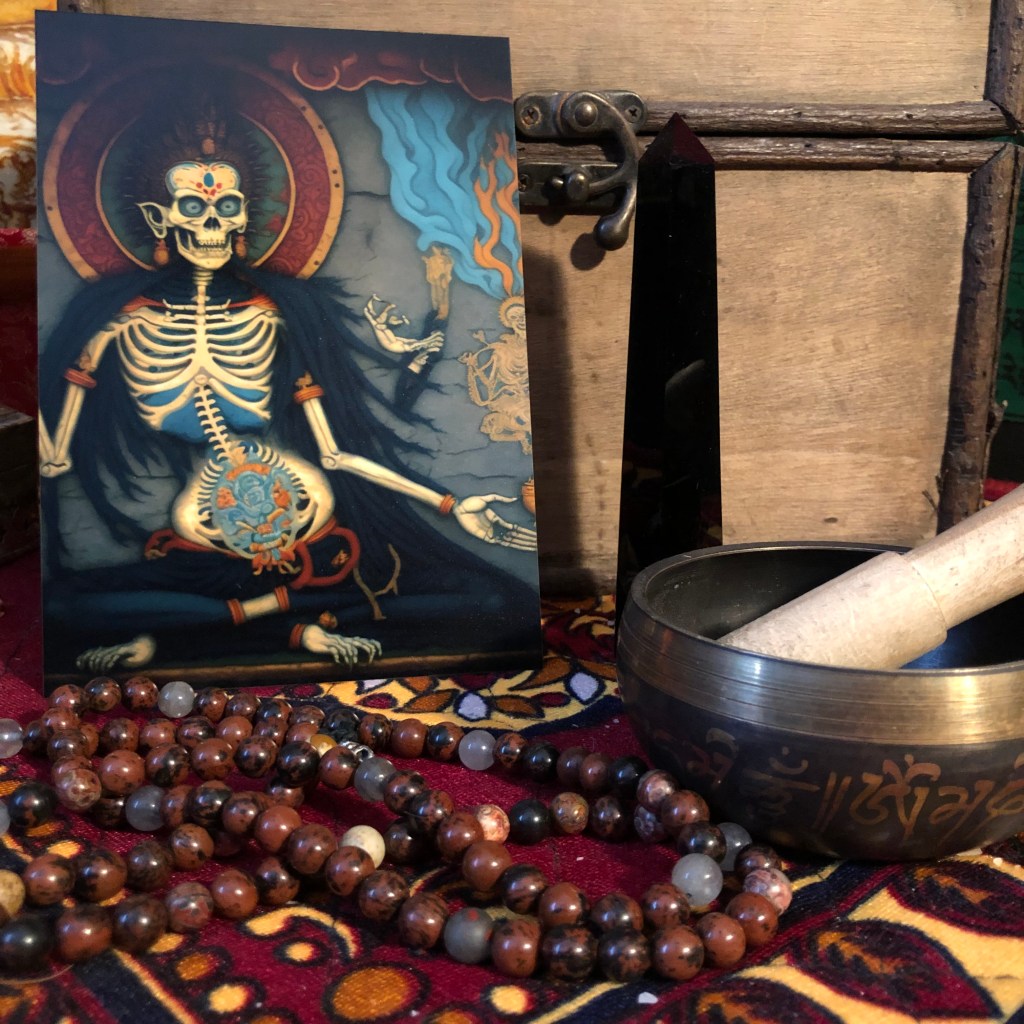
Padmasambhava

Padmasambhava, also known as Guru Rinpoche, was a legendary tantric Yogi and the founder of Vajrayana Buddhism in Tibet, bringing the religion from India around the 8th century and establishing the first Tibetan sect now known as the Nyingma (Old School). He is considered by many to be the second Buddha, foretold by Shakyamuni (Gautama Buddha) to reveal the tantric/esoteric (Vajrayana) teachings and to propel and protect Buddhism in the degenerate age (Kali Yuga).

Jigme Khyentse writes in the book “White Lotus,”

“Before he [Shakyamuni] passed into mahaparinirvana, the Buddha prophesized that his activities would be prolonged and his teachings propagated and protected by Padmasambhava, whom Tibetan Buddhists frequently refer to as Guru Rinpoche, the Precious Master.”

Vajrayana is an outgrowth of Mahayana Buddhism and involves a wide collection of practices aimed at providing liberation (nirvana) in a single lifetime, hence its name meaning “Thunderbolt Vehicle.” This differs from the Mahayana (Great Vehicle) path where it can take an untold number of lives (incarnations) to accomplish complete liberation. Because of this difference in philosophy, the indigenous Tibetan and Himalayan peoples could only be persuaded by the infinite power of the Vajrayana and were quite reluctant to adopt Buddhism prior to Padmasambhava’s arrival.

Through various trials and tribulations, Padmasambhava was able to subdue the powerful gods and beings who inhabited the region of Tibet. In doing so, he gained their favor and service in return, incorporating them into the Buddhist religion as protectors and stewards of the Dharma. This is why we see numerous gods from other pantheons mentioned in the rituals and myths of tantric Buddhism, as Vajrayana practitioners of all nationalities seem to include their own ancestral deities into their practice. This is easily observed in the Tibetan, Japanese, Chinese, and Mongolian variants of Vajrayana, where each culture has created a syncretic and unique flavor of religious practice, not completely removed from its source but rather philosophically reformed and reworked.

The mantra of Padmasambhava OM AH HUM VAJRA GURU PADMA SIDDHI HUM is one of the most popular and powerful mantras used in Tibetan Buddhism, recited often to instantly evoke the Guru, gain enlightenment, and achieve siddhi (occult power). It can be translated in many ways and has various levels of meaning, but a general interpretation of the syllables would be:

OM AH HUM – Purifies body, speech, and mind.

VAJRA GURU – Perfect Teacher.

PADMA – Lotus, synonymous with nature of mind.

SIDDHI – Occult power, success in practice, accomplishment.

HUM – The syllable of enlightenment, the unshakable nature of ultimate truth.

Padmasambhava permeates everything and exists everywhere, nestled into the very fabric of space and time. At the time of his death (parinirvana), he achieved “Rainbow Body,” dissolving into light and leaving behind nothing but hair, nails, and clothing. He is known also as Padmakara (Lotus-Born), meaning he is born in our minds, existing eternally in the unstained regions of our consciousness, quickly summoned by this sacred formula. This mantra should be recited as often as needed, whether for guidance, protection, clarity, wisdom, or any other purpose.

OM AH HUM VAJRA GURU PADMA SIDDHI HUM

Chaturbhuja (Four-Armed) Mahakala

Subscribe to continue reading

Subscribe to get access to the rest of this post and other subscriber-only content.

Om Tare Tuttare Ture Svaha

We’ve just released another mantra track on our channel, may it benefit all beings.

Tara is a prominent goddess in both Hindu and Buddhist traditions, representing the feminine aspects of the Supreme, whether as an emanation (Mahavidya) of the great Durga or as a female embodiment of the Buddha. Tara has an exceptionally wide array of forms depending on which religious pantheon one is focusing on, varying from entirely wrathful forms to completely peaceful ones. These different emanations are necessary according to each individuals’ particular inclinations (due to karmic imprints) or specific school of practice.

In Vajrayana Buddhism, Tara is believed to have 21 forms with varying attributes, colors, and characteristics.  She is invoked for protection and liberation from obstacles, to dispel poisons and bad dreams, and to destroy demons or other harmful spirits. Tara is revered as a loving mother and is often referred to as the “Mother of All Buddhas.” She guards sentient beings against fear, anxiety, and disease. Tara is often Green in color, representing all the activities of the Buddha, but white is also common, used for achieving long life and longevity. Other forms and colors exist as well. The seed syllable of Tara is TAM.

The Sanskrit word tā́rā means “star”, stemming from the Proto-Indo-European word h₂stḗr, which refers to stars (or planets) and means “shiner or glower.” Her mantra is OM TARE TUTTARE TURE SVAHA which means “Praise to Tara the Swift Liberator, Hail!” Above her sits Amitabha, Buddha of Boundless Light.

“…Homage to her whose face is like one hundred full autumn moons

And who blazes with light like that of thousands of stars…

…Homage to her whom Indra, Agni, Brahma, Vayudeva,

Vishvakarman, and Ishvara present offerings…”

#tara #mantra #protection #buddhism #goddess

Annual Summer KTD Trip

Back at headquarters after a very busy and powerful weekend at KTD.

Two empowerments were given (Stainless Ushnisha and Stainless Light Rays), both related to the construction of stupas, the consecration of the items therein, and the clearing away of obstacles. These were given by Khenpo Lodrö Dönyö Rinpoche, abbot of the Mirik Monastery. This is something we would like to sponsor here at some point in the future.

After that, the monks began a 7 day Chakrasamvara puja at the request of the Karmapa, whose father passed away.

It is always rejuvenating to visit this holy site, but, it is also hard to leave. If you find yourself in the area, you should certainly stop by.

May all beings thrive.

“There is an old saying that the path is the goal and goal is the path. You make your journey, you get to your destination, and arriving at your destination brings on another question: how to proceed from there? In that way each goal itself becomes the path. Particularly from the tantric point of view, you don’t achieve anything except path. Discovery of the path is achieving.”

-Trungpa Rinpoche

Karma Triyana Dharmachakra

Interpreting Odin’s Sacrifice on the World Tree

One interpretation of Odin’s world tree ritual is the destruction of his ego: the sacrificing of his lower self to his higher Self. The ritual is a metaphor for replacing our material limitations for the infinite potential of primordial wisdom; exchanging our mundane form for that of the almighty consciousness of Odin. Odin, as the material individual, strives to return to the source, which like Shiva or Buddha, is nothing other than his innate, true nature, beyond constructs and existing within everything. This is why Odin is known as the “Masked God” or “God of Masks,” as his shapeless state allows him to cloak himself in whatever physical form he wants, being able to shift appearances according to his worldly goals.

Names of Odin relating to this are Fjallgeiguðr (Shape God), Fjolnir (The One Who is Many), and Grimnir (Masked One). Odin, in this way, represents all possible expressions of life and exists within all sentient beings. Odin is the great animator of matter, obscured and covered up to varying degrees by the limitations of our ignorance and material attachments. By removing these obstacles one by one, Odin, as the common man, realizes and becomes his true Self; the unchanging reality which can be described as furious, terrifying, and awesome. This is why he is known as “The Terrible” or “Furious One,” as the realization of this state can be deemed nothing other than ferocious and shocking. This is identical to some names of Shiva that relate to this same phenomenon, such as Bhairava (Lord of Terror), Mahakala (Beyond Time), and Rudra (The Howler/Dreadful).

This primordial state, the formless consciousness beyond conceptual and dualistic framework, can be further represented by Odin’s one eye, which sees nothing but the true state of reality: non-dual and single focused. This pure vision shows him all things; the causes and effects of all phenomena; unaffected by time, change, or abstract forms. Odin as the “One-Eyed God” appears in many ways such as Hoárr (One Eyed), Báleygr (Flaming Eye) and Bileygr (Flashing Eye). Odin, the individual, has but one single motive: the search for ultimate wisdom/source. Further evidence for this is reflected in his names Sanngetall (Seeker of Truth), Fjǫlsviðr (Very Wise), and Forni (Ancient One).

This is the eternal Odin within us, the awareness we must all uncover if we want to transcend our worldly limitations. This formless state of being is what remains when the body falls to the wayside, remaining intact for all of eternity. Through his ritual on the world tree, Odin loses attachment to his body/shape/name and realizes his supreme nature; flooded by the ancient wisdom of the cosmos represented by the runes, poetry, and other various magical techniques.

May all sentient beings seek the source of consciousness and realize Odin within themselves.

Hailaz / Namaste

Tantra, Practice, Experience

In science, one applies approved methods to achieve a certain outcome. If one wants to develop new methods, they experiment until they find what works, then relay the information to others.

Tantra is an identical process, although it works on the plane that science struggles to grasp, the spiritual or metaphysical plane of conscious beings.

If you practice a certain tantric technique in the correct way, you will generally be able to achieve the results that the tantra describes, as long as you understand and have crossed the thresholds present in any preliminary practices.

In this way, one doesn’t usually follow the path out of blind faith, but rather, does so because of the direct experience of that which the tantra describes. Without putting the methods into practice and without direct experience, there can be no hope of achieving the described outcome of a tantric text or teaching.

No matter how much one reads about a topic of activity like meditation or tantra, if the material is not practiced and experienced, it will remain a distant, exotic fancy for one to flirt with.

May all sentient beings look inward and experience mind in its raw state.

Hailaz / Namaste

-Ansuz Society