This process is something that is done differently by almost everyone, as there has never existed a pan-Pagan dogma regarding this type of activity. However, most would agree that when constructing an altar in the Germanic fashion, there are 4 main pieces to consider. These 4 pieces we will cover here along with other ideas for what one can add to their setup. Having an altar dedicated to spiritual activity is important, as it gives one a place to conduct work that is vital to the human experience.
First, one must find a location that one is drawn to, perhaps isolated in the forest at the foot of a particularly powerful tree, a secret natural site, or inside one’s home in a secluded area. Second, it is recommended that an organic “table” be present in the location to conduct exchanges and make offerings, such as a stump or flat stone. If there is not, one should build something for this purpose. This can be a simple platform, or it can be an entire temple, this all depends on the person’s means and dedication. Third, the deity with which one wishes to communicate (in this case Odin) needs a home or place to inhabit on the altar. This can take the form of a special tree, stone, idol, statue, image, or in some cases, the skull of an animal or human. Generally, the deity is thought to reside in this location indefinitely, although, some will argue that they are only meant as temporary dwellings for the gods and spirits to reside in while the operant conducts their business. The fourth piece, especially important in the case of Odin (but also relevant to any Pagan altar), would be the drinking vessel in which we offer libations.
Once one has completed these 4 tasks, the altar is ready to be blessed and put into immediate use. Blessings include fumigation, galdr, and various invocations to protect the space. Some other things to consider placing on the altar are offering bowls, incense vessels, candles, a set of runes, and a place to leave meat or gifts intended for Odin’s ravens and wolves. Aside from these things, it is up to one’s discretion what they choose to exchange with the High One. When it comes to maintaining this space, one must keep things fairly organized and clean. This shows respect to the deity and helps one stay disciplined.
Strive to replace the rune set every year, if made of wood. If the runes are made of stone, they should be washed, cleansed and re-consecrated through galdr and one’s own blood. Last, libations should be made according to your means, but it is recommended to refresh the drinking vessel either every 3 days, 9 days, 45 days, and/or on full Moons. When throwing out the old libation, it should be offered to a tree or local spirit, never put into the drain or trash.
May this be of use to new and current practitioners.
The Summer Solstice is the time of year when the daylight is longest, the power of the Sun is at its peak, and the solar cycle reaches its apex, tipping the scales towards the dark half of the year once again. After this turning point, the sunlight begins to wane, shortening the daylight minute by minute until the Winter Solstice. Typically, this was a time to celebrate the Sun, spend time outdoors, and enjoy the bliss of good weather. Mead, wine, and other beverages would be consumed, and great feasts would be enjoyed.
In “Teutonic Mythology” by Grimm, it is said:
“Twice in the year the sun changes his course, in summer to sink, in winter to rise. These turning-points of the sun were celebrated with great pomp in ancient times, and our St. John’s or Midsummer fires are a relic of the summer festival. The higher North, the stronger must have been the impression produced by either solstice, for at the time of the summer one there reigns almost perpetual day, and at the winter one perpetual night.”
Games and various competitions would be hosted along with other festivities such as dancing and music. Entertainment would be lively and abundant, encouraging joy and merriment among the community. In the Germanic context, many people honor the god Baldr during this time as a god of light and/or personification of the light of the Sun, which in a mythological context, “dies” and beings to decline after this time, mirrored by Baldr’s death and descent into Hel. Because of these connections, a common blot/ritual focus during the Summer Solstice is the death (or funeral) of Baldr, the god of light. Stone ships are erected, abundant offerings are made, and various sacrificial items are thrown into fire. These offerings are meant to aid Baldr in his journey on the long road of the underworld.
In “Celtic Mythology and Religion” by Macbain, he says:
“The midsummer festival, christianised into St John’s Eve and Day, for the celebration of the summer solstice, is not especially Celtic, as it is a Teutonic, feast. The wheels of wood, wrapped round with straw, set on fire, and sent rolling from a hillock summit, to end their course in some river or water, which thus typified the descending course of the sun onward till next solstice, is represented on Celtic ground by the occasional use of a wheel for producing the tinegin, but more especially by the custom in some districts of rolling the Beltane bannocks from the hill summit down its side. Shaw remarks – “They made the Deas-sail [at Midsummer] about their fields of corn with burning torches of wood in their hands, to obtain a blessing on their corn. This I have often seen, more, indeed, in the Lowlands than in the Highlands. On Midsummer Eve, they kindle fires near their cornfields, and walk round them with burning torches.” In Cornwall last century they used to perambulate the villages carrying lighted torches, and in Ireland the Eve of Midsummer was honoured with bonfires round which they carried torches.”
Large bonfires and “Sun-wheels” are made during this time, reflecting the power and glory of the Sun. Special attention was given to the goddess during this time as well, whether as a deification of the Sun itself, the Earth, the Mother, or a mix of the 3. Offerings such as flowers, cakes, milk, honey, and blood are given to the gods and spirits, a ritual exchange of abundance for abundance. As observed in the above quote, it was (and is) common practice to bring the energy of the Sun down to Earth in the form of a torch, then parade it through the fields, groves, or temples in order to bless them with this powerful energy.
In “A History of Pagan Europe” by Jones & Pennick, it says:
“…But the summer solstice, under its statutory date of 25 June, became a popular festivity early in Germanic history. The German word Sonnenwende always refers, in medieval texts, to the summer solstice, not to the winter solstice. At the end of the first century CE some German troops in the Roman army at Chesterholme listed their supplies for the celebration in a record which has come down to us. In the early seventh century, Bishop Eligius of Noyon in Flanders criticised the chants, carols and leaping practised by his flock on 24.”
Here we are given examples of some ancient Germanic practices revolving around the Summer Solstice. We are told of singing, chanting, and competitive games like “leaping”. Clearly, the Christian Romans were disturbed by this revelry, showing its clear Pagan origins. This turning point in the year was extremely important to observe, as it strikes a pivotal moment in the Sun’s lifecycle, affecting every aspect of our lives.
Kenaz is a particular rune, changing dramatically in context from Elder to Younger runes. The continental Germans seemed to hold this rune in a more positive light than their Scandinavian neighbors in the North. Kenaz is a reconstructed word from Proto-Germanic meaning “torch,” associated with creative fire, skills, knowledge, and teaching. The torch is that which illuminates the darkness, showing us the way in places unknown. This has been equated with an internal creative “spark” as well, which I think is reflected in the hard “k” sound represented by this rune. If we look to the Gothic language, we find evidence for this theory in the kindred word kōnja which refers to pine sap. This must be directly related to the torch, as pine/spruce has long been a favored wood for this use.
The Gothic name for this rune is kosma/kusma, stemming from kunnan meaning “to be able, to know how,” referring to one’s inner abilities and skills. This word travels through time and tribe almost unchanged in sound and meaning, showing up in modern English in the words know and keen. In my opinion, the best example of this concept is crystallized in the Swedish word konst, meaning “art, knowledge, science, magic, secret,” and in the cognate German word kunst meaning “skill, craft, ability, magic.” This internal power of knowledge, associated with a craft or specific artistic focus, is the secret “light” side of the Kenaz rune, symbolizing our ability to make things known, to teach them, and to exhibit mastery in arts, crafts, intellectual or occult matters.
When looking for clues in the rune poems, the only evidence we find in relation to a “torch” is from the ‘Old English Rune Poem,’ where it states:
“Torch is known by each of the living through its fire
-bright and blazing- it burns oftest
Where the athelings are at ease indoors.”
Here it is clear that the word “torch” is denoting skill as a display of one’s “inner fire.” This is something (as a torch in the dark) that all can witness. “Bright and blazing” is the external effect of mastery and true skill in craft, as creation is a bright and blazing power. The last line denotes a sense of peace inherent in the “athelings,” which means “nobles, lords, heroes.” This clearly reminds an English reader of the word athlete, which signifies “those competing to win a prize.” I believe this relates to the calm felt within an extremely wise, skilled, or focused group; where everyone’s flame is burning bright and clear, all can feel a sense of ease and comfort. We get another look at this concept with the Old English word kennan which means “to make known, declare” but also “to bring forth, produce.” This is essential to the function of a craftsmen, artist, musician, or anyone who actively works with creative energies and systems.
In Old Norse, this rune is represented in the word kaun, meaning “sore, ulcer, boil,” and carries a much more sinister and harmful aspect associated with it. In most old poetry and analysis, it seems this rune was more of a curse or fetter than something used for anything “positive.” Although, in some Freemason rites, it has been shown that the Younger rune (ᚴ) is still in effect as a “torch,” as it mimics the man holding his sword (torch) at this angle during initiation rituals. As one walks through this “tunnel of torches,” he is “illuminated/initiated” into a new reality.
In the ‘Old Norwegian Rune Rhyme” it is said:
“A sore is a curse for children;
Bale makes a man pale.”
Likewise, in the “Old Icelandic Rune Poem” it is said:
“A boil is bale for bairns, and a scourgeful spot,
And a home for flesh-rot.”
Here we see how our Scandinavian ancestors viewed this rune, as a much darker and fearful tone is taken with it. They viewed this rune in the context of evil and pain, without any allusions to a “lighter” aspect within the poetry. However, all these physical ailments have in common the sensation of “burning” within those experiencing it. This gives us insight into the deeper layers of the rune, where “fire” is still present, albeit in a new form. This rune was probably used strictly as a curse unless by the most skilled of sorcerers, who may have been able to turn this internal strife and struggle into acts of creation or transcendence. If looking at the Younger Futhorc as a whole, we see Kaun landing next to another very sorcerous and powerful rune, Hagal, the hail stone of transformation. Seeing these very destructive and feared runes side by side, as fire and ice respectively, shows a sort of miniature Ragnarök within the cycle of the Futhorc, enhancing the importance of viewing them in their respective “aetts” or groups, as here we end the first and begin the second. This is something I plan to venture into with more thought later…
To conclude, Kenaz is a rune steeped in much power and is tied together throughout all linguistic changes in the concept of an internal “fire” or a “burning” sensation. We have the older associations with torches, knowledge, creation and skill; being associated with teachers, students, craftsmen, and artistic masters. We also have the concept of “keenness” tied in, being exceptionally skilled and knowledgeable, “sharp” of mind and highly productive. In the North, this rune carried a more malicious nature, representing sickness, pain, and struggle. When approaching this rune from all the previous angles, we see a very wide range of meanings one can attribute to this rune, depending mostly on which system of runes one is working with. If using the Elder or Anglo-Saxon runes, this rune is viewed in relation to the torch. If using the Younger runes, it is likely you will associate this rune with pain or sickness.
Taken from the book “Wandering the Runic Path: Esoteric Analysis of the Germanic Runes” by Hrukjan.
We are wrapping up the final edits for the second rune book by Hrukjan titled “Wandering the Runic Path: Esoteric Analysis of the Germanic Runes.”
These will be published early next month and copies will be available from us around Samhain.
For those interested in the book, we’d like to share some information from the introduction:
“This book is meant to help guide the runic adept through various untrodden paths regarding the runes and their use in esoteric Pagan practice. Through many avenues such as language, myth, religious comparison, and thorough analysis, one can expand the dimensions of each rune into the endless fathoms of space and time. Each rune of the Elder Futhark has been dissected and tirelessly studied so that no stone is left unturned in their usability and ultimate meaning. Along with in-depth study, each “aett” of runes has also been given a set of common themes that one can ponder in association to their roles within the entirety of the Futhark. Not only this, but it is speculated throughout the book that the order of the runes is not only important, but carefully tells a unique story regarding life, death, rebirth, and the ultimate truth of existence as expressed by the people who created and used them.
While much of this book is speculative in nature, offering a deeply subjective analysis of these symbols, there is also much concrete and objective information regarding their history, etymology, and journey through time. From their many connections to Sanskrit and other Indo-European languages, the reader can form a thorough understanding of these symbols based on thousands of years of transformation. The reader will see how these runes transcend culture and relate to the natural surroundings of the different tribes that used them as they migrated across much of Europe, Asia, and beyond. Through this approach, one will see that the use of the runes is not only universally applicable, but also, not restrained to a certain “folk” or people. By realizing the scope of their use, one can see them as a divine tool for Self-development and transformation, as each rune is a key to ultimate realization.
If you are looking for a book that is not just informative, but also applicable to religious and spiritual practice, then this book should offer you many avenues towards your own purified understanding of these ancient symbols as used by the greatest of sages and magicians of the past. My hope is that this book will act as a compass for the devoted reader as they traverse the dark and endless paths laid before them by these ancient symbols. By doing so, one does not get lost or steered in detrimental directions by those who would rather see you confused and reliant on outside influences. Runic knowledge and the wisdom inherent within them are present in every sentient being, especially those who have the memories of these signs within their very soul. These secret symbols mirror that which exists within us and each rune is a key to unlocking the mysteries that lie dormant within our experience of reality. May this book help you transcend the limitations of individual existence and soar into the ether as Odin once did upon the great World Tree.”
Odin as the primordial state of consciousness applies to women as well, as Odin is said to have given soul to both. This innate awareness is formless and is beyond any associations with body or sexual identity. Therefore, one does not have to look at primal awareness as something based on these limiting and mundane concepts. This doesn’t mean that Freyja is not involved in the equation, as Freyja is the energy and flux of the natural/material universe, identical to great Kali/Shakti/Tara Ma. Freyja represents matter, while Odin represents consciousness. Without Odin, there would be no Freyja, and without Freyja, Odin would have nothing to manifest into. These are the two pieces of the puzzle that create what we know of our existence and reality; the Father (consciousness) and the Mother (material world). Each sentient being and all physical matter encapsulates these qualities. They are inseparable. Through training and practice, one can destroy the surface duality represented in these two halves, reuniting them into one single point of experience. Either deity can be venerated as supreme, as they both express one final outcome of creation.
We have uploaded a new galdr track titled “Ek Immi Óðinn” to our YouTube channel.
Ek Immi Óðinn can be translated to “I am Odin” and is meant to invoke the supreme awareness within. After one feels the deity present in their surroundings, one is to merge this primordial consciousness into oneself, replacing the mundane qualities of their hindered state of being associated with ignorance, weakness, and delusion. This method is mirrored in the Sanskrit mantra “Soham,” meaning “I am That.” This is a technique which allows the practitioner to become the deity (Odin) through the replacement of one’s limited state of mind, substituting it with the primordial awareness represented by the all-pervading consciousness of Odin. Through chanting this galdr repeatedly, one can transform themselves with immense speed and precision if one practices with single-pointed focus.
May all sentient beings seek the source of their consciousness and realize Odin within.
One interpretation of Odin’s world tree ritual is the destruction of his ego: the sacrificing of his lower self to his higher Self. The ritual is a metaphor for replacing our material limitations for the infinite potential of primordial wisdom; exchanging our mundane form for that of the almighty consciousness of Odin. Odin, as the material individual, strives to return to the source, which like Shiva or Buddha, is nothing other than his innate, true nature, beyond constructs and existing within everything. This is why Odin is known as the “Masked God” or “God of Masks,” as his shapeless state allows him to cloak himself in whatever physical form he wants, being able to shift appearances according to his worldly goals.
Names of Odin relating to this are Fjallgeiguðr (Shape God), Fjolnir (The One Who is Many), and Grimnir (Masked One). Odin, in this way, represents all possible expressions of life and exists within all sentient beings. Odin is the great animator of matter, obscured and covered up to varying degrees by the limitations of our ignorance and material attachments. By removing these obstacles one by one, Odin, as the common man, realizes and becomes his true Self; the unchanging reality which can be described as furious, terrifying, and awesome. This is why he is known as “The Terrible” or “Furious One,” as the realization of this state can be deemed nothing other than ferocious and shocking. This is identical to some names of Shiva that relate to this same phenomenon, such as Bhairava (Lord of Terror), Mahakala (Beyond Time), and Rudra (The Howler/Dreadful).
This primordial state, the formless consciousness beyond conceptual and dualistic framework, can be further represented by Odin’s one eye, which sees nothing but the true state of reality: non-dual and single focused. This pure vision shows him all things; the causes and effects of all phenomena; unaffected by time, change, or abstract forms. Odin as the “One-Eyed God” appears in many ways such as Hoárr (One Eyed), Báleygr (Flaming Eye) and Bileygr (Flashing Eye). Odin, the individual, has but one single motive: the search for ultimate wisdom/source. Further evidence for this is reflected in his names Sanngetall (Seeker of Truth), Fjǫlsviðr (Very Wise), and Forni (Ancient One).
This is the eternal Odin within us, the awareness we must all uncover if we want to transcend our worldly limitations. This formless state of being is what remains when the body falls to the wayside, remaining intact for all of eternity. Through his ritual on the world tree, Odin loses attachment to his body/shape/name and realizes his supreme nature; flooded by the ancient wisdom of the cosmos represented by the runes, poetry, and other various magical techniques.
May all sentient beings seek the source of consciousness and realize Odin within themselves.
ALU represents orally transmitted knowledge that is passed down or transferred between individuals. This is akin to one “vessel” pouring liquid (ALU) into another vessel, representing the passing of tradition and secret wisdom from teacher/guru to student/disciple. This can be visualized like a great fountain, where water cascades down from one source point, representing the head of the spiritual lineage, falling down into further basins which overflow into more and more, representing each member who retains the teachings.
One could also speculate that the magical phrase ALU, while being associated with an “intoxicating” beverage, could be a reference to the “madness” that Odin is said to bring forth in his devotees. Other Proto-Germanic words like aluh (amulet) and alh (protect) can bring us to see ALU as being “protected by the intoxication of Odin.” It is quite possible, as with the Vedic and Egyptian ancient temples, that this ALU was a mix of substances, kept within the temple for sacred use. Other ingredients were likely various herbs and psychedelic mushrooms.
ALU can also be associated with inspiration and the “Mead of Poetry.” This magical liquid is said to cause consumers to become skalds (poets) and scholars; created by the dwarves Fjalar and Galar by mixing honey with the blood of the wise god Kvasir. Odin steals this magical mead disguised as an eagle and brings it back to Asgard. He then (through his mouth) delivers it to the gods and those skilled in poetry, emphasizing the concept of orally transmitted wisdom. This story can be found in Skáldskaparmál.
May ALU flow within all sentient beings and may divine intoxication drive your spirit forward.
When it comes to Indo-European cultural and religious phenomena, the Kóryos is one of the most discussed aspects. The Kóryos,Männerbund, or Warband, was the living embodiment of the storm god; descending unexpectedly and laying waste to that on which it fell. Like the violent storm, tempest, or high winds, the wolf-warriors of Odin strike suddenly and swiftly. To the more “civilized” and agricultural folk, these storm god embodiments were the bane of farms, homes, and settlements. Originally, the Indo-European Kóryos/warbands were the living reflections of the “fury” and “rage” associated with the Vedic god Rudra, who to the Germanic people became known as Wodanaz/Wotan. Later on, the Vikings of Scandinavia would continue this traditional raiding under the guidance of the All-Father, Odin. Like Odin’s possession, fury, and madness, these wolf-warriors descend suddenly, unexpectedly, and terribly upon the sedentary, comfortable, and more “civilized” peoples that they encountered in their travels.
Odin/Wodanaz represents the storm, war, and sorcerous/magical powers. In the word Wodaz (excited, obsessed, furious) we get a glimpse of what the primordial state looked like in the mind of the ancient Germans, the “Awesome Consciousness” of Odin, which can otherwise be described as terrifying or exciting. This is a state of spaceless, heightened awareness. Complete focus on the present moment. The invocation of Wodaz was completely entrenched in the now, not lost in past or future. Within this state, lies the intense “frenzy” that these warriors have been known for and documented about for over 2000 years across many different Indo-European cultures including the Germans, Greeks, and Iranians. Because of this rampant focus and rage, these warriors would continue to be feared far into the Viking age, where this type of elite warrior emerged in the form of the Berserker (Bear Shirt) or Ulfheðnar (Wolf Coats). These warriors would also play an enormous role in the creation of the Werewolf myths and legends. As we can see, this shows a particular skill in what we would otherwise term as “shapeshifting.” Names of Odin that apply to this type of sorcery are Fjallgeiguðr (Shape God), Svipall (Changing/Shape-Shifter), and Grímnir (Masked One).
Because of this, many agricultural communities would rightfully view Odin/Rudra as more of a demon or deity that one wished to keep away. This practice originated from the Vedic practice of making offerings to Rudra, who was generally prayed to in order to send his disease and fury elsewhere; overlooking the ones making the offerings or sacrifices. Ultimately, one wanted to divert this storm god’s awesome and terrible wrath away from themselves and towards their enemies. These offerings were also given for his blessings of prosperity and to prolong the lives of the ritual participants, as Rudra was also a god of death, time, and disease. Like Odin, Rudra was also known for delivering and releasing fetters such as illness, obstacle, and hardship. Therefore, as much as one wanted to divert the god’s wrath away from themselves, they made offerings in exchange for his particular blessings.
Rudra means “The Howler/Roarer”, which refers to wind and storms. He is also known as Ugra, which means “Mighty, Wrathful, Furious,” and “Terrible.” This word is synonymous with the word Ghora, meaning “Frightful, Vehement, Sublime” and “Horror.” Ghora is also a name of Shiva, meaning “The Terrible.” Likewise, Odin has similar titles, including Hrjóðr (Roarer), Hrani (Blusterer), and Viðrir (Stormer). The epithet “Wodanaz” means something like “The Furious One,” “The Possessor,” or “The Exciter,” representing what would later become Odin (The Furious). He is also commonly known as Yggr, which means “Terrible One.”
Warbands embody the storm in this way, with each member taking on the “furious” form of Wodanaz/Rudra. This was done by ritually entrenching one’s focus in the moment and becoming “possessed” by the god himself. This is done through active cultivation of complete and total focus, or, “Wodaz,” via chanting, ceremony, or dance. Sometimes, intoxicants were used in order to reach a higher state of perception. Other relative names of Odin that portray this type of activity include Vakr (Wakeful, Alert), Hagvirkr (Skillful Worker), and Gapþrosnir (The One in Gaping Frenzy).
Because of this association with Odin and the Männerbund, we can see how Odin was the god of the young, traveling warrior, filling the roles of initiator and father. This connects Odin’s archetype as “The Wanderer”, as he must wander to gain the knowledge or rewards he seeks, not stay sedentary. Names of Odin that refer to wandering include Farmagnuðr (Journey Empowerer), Fengr (Fetcher/Catcher), and Gangari (Walker/Wanderer). This spiritual drive to travel can be associated with Odin, as he is the one who inspires us to set out on journeys, wander, and seek new places. He is also known as Hleifruðr (Wayfinder), Reiðartýr (Wagon God, God of Riders), and Vegtam (Way (Road) Tamer).
In conclusion, one can see how this cult of Wodanaz/Rudra developed, persisted, and eventually spread across Europe and Asia, mixing, altering, and diversifying the landscape as it spread. Like the Kóryos, Wodanaz/Odin spreads (or creates) new tribes, reinforcing his role as a progenitor deity, while Thor, the “Protector of Midgard” and Odin’s son, preserves the villages and enables auspicious conditions to arise within and around them. Odin/Wodanaz as the Sky Father mates with the native Earth Mothers that the Männerbund/Warband would encounter on their raids, giving birth to new mythologies, cultures, and tribes. The Kóryos, under the guidance of the wrathful storm god, is without a doubt responsible for the spread of Indo-European languages and cultures across the world. Paired with their domestication of the horse, elements of Indo-European culture, religion, and language exist in nearly every corner of the world today.
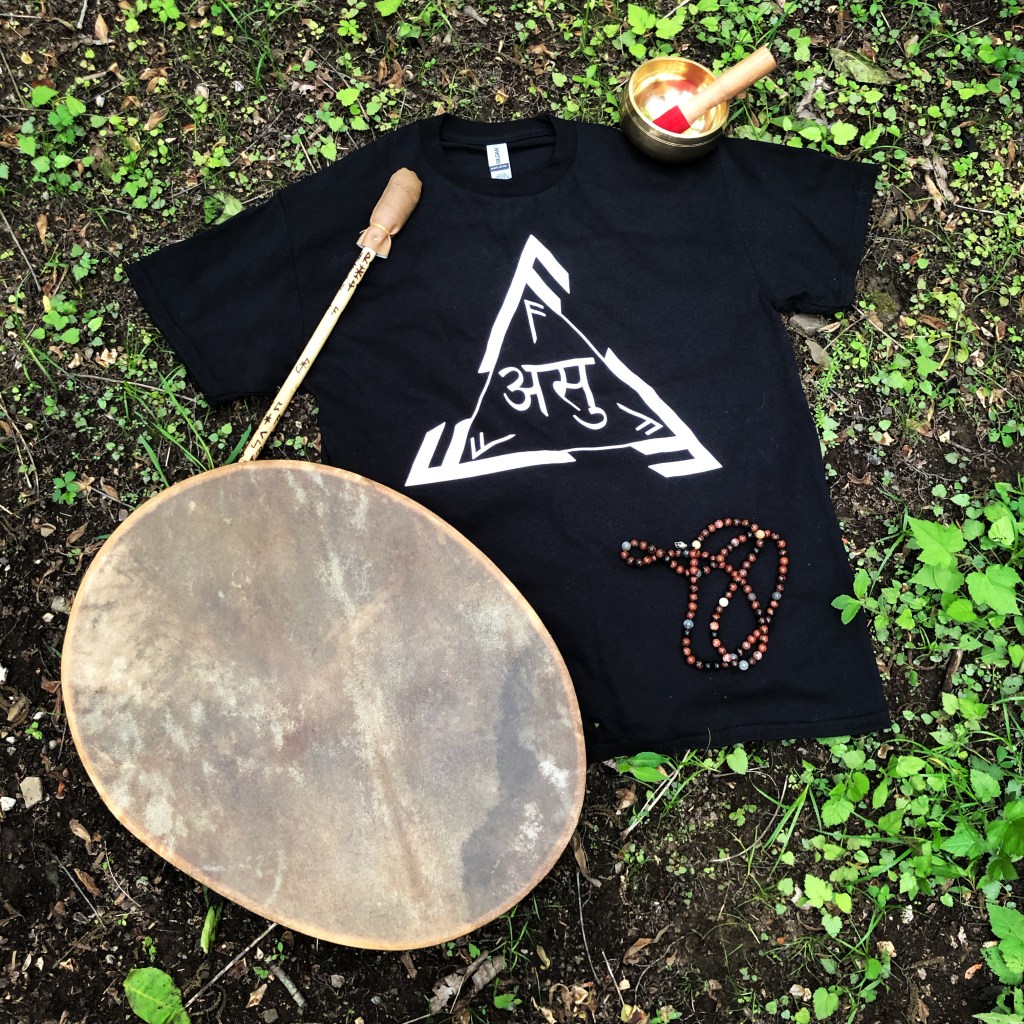
Our first batch of shirts have arrived and look awesome.
These will be given out to members, donors, volunteers and collaborators in order to spread not only the sign, but the culture of the Ansuz Society.
Our hope is that these will be worn with modesty, positivity, and respect.
For those who would like to purchase a shirt directly, they can be ordered for $20 with free shipping in the USA. Please use the contact form to order. Sizes available are small, medium, and large. Very limited quantity available.
While we invite everyone to interpret these symbols as they see fit, we would like to offer a brief overview of the design:
-3 Ansuz runes representing the gods Odin (soul), Vili (will), and Ve (body); the 3 components necessary for human life.
-the related Sanskrit word ásu, meaning “breath, spirit, life force, life.”
In regards to the triangular shape, we have a strong emphasis on the fire element, hence one interpretation of the triangle as fire. This fire is being propagated by the breath or wind represented by the Ansuz runes. The upward triangle also has associations with the air element, and therefore, is another representation of the breath, wind, and soul of which Odin is said to have given to mankind. With these connections in mind, this sign can be viewed as an internal flame driven by the winds of inspiration, or, Odin.
We also believe that all matter is a form of the Great Mother who strives for union with the Great Father (source of consciousness). That said, another interpretation of the upward triangle is to represent the male aspect of primordial awareness; the unmovable, foundational consciousness which exists in all sentient life. Because of this connection, the upward triangle can also be perceived of as representing Shiva, as his half of the Shatkona is the △ shape, while Shakti is symbolized by the ▽ shape. This primordial awareness, associated with male energy, is called by many names across the world and seen in deities such as Odin, Shiva, and Vajradhara.



 Ansuz Society