Samhain/Álfablót

Samhain is a time when the spirits of nature, the dead, and the gods are most likely to emerge to walk amongst the living. During these days, when daylight becomes shorter and shorter, nature around us seems to die and shed its vitality, leaving trunks and branches barren, resembling bones protruding from the forest soil. This is a time when we are meant to shift our focus from outdoors to indoors and shed our dead weight from the previous year. By doing this, we are mirroring the process of nature and turning our energy inward. During this time of year come the final harvests, meaning that the workload is drastically cut down and many daily activities change. These hours were to now be replaced with indoor tasks such as tending to animals, repairing tools, spiritual practice, and performing various crafts such as woodworking, writing, or blacksmithing.

It is customary to make offerings to the deities, ancestors, and wandering spirits during this time in order to receive their favors, blessings, and good luck. We please the spirits to avoid their wrath. We offer to the ancestors to uphold family honor. We give our veneration to the gods to gain their power and visage. By performing rituals during this particular time of year, one enables themselves to access various forces and gain insight into the past, future, and matters regarding cause and effect within the present which will aid one’s progress moving forward.

In “A History of Pagan Europe” by Jones & Pennick, they write:

“Samhain (1 November). This was the most important festival of the year, showing the pastoralist, rather than agricultural, origin of the calendar. Samhain was the end of the grazing season, when flocks and herds were collected together, and only the breeding stock set aside from slaughter. It was a time of gathering-together of the tribe at their ritual centre for rituals of death and renewal, dedicated to the union of the tribal god (in Ireland, the Daghda) with a goddess of sovereignty, the Morrigan, or, more localised, Boann, deity of the River Boyne.”

As the last of the great harvests, Samhain brings reward and celebration, the end of one year and the transition into the next. According to many European tribes, Samhain marked the turning point between the years and represented the New Year celebration of their cultures. With Samhain we descend into “night,” resembling the womb of the goddess or the abode in which she resides. The goddess reigning over this time of year was almost always in the form of a grim, fate-controlling hag or crone, such as Hel or the Morrigan.

In “Celtic Mythology and Religion,” Macbain writes:

“Equal to Beltane in importance was the solemnity of Hallowe’en, known in Gaelic as Samhuinn or ‘summerend.’ Like Beltan it was sacred to the gods of light and of earth; Ceres, Apollo, and Dis also, must have been the deities whose worship was honoured. The earth goddess was celebrated for the ingathering of the fruits; Apollo or Belinus and Proserpine were bewailed for their disappearing from earth, and Dis, who was god of death and winter’s cold, and who was especially worshipped by the Celts, as Caesar says, was implored for mercy, and his subjects, the manes of the dead, had special worship directed to them. It was, indeed, a great festival—the festival of fire, fruits, and death.”

In reference to Norse and Germanic paganism, we see the worship of elves and land spirits was also common during this time. In modern Germanic paganism, many people celebrate Samhain under the name Álfablót (Elf Sacrifice), which is a time when harvests are reaped and sacrifices are made to the elves and gods. Elves and the dead are strongly connected to the ancient mounds of the Pagans, therefore, much of the activity surrounding this festival would have likely involved distributing offerings to the gods and conducting sacrifices directly upon the mound (or grave) of the dead. This is where the elves were thought to reside.

In “Sorcery and Religion in Ancient Scandinavia,” Vikernes gives us further examples pertaining to the Nordic new year and pre-Christian Halloween customs. He writes:

“The first holiday of the year was New Year’s Day, better known in English as Halloween (“initiation evening”), and in Gaelic as Samhain (“summer’s end”). The sorcerers and later the gods (i, e. religious kings) and their challengers dressed up as different creatures with access to the realm of the dead. They fasted and hung their clothes in a tree or the gallows, to make it look as if they had hanged themselves. They wounded themselves with a spear, to bleed, smeared ash or white mud all over their bodies to look like the dead, they put on masks and sacrificed a cow or an ox on the grave mound, so that the blood poured down and into the grave underneath; into the realm of the dead. They then blew a horn, in the Bronze Age a lure, to open up the entrance to the realm of the dead. They then traveled into hollow trees, caves in the mountain, holes in the ground, or more commonly into the burial mounds. These were all seen as entrances to the realm of the dead. Inside, in the darkness of the grave, a woman was waiting for them, sprinkled in the sacrificed animal’s blood and dressed like the queen of death. They then took at least some of the objects their dead forebears had been buried with and brought them back out.”

As we can see, Samhain (or Álfablót) type celebrations were not only distinct to Celtic and Germanic culture, but rather appear as a pan-European tradition representing a celebration of the dead, the ancestors, and the final harvests of the year. It is clear that no matter which form of paganism(s) one practices, the celebration and event known to us now as Halloween is of very ancient and sacred importance. Not only as a transitional period between the seasons, but as a time when it was believed to be easiest to pierce the veil between states and interact with beings outside of our normal cognition. It is because of the superstitions and pagan worldviews of the past that we have many (if not all) of our current yearly celebrations.

Hungry Grass

In honor of the season and the veil soon thinning, I have taken to studying more macabre and spooky plant lore for fun.

I hope that you enjoy this first tale.

Hungry grass, also known as Féar Gortach is said to be a patch of grass that is indistinguishable from any other section of grass. However, it is said to be cursed by the dead that lay buried underneath.
Should you stand or walk upon hungry grass, you will be overtaken by weakness and hunger.

Variations of the hungry grass story tell of a person stepping upon the grave or burial plot of a victim from An Gorta Mór (the Great Famine) of the 1840’s. The Irish term “féar gorta” can be more accurately translated as “famine grass” rather than “hungry grass.”

This myth may be a folklore manifestation of the historical trauma suffered during the Great Famine (An Gorta Mór) of the 1840’s. When the Famine took hold, men, women and children were left to starve to death as a direct result of the Potato Blight and a misuse of resources under British Government rule at the time.

Over one million people died in poverty, starvation and agony. These poor souls were thrown into mass graves, usually in fields. These spaces became known as “Famine Graveyards”.

The grass eventually grew over the buried bodies and it was said to be cursed.

When scientific reasoning wasn’t particularly widespread, it was probably a fair attempt at rationalizing the unexplained deaths or episodes of fainting that would occur from time to time due to malnutrition.

An alternative version of the hungry grass tale relates that anyone walking through it is struck by temporary hunger. In order to safely cross the grass, one must carry a bit of food to eat along the way such as a sandwich or crackers and some ale.

In a few rare accounts, the hungry grass is said to actually devour humans.

There was the idea that the hungry grass may also eat crops too. Before the term “hungry grass” was coined, people thought that a spirit of a man was, in fact, eating people. The word “féar” in Irish is both “man” and “grass”. So, Hungry Man came to be because they feared him. It was said that if you give relief to Hungry Man, you will enjoy unfailing prosperity, even during the worst periods of famine and death.

Although the hungry grass superstition is outdated nowadays and seems very specific to Ireland, it has a lot of narrative appeal.

Beware the hungry grass!

Yarrow Lore (Achillea millefolium)

The scientific name for the common yarrow plant (Achillea millefolium) translates to ‘a thousand leaves’, in reference to the tiny, lacy, fern-like leaves. It is also called plumajillo (“little feather”) due to the shape and wispy characteristics of the leaves. Other names include chipmunk tail, milfoil, bloodwort, nosebleed plant, woundwort and field hops. The common name of yarrow may be derived from the Celtic word garw, which means “rough” and could be associated with yarrow’s ability to thrive in inhospitable conditions.

Yarrow was (scientifically) named after the Greek warrior Achilles, whose longevity in battle was credited to being dipped in a warm bath of yarrow shortly after birth. Later, it’s said that he used yarrow leaves to heal the wounds of his men. In keeping with this heroic legacy, yarrow is one of our strongest allies for heavy or hemorrhagic bleeding and first-aid herbalism.

Yarrow has long been associated with the occult and divination practice. It was considered an “herb of witches” due to its outstanding healing power. This could also have given rise to some of the common names for yarrow, such as bad man’s plaything, elf’s herb, devil’s plaything, devil’s herb and devil’s nettle. The Druids selected stems of yarrow to forecast weather for the season. The Irish included this as one of the herbs of St. John and hung it on houses as protection from sickness. In Celtic folklore, yarrow was used in handfasting and wedding rituals. It is said that yarrow keeps a newly married couple happy and at peace for seven years. I am not sure what happens after those seven years! Yarrow was also used by the Chinese as an oracle for foretelling the future.

Yarrow has been used in old European love charms for millennia. This plant is said to be a cure for heartache and has been used as a love charm. When the herb is pressed into a small sachet and placed under one’s pillow, it provokes dreams that can reveal the identity of one’s true love.
One Gaelic incantation that is recited when plucking yarrow goes like this: “I will pluck the smooth yarrow that my figure may be sweeter, that my lips may be warmer, that my voice may be gladder. May my voice be like a sunbeam, may my lips be like the juice of the strawberry…”
The Farmer’s Almanac published an article in 1986 that included an article titled “How to Find the Perfect Mate”. Several superstitious acts were listed, beginning with “Pluck a stalk of yarrow and stick it up your nose. If a drop of blood appears, your love is true.”

Yarrow was used by the Saxons as an amulet. These served as protection from all sorts of ailments and robbery. While it was used for security purposes, at the same time it could serve evil intents as well. Other legends state that when going on a journey, one should pull ten stalks of yarrow, keep nine, and throw the tenth away (as an offering to the spirits), place the nine under your right heel and evil spirits would have no power over you.

Amidst all the lore and practical uses, yarrow is also a ceremonial and mind-altering medicine. It is mildly psychotropic, and many herbalists have reported shifts in consciousness after taking high doses. When fermented in ale or mead, yarrow’s intoxicating effects seem to be enhanced. You won’t experience these effects if you’re taking yarrow in standard medicinal doses.

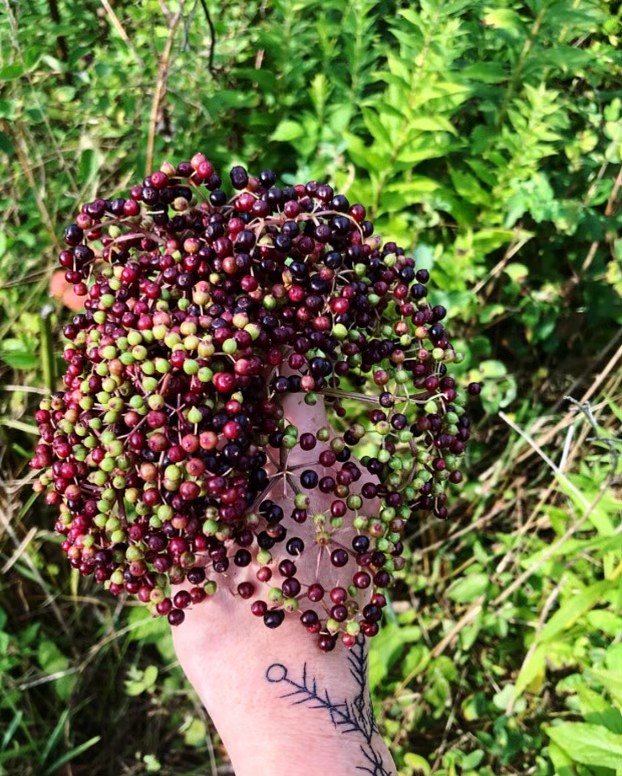
Elderberry and Elder Lore

One could spend a lifetime soaking up Elderberry lore. Please, if we have missed something important, let us know!

Elder can be found most prominently in European history and mythos. Elderberry gets its name from the Old English aeld, which means “fire.”  This association with fire comes from archeological evidence suggesting the use of its hollow branches to blow into fire to get it going.

In Celtic Ogham, the Ruis (ᚏ) symbol represents the Elder. In Old Irish, ruise means “red” or “redness”. This Ogham refers to blushing, intense emotions, shame, being red in the face and the glow of anger. It also refers to the practice of using Elderberries to redden one’s cheeks. Ruis shows sacrifice must be made in order to gain. We must face our failures and pain on our path to achievements.

Elder is sacred to many goddess-traditions and especially to the goddess Frau Holle. It is said that Frau Holle lived inside of the elder bush and she has been referred to as the Elder Mother. Frau Holle has been represented in various ways in several cultures and has gone by many names in Germanic mythology including Mother Earth, Perchta, Odin’s Wife, Frigg, Holda, and several more. She has many faces.

Frau Holle is alternately a hag and a nurturing mother, believed to be a bridge between life and death; communicating with and helping souls to pass over. She holds the power to unleash a variety of magicks on all beings and things in the world. Not one part of the Elderberry bush is to be cut or burnt without permission from her. If one does, you may experience her wrath.

In Danish, the Elder Mother is called Hyldemoer and is associated with Elves, commonly perceived as living within the roots of the Elder tree. Elder wood was considered dangerous to use when building cradles for fear that the Elder Mother could torment or steal the child away.

In an ancient Irish collection of stories known as “The Lays of Fionn Mac Cumhail”, there is a tale called “The Headless Phantoms”. In this tale, Fionn stays in a strange and otherworldly house where elder logs are burnt. He spends the evening being forced to face a myriad of horrible monsters.

The Romani were so fearful of the wrath of the Elder Mother that they would go through great lengths to inspect each bundle of firewood to be sure there was no Elder before casting it upon the fire. It is said that “should you doze off under an Elder bush, you may be taken away to the otherworld or you may never wake at all.

The Elder is known as a great protector and powerful ward against evil. Elderberries are still commonly planted in gardens to watch over the plants. Leaves of the bush were placed above doors to ward off witches. Elderberries on windowsills are supposed to keep vampires from entering. The vampire’s compulsive need to count all the berries would keep them occupied until dawn.

It has also been used in a variety of burial rituals. Green Elder branches were placed in fresh graves to protect the dead from evil spirits. Carrying or wearing any part of the Elder would protect you from harm. Elderberry oil (or water) has been used in blessing rituals. Among Christian traditions, the Elder was a fearful symbol of sorrow and death. In medieval times, some Europeans would tie Elderberry twig hoops to parts of the body that had rheumatism and believed that this would cure it. The Romans created hair color from the dark juice of the berries.