Summer Solstice/Midsummer

The Summer Solstice is the time of year when the daylight is longest, the power of the Sun is at its peak, and the solar cycle reaches its apex, tipping the scales towards the dark half of the year once again. After this turning point, the sunlight begins to wane, shortening the daylight minute by minute until the Winter Solstice. Typically, this was a time to celebrate the Sun, spend time outdoors, and enjoy the bliss of good weather. Mead, wine, and other beverages would be consumed, and great feasts would be enjoyed.

In “Teutonic Mythology” by Grimm, it is said:

“Twice in the year the sun changes his course, in summer to sink, in winter to rise. These turning-points of the sun were celebrated with great pomp in ancient times, and our St. John’s or Midsummer fires are a relic of the summer festival. The higher North, the stronger must have been the impression produced by either solstice, for at the time of the summer one there reigns almost perpetual day, and at the winter one perpetual night.”

Games and various competitions would be hosted along with other festivities such as dancing and music. Entertainment would be lively and abundant, encouraging joy and merriment among the community. In the Germanic context, many people honor the god Baldr during this time as a god of light and/or personification of the light of the Sun, which in a mythological context, “dies” and beings to decline after this time, mirrored by Baldr’s death and descent into Hel. Because of these connections, a common blot/ritual focus during the Summer Solstice is the death (or funeral) of Baldr, the god of light. Stone ships are erected, abundant offerings are made, and various sacrificial items are thrown into fire. These offerings are meant to aid Baldr in his journey on the long road of the underworld.

In “Celtic Mythology and Religion” by Macbain, he says:

“The midsummer festival, christianised into St John’s Eve and Day, for the celebration of the summer solstice, is not especially Celtic, as it is a Teutonic, feast. The wheels of wood, wrapped round with straw, set on fire, and sent rolling from a hillock summit, to end their course in some river or water, which thus typified the descending course of the sun onward till next solstice, is represented on Celtic ground by the occasional use of a wheel for producing the tinegin, but more especially by the custom in some districts of rolling the Beltane bannocks from the hill summit down its side. Shaw remarks – “They made the Deas-sail [at Midsummer] about their fields of corn with burning torches of wood in their hands, to obtain a blessing on their corn. This I have often seen, more, indeed, in the Lowlands than in the Highlands. On Midsummer Eve, they kindle fires near their cornfields, and walk round them with burning torches.” In Cornwall last century they used to perambulate the villages carrying lighted torches, and in Ireland the Eve of Midsummer was honoured with bonfires round which they carried torches.”

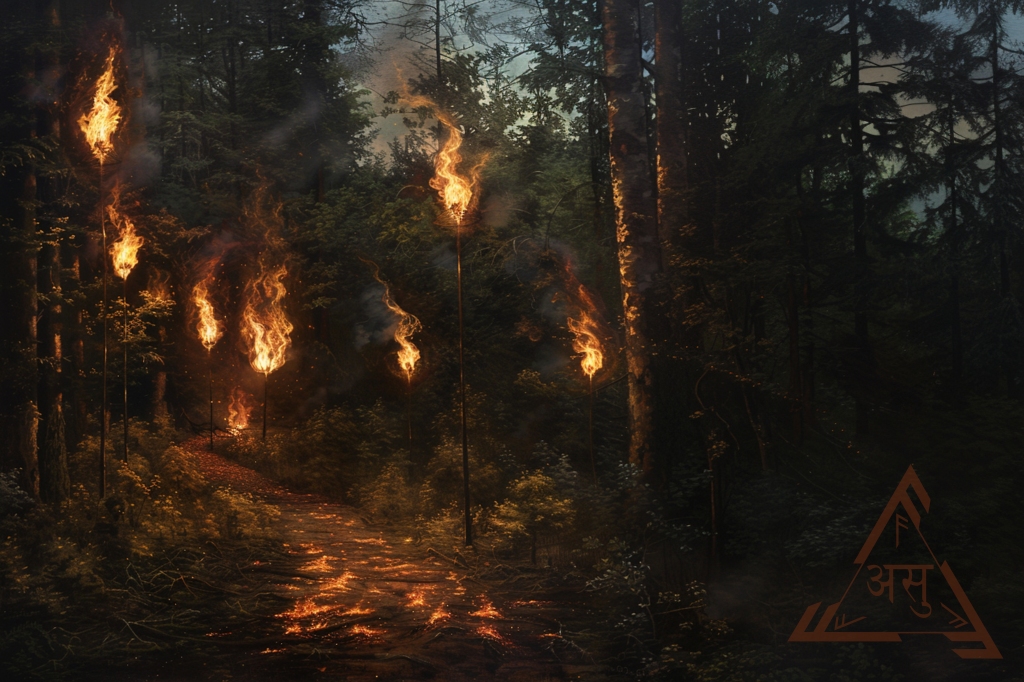
Large bonfires and “Sun-wheels” are made during this time, reflecting the power and glory of the Sun. Special attention was given to the goddess during this time as well, whether as a deification of the Sun itself, the Earth, the Mother, or a mix of the 3. Offerings such as flowers, cakes, milk, honey, and blood are given to the gods and spirits, a ritual exchange of abundance for abundance. As observed in the above quote, it was (and is) common practice to bring the energy of the Sun down to Earth in the form of a torch, then parade it through the fields, groves, or temples in order to bless them with this powerful energy.

In “A History of Pagan Europe” by Jones & Pennick, it says:

“…But the summer solstice, under its statutory date of 25 June, became a popular festivity early in Germanic history. The German word Sonnenwende always refers, in medieval texts, to the summer solstice, not to the winter solstice. At the end of the first century CE some German troops in the Roman army at Chesterholme listed their supplies for the celebration in a record which has come down to us. In the early seventh century, Bishop Eligius of Noyon in Flanders criticised the chants, carols and leaping practised by his flock on 24.”

Here we are given examples of some ancient Germanic practices revolving around the Summer Solstice. We are told of singing, chanting, and competitive games like “leaping”. Clearly, the Christian Romans were disturbed by this revelry, showing its clear Pagan origins. This turning point in the year was extremely important to observe, as it strikes a pivotal moment in the Sun’s lifecycle, affecting every aspect of our lives.
Ostara / Equinox Hails!

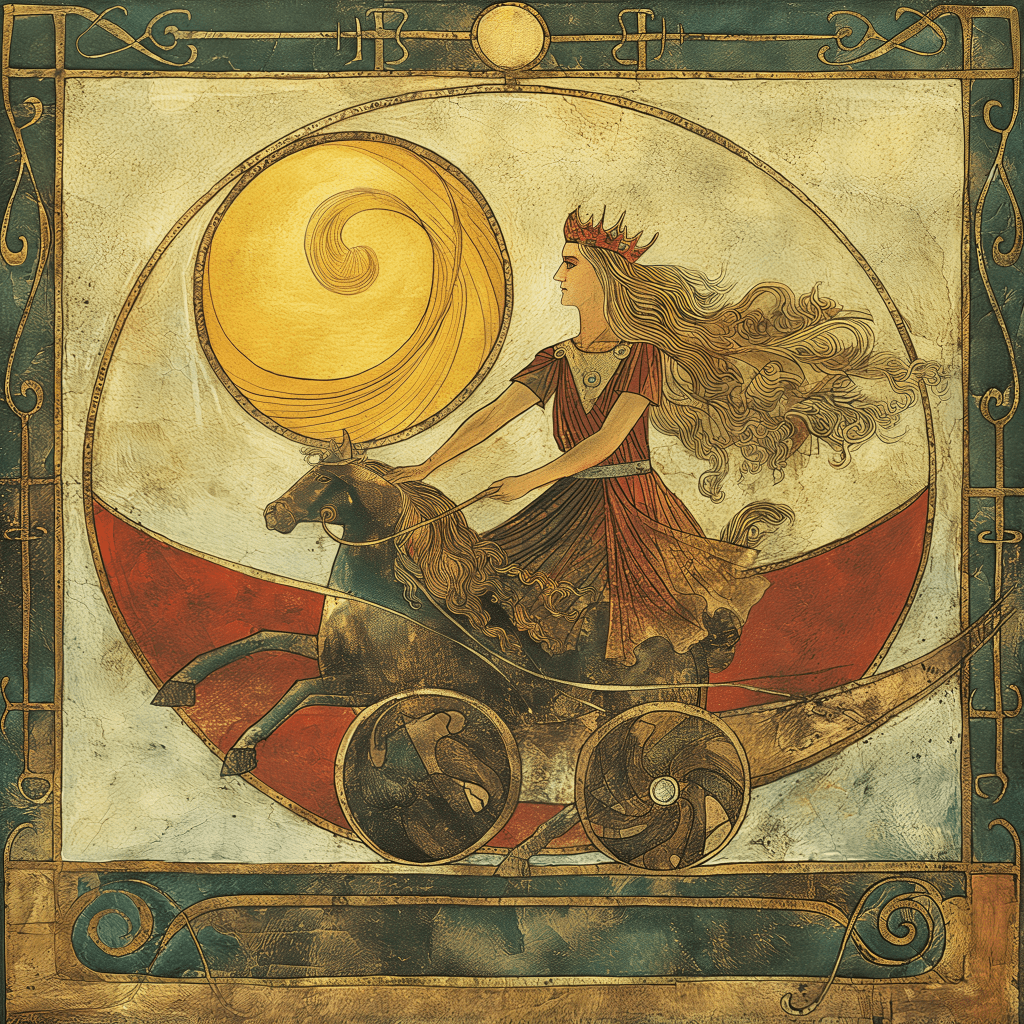
The Spring Equinox marks the traditional Easter celebration, the moment when the Sun crosses the equator from south to north. This is when animals like rabbits, deer, chipmunks, and other creatures of the forest begin to have their offspring. Various flora also emerge around this time, dotting the landscape with hints of color. During the Spring Equinox we pay special attention to the great Goddess in her youthful form of Ostara, Goddess of the Dawn. Ostara is associated with the rising Sun in the East, fertility, and light; a beacon of joy and good fortune. To many ancient Germanic Pagans, Ostara was credited with Springs deliverance. From her name we derive the modern word Easter, nodding to the Pagan origins of this holiday. To Ostara we make offerings and pray for a good year, thanking her for the return of the light. In one particular myth, Ostara transforms a bird into a rabbit who would then lay colorful eggs for her, showing us where the core symbolism of our modern holiday came from.

Hailaz Austra!

#ostara #spring #equinox #paganism

Kenaz

ᚲ / C / K

Kenaz is a particular rune, changing dramatically in context from Elder to Younger runes. The continental Germans seemed to hold this rune in a more positive light than their Scandinavian neighbors in the North. Kenaz is a reconstructed word from Proto-Germanic meaning “torch,” associated with creative fire, skills, knowledge, and teaching. The torch is that which illuminates the darkness, showing us the way in places unknown. This has been equated with an internal creative “spark” as well, which I think is reflected in the hard “k” sound represented by this rune. If we look to the Gothic language, we find evidence for this theory in the kindred word kōnja which refers to pine sap. This must be directly related to the torch, as pine/spruce has long been a favored wood for this use. 

The Gothic name for this rune is kosma/kusma, stemming from kunnan meaning “to be able, to know how,” referring to one’s inner abilities and skills. This word travels through time and tribe almost unchanged in sound and meaning, showing up in modern English in the words know and keen. In my opinion, the best example of this concept is crystallized in the Swedish word konst, meaning “art, knowledge, science, magic, secret,” and in the cognate German word kunst meaning “skill, craft, ability, magic.” This internal power of knowledge, associated with a craft or specific artistic focus, is the secret “light” side of the Kenaz rune, symbolizing our ability to make things known, to teach them, and to exhibit mastery in arts, crafts, intellectual or occult matters. 

 When looking for clues in the rune poems, the only evidence we find in relation to a “torch” is from the ‘Old English Rune Poem,’ where it states: 

“Torch is known by each of the living through its fire

-bright and blazing- it burns oftest

Where the athelings are at ease indoors.”

 Here it is clear that the word “torch” is denoting skill as a display of one’s “inner fire.” This is something (as a torch in the dark) that all can witness. “Bright and blazing” is the external effect of mastery and true skill in craft, as creation is a bright and blazing power. The last line denotes a sense of peace inherent in the “athelings,” which means “nobles, lords, heroes.” This clearly reminds an English reader of the word athlete, which signifies “those competing to win a prize.” I believe this relates to the calm felt within an extremely wise, skilled, or focused group; where everyone’s flame is burning bright and clear, all can feel a sense of ease and comfort. We get another look at this concept with the Old English word kennan which means “to make known, declare” but also “to bring forth, produce.” This is essential to the function of a craftsmen, artist, musician, or anyone who actively works with creative energies and systems. 

 In Old Norse, this rune is represented in the word kaun, meaning “sore, ulcer, boil,” and carries a much more sinister and harmful aspect associated with it. In most old poetry and analysis, it seems this rune was more of a curse or fetter than something used for anything “positive.” Although, in some Freemason rites, it has been shown that the Younger rune (ᚴ) is still in effect as a “torch,” as it mimics the man holding his sword (torch) at this angle during initiation rituals. As one walks through this “tunnel of torches,” he is “illuminated/initiated” into a new reality. 

 In the ‘Old Norwegian Rune Rhyme” it is said: 

“A sore is a curse for children;

Bale makes a man pale.” 

 Likewise, in the “Old Icelandic Rune Poem” it is said: 

“A boil is bale for bairns, and a scourgeful spot,

 And a home for flesh-rot.” 

 Here we see how our Scandinavian ancestors viewed this rune, as a much darker and fearful tone is taken with it. They viewed this rune in the context of evil and pain, without any allusions to a “lighter” aspect within the poetry. However, all these physical ailments have in common the sensation of “burning” within those experiencing it. This gives us insight into the deeper layers of the rune, where “fire” is still present, albeit in a new form. This rune was probably used strictly as a curse unless by the most skilled of sorcerers, who may have been able to turn this internal strife and struggle into acts of creation or transcendence. If looking at the Younger Futhorc as a whole, we see Kaun landing next to another very sorcerous and powerful rune, Hagal, the hail stone of transformation. Seeing these very destructive and feared runes side by side, as fire and ice respectively, shows a sort of miniature Ragnarök within the cycle of the Futhorc, enhancing the importance of viewing them in their respective “aetts” or groups, as here we end the first and begin the second. This is something I plan to venture into with more thought later… 

 To conclude, Kenaz is a rune steeped in much power and is tied together throughout all linguistic changes in the concept of an internal “fire” or a “burning” sensation. We have the older associations with torches, knowledge, creation and skill; being associated with teachers, students, craftsmen, and artistic masters. We also have the concept of “keenness” tied in, being exceptionally skilled and knowledgeable, “sharp” of mind and highly productive. In the North, this rune carried a more malicious nature, representing sickness, pain, and struggle. When approaching this rune from all the previous angles, we see a very wide range of meanings one can attribute to this rune, depending mostly on which system of runes one is working with. If using the Elder or Anglo-Saxon runes, this rune is viewed in relation to the torch. If using the Younger runes, it is likely you will associate this rune with pain or sickness.

Taken from the book “Wandering the Runic Path: Esoteric Analysis of the Germanic Runes” by Hrukjan.

Elderberry and Elder Lore

One could spend a lifetime soaking up Elderberry lore. Please, if we have missed something important, let us know!

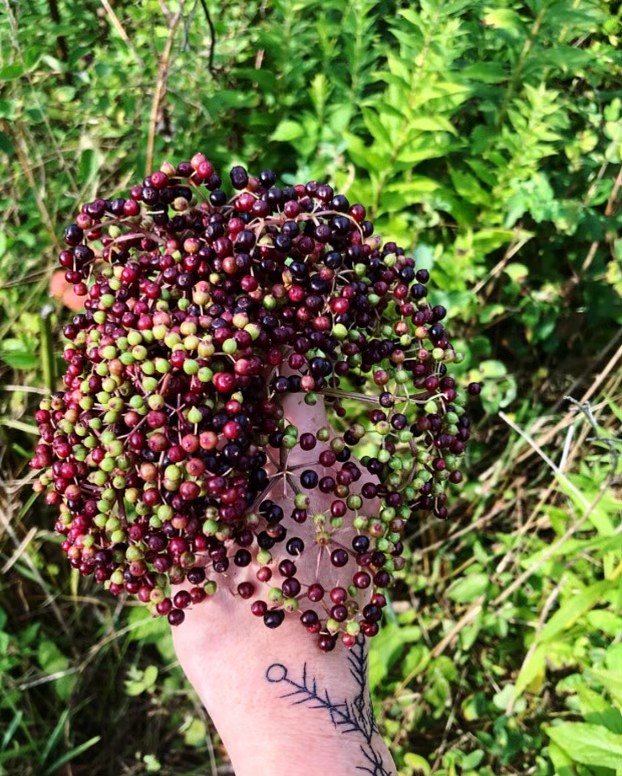
Elder can be found most prominently in European history and mythos. Elderberry gets its name from the Old English aeld, which means “fire.”  This association with fire comes from archeological evidence suggesting the use of its hollow branches to blow into fire to get it going.

In Celtic Ogham, the Ruis (ᚏ) symbol represents the Elder. In Old Irish, ruise means “red” or “redness”. This Ogham refers to blushing, intense emotions, shame, being red in the face and the glow of anger. It also refers to the practice of using Elderberries to redden one’s cheeks. Ruis shows sacrifice must be made in order to gain. We must face our failures and pain on our path to achievements.

Elder is sacred to many goddess-traditions and especially to the goddess Frau Holle. It is said that Frau Holle lived inside of the elder bush and she has been referred to as the Elder Mother. Frau Holle has been represented in various ways in several cultures and has gone by many names in Germanic mythology including Mother Earth, Perchta, Odin’s Wife, Frigg, Holda, and several more. She has many faces.

Frau Holle is alternately a hag and a nurturing mother, believed to be a bridge between life and death; communicating with and helping souls to pass over. She holds the power to unleash a variety of magicks on all beings and things in the world. Not one part of the Elderberry bush is to be cut or burnt without permission from her. If one does, you may experience her wrath.

In Danish, the Elder Mother is called Hyldemoer and is associated with Elves, commonly perceived as living within the roots of the Elder tree. Elder wood was considered dangerous to use when building cradles for fear that the Elder Mother could torment or steal the child away.

In an ancient Irish collection of stories known as “The Lays of Fionn Mac Cumhail”, there is a tale called “The Headless Phantoms”. In this tale, Fionn stays in a strange and otherworldly house where elder logs are burnt. He spends the evening being forced to face a myriad of horrible monsters.

The Romani were so fearful of the wrath of the Elder Mother that they would go through great lengths to inspect each bundle of firewood to be sure there was no Elder before casting it upon the fire. It is said that “should you doze off under an Elder bush, you may be taken away to the otherworld or you may never wake at all.

The Elder is known as a great protector and powerful ward against evil. Elderberries are still commonly planted in gardens to watch over the plants. Leaves of the bush were placed above doors to ward off witches. Elderberries on windowsills are supposed to keep vampires from entering. The vampire’s compulsive need to count all the berries would keep them occupied until dawn.

It has also been used in a variety of burial rituals. Green Elder branches were placed in fresh graves to protect the dead from evil spirits. Carrying or wearing any part of the Elder would protect you from harm. Elderberry oil (or water) has been used in blessing rituals. Among Christian traditions, the Elder was a fearful symbol of sorrow and death. In medieval times, some Europeans would tie Elderberry twig hoops to parts of the body that had rheumatism and believed that this would cure it. The Romans created hair color from the dark juice of the berries.