Back at headquarters after a very busy and powerful weekend at KTD.
Two empowerments were given (Stainless Ushnisha and Stainless Light Rays), both related to the construction of stupas, the consecration of the items therein, and the clearing away of obstacles. These were given by Khenpo Lodrö Dönyö Rinpoche, abbot of the Mirik Monastery. This is something we would like to sponsor here at some point in the future.
After that, the monks began a 7 day Chakrasamvara puja at the request of the Karmapa, whose father passed away.
It is always rejuvenating to visit this holy site, but, it is also hard to leave. If you find yourself in the area, you should certainly stop by.
May all beings thrive.
“There is an old saying that the path is the goal and goal is the path. You make your journey, you get to your destination, and arriving at your destination brings on another question: how to proceed from there? In that way each goal itself becomes the path. Particularly from the tantric point of view, you don’t achieve anything except path. Discovery of the path is achieving.”
The Spring Equinox marks the traditional Easter celebration, the moment when the Sun crosses the equator from south to north. This is when animals like rabbits, deer, chipmunks, and other creatures of the forest begin to have their offspring. Various flora also emerge around this time, dotting the landscape with hints of color. During the Spring Equinox we pay special attention to the great Goddess in her youthful form of Ostara, Goddess of the Dawn. Ostara is associated with the rising Sun in the East, fertility, and light; a beacon of joy and good fortune. To many ancient Germanic Pagans, Ostara was credited with Springs deliverance. From her name we derive the modern word Easter, nodding to the Pagan origins of this holiday. To Ostara we make offerings and pray for a good year, thanking her for the return of the light. In one particular myth, Ostara transforms a bird into a rabbit who would then lay colorful eggs for her, showing us where the core symbolism of our modern holiday came from.
We have recorded a rendition of the Mahamrityunjaya mantra with a new affiliate @kshatriyacowboy. This verse can be found in the Rigveda (RV 7.59.12) and is devoted to the great Rudra-Shiva in his form of Tryambakam or “The Three Eyed One.”
There are many translations of this mantra, but it is generally referred to as the “Great Conquest Over Death” or “Death Destroying” mantra.
The Mahamrityunjaya mantra is a request to be separated from the clutches of death; a longing to be free of attachments to samsara and one’s inherent ignorance regarding the perception of self. The mantra expresses a specific wish to not be removed from the possibility of immortality; requesting to have one’s attachment to samsara be broken (the suffering of bodily/individual bondage) but for one’s consciousness (Self/Atman) to remain intact for eternity; completely overwhelmed and overflowing with devotion for the primeval essence. This is requested as a means to continue worshiping the divine Shiva for all of infinity, who is none other than the progenitor of primordial consciousness; the true state of one’s being. The mantra describes this metaphorically as a cucumber (or melon) being separated from its vine but continuing to live on as an emanation of its source (Shiva). This request is for consciousness to become free from the shackles of the flesh (vine) associated with the experience of samsara (change), ego, and death. Through this process, one’s true Self may live on forever in constant reverence of the primordial source; the original state of awareness from which one’s perception comes and to what one’s consciousness is inseparable from, no matter how obscured or hidden by one’s mundane delusions.
Oh Three Eyed one, great Shiva,
Fragrant (blissful, aromatic) sustainer of prosperity,
As the cucumber is removed from its vine (bondage),
May I be relinquished from death (attachment to samsara) but not from immortality.
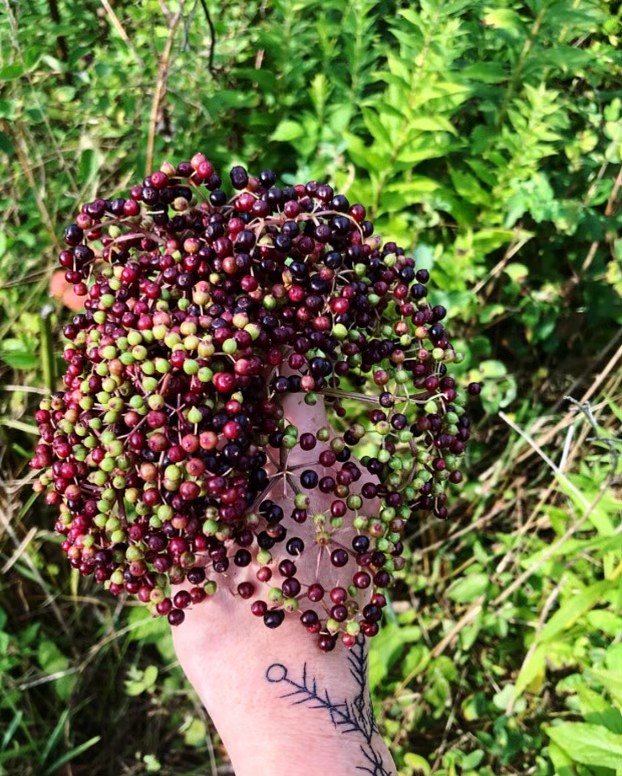
One could spend a lifetime soaking up Elderberry lore. Please, if we have missed something important, let us know!
Elder can be found most prominently in European history and mythos. Elderberry gets its name from the Old English aeld, which means “fire.” This association with fire comes from archeological evidence suggesting the use of its hollow branches to blow into fire to get it going.
In Celtic Ogham, the Ruis (ᚏ) symbol represents the Elder. In Old Irish, ruise means “red” or “redness”. This Ogham refers to blushing, intense emotions, shame, being red in the face and the glow of anger. It also refers to the practice of using Elderberries to redden one’s cheeks. Ruis shows sacrifice must be made in order to gain. We must face our failures and pain on our path to achievements.
Elder is sacred to many goddess-traditions and especially to the goddess Frau Holle. It is said that Frau Holle lived inside of the elder bush and she has been referred to as the Elder Mother. Frau Holle has been represented in various ways in several cultures and has gone by many names in Germanic mythology including Mother Earth, Perchta, Odin’s Wife, Frigg, Holda, and several more. She has many faces.
Frau Holle is alternately a hag and a nurturing mother, believed to be a bridge between life and death; communicating with and helping souls to pass over. She holds the power to unleash a variety of magicks on all beings and things in the world. Not one part of the Elderberry bush is to be cut or burnt without permission from her. If one does, you may experience her wrath.
In Danish, the Elder Mother is called Hyldemoer and is associated with Elves, commonly perceived as living within the roots of the Elder tree. Elder wood was considered dangerous to use when building cradles for fear that the Elder Mother could torment or steal the child away.
In an ancient Irish collection of stories known as “The Lays of Fionn Mac Cumhail”, there is a tale called “The Headless Phantoms”. In this tale, Fionn stays in a strange and otherworldly house where elder logs are burnt. He spends the evening being forced to face a myriad of horrible monsters.
The Romani were so fearful of the wrath of the Elder Mother that they would go through great lengths to inspect each bundle of firewood to be sure there was no Elder before casting it upon the fire. It is said that “should you doze off under an Elder bush, you may be taken away to the otherworld or you may never wake at all.
The Elder is known as a great protector and powerful ward against evil. Elderberries are still commonly planted in gardens to watch over the plants. Leaves of the bush were placed above doors to ward off witches. Elderberries on windowsills are supposed to keep vampires from entering. The vampire’s compulsive need to count all the berries would keep them occupied until dawn.
It has also been used in a variety of burial rituals. Green Elder branches were placed in fresh graves to protect the dead from evil spirits. Carrying or wearing any part of the Elder would protect you from harm. Elderberry oil (or water) has been used in blessing rituals. Among Christian traditions, the Elder was a fearful symbol of sorrow and death. In medieval times, some Europeans would tie Elderberry twig hoops to parts of the body that had rheumatism and believed that this would cure it. The Romans created hair color from the dark juice of the berries.
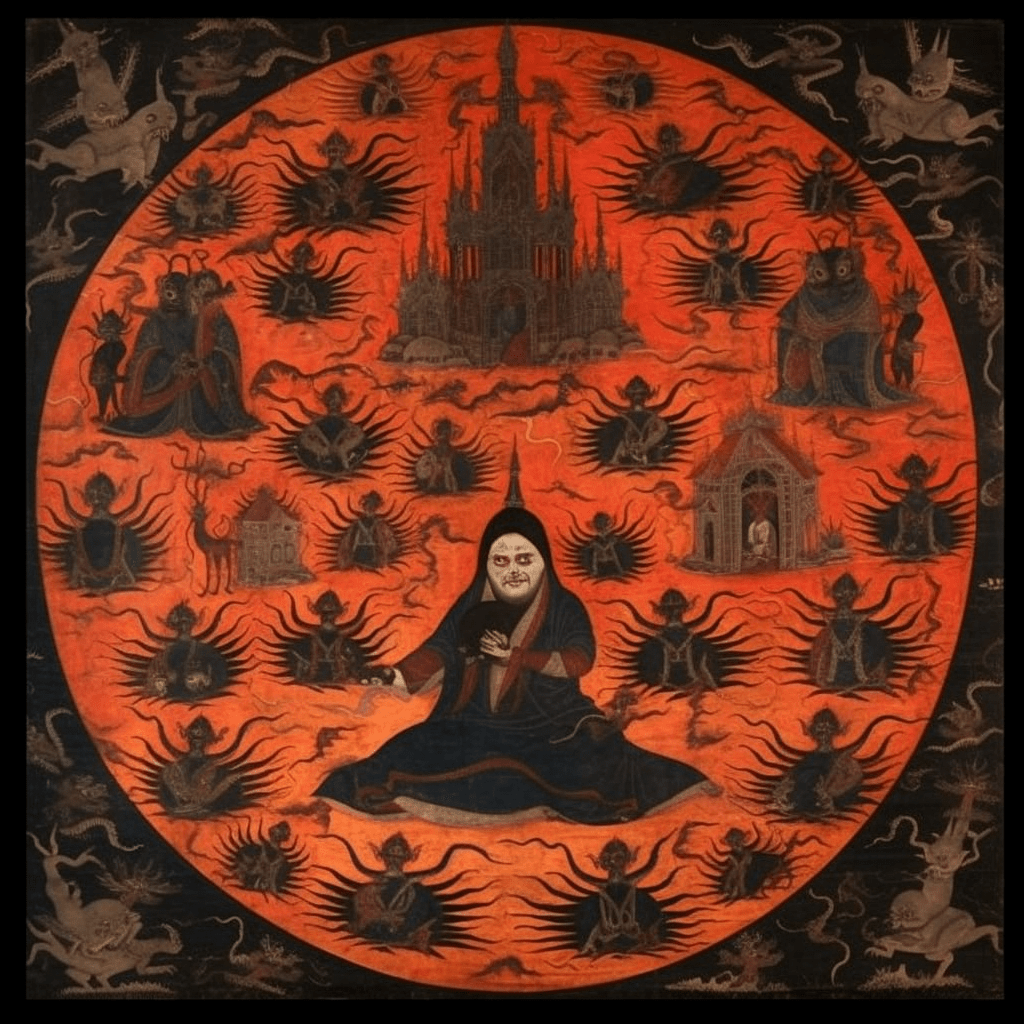
“…We tend to think of Mara as something ferocious that is going to come along and cut us up or drag us off; it is not necessarily that dramatic or that overtly unpleasant. Mara is anything that obstructs the practice of Dharma and seduces you into abandoning the practice of Dharma and favoring worldly activities…”
-K.K.R.
Mara is a Sanskrit word meaning “death” and has relation to the Vedic god of death Mrtyu. This word stems from a more archaic Indo-European root mer-, which means “to die.” With this in mind, and in the context of Buddhism, we can associate Mara with anything that makes our focus on the Dharma “die”, become distracted, or diminish.
It is important that we consider all distractions in our practice as potential incarnations and activities of Mara. If it is more applicable to your vocabulary, viewing these distractions as demons can be equally beneficial. However, this concept isn’t to be externalized in meaning, as the root of Mara lies within us and not on the outside. Even in the case of a wild animal devouring us, we cannot view the animal as Mara, but instead, our attachment to our own body as the essence of Mara’s activity.
Mara(s) can generally be classified into four different categories. The first applies to our “unskillful” emotions such as greed, hate, and ignorance. The second applies to death and the circumstances that cause death. The third applies to conditioned existence and its symptoms. The fourth applies to the being Mara and his daughters, who tried to prevent Gautama Buddha from attaining liberation on the night of his enlightenment.
Although some of these have “external” sounding features, it is important to remember that all phenomenon we experience as Mara can be associated with our own ignorance in perception, and therefor, exist within us as obscurities. For instance, during meditation, a barking dog only exists as a Mara/demon in the sense that our perception is being disturbed by it, due (most likely) to our attachments to silence, control, and comfort. If one shifts their perception to pure emptiness, one makes their mind like the space inside a cave, where sound may enter and echo, but ultimately, moves through like wind and attaches to nothing.
If our mind rests in this realization of emptiness, then all external phenomenon move through it like clouds in the sky or waves in the ocean.
May all sentient beings conquer the Maras that obstruct their Dharma practices.


 Ansuz Society