
Subscribe to continue reading
Subscribe to get access to the rest of this post and other subscriber-only content.

Subscribe to get access to the rest of this post and other subscriber-only content.
Stanza 23 of The Hávamál reads:
“The witless man is awake all night,
Thinking of many things;
Care-worn he is when the morning comes,
And his woe is just as it was.”
This stanza offers timeless insight into the nature of worry and sleeplessness. It warns against the unproductive torment of overthinking, something that transcends time, culture, and language.
Insomnia and nighttime rumination are now well documented features of anxiety and depression. The pre-dawn hours, when the world is still and our thoughts are loudest, can feel especially oppressive.
Odin’s advice urges wisdom through healthy and proactive emotional moderation. He implies that constant brooding leads us nowhere. A sleepless night of rumination changes nothing and only compounds one’s suffering. This is the product of avoiding one’s anxieties during waking hours. We cannot hide from these things.
This emotional state also appears in Anglo-Saxon poetry, such as in The Wanderer. The speaker describes his lonely morning sorrows: “Often I must bewail my sorrows alone every morning: none is now alive to whom I dare plainly speak my mind”.
Interestingly, a similar concept is found in the Old English word uhtceare, which roughly translates as “pre-dawn anxiety” or “the sorrow before dawn.” It refers to the experience of lying awake in the early hours, consumed by worry. The word is formed from uhta, meaning the time just before daybreak, and cearu, meaning care, grief, or anxiety.
The fact that both Norse and Anglo-Saxon traditions preserved and named this specific experience speaks to how universally felt it was throughout the Germanic world.
Yet, perhaps there is comfort to be found in this. The ancients wrestled with the same restlessness that plagues us today. If even the Allfather himself thought it important enough to caution against, then perhaps it’s a reminder that we’re not alone in our struggles. And that, in itself, may offer some solace.

The Chanterelle is an edible mushroom with medicinal perks.
You can find this golden treasure living in symbiosis with pine, spruce, oak and hornbeam.
They will reappear in the same places year after year so long as the mycelium in the soil is not disturbed. One patch can produce fungi for generations.
Some of the benefits of Chanterelles include:
• Rich source of several vitamins and minerals including vitamin D which supports bone health
• Known to help reduce inflammation
• Great immunity boosters
We like to pickle our excess Chanterelles for later use.
Let us know if you have any favorite Chanterelle recipes or other uses!

In Vedic astrology, eclipses are seen as a symbol of revenge or as a bad omen.
According to mythology, eclipses are caused by the Chaya Graha (shadow planets) Rahu and Ketu, who were once part of a divine serpent. The story is traced back to a time before creation in the tale of the churning of the ocean, known as the Samudra Manthan. The churning of the ocean represents our consciousness. After an awful and lengthy war, the devas (gods) and asuras (demons) cooperated to churn the galactic material called the Milk Ocean. The churning poured forth several gifts and treasures. They included the goddess of wealth Lakshmi, the wish-fulfilling tree Kalpavriksha, the wish-fulfilling cow Kamadhenu, and Dhanvantari, who carries a pot of amrita and a book of medicine called Ayurveda. Amrita is a Sanskrit word that means “immortality” and is a drink (or nectar) intended only for the gods.
A serpent demon (Svarabhānu) aspired to become invincible. Sitting between Surya (the Sun) and Chandra (the Moon), Svarabhānu disguised himself as a deva and managed to take a sip of Amrita during Samudra Manthan. Surya and Chandra recognized the imposter and informed Mohini (the female form of Lord Vishnu), preserver of life and order, who quickly decapitated him. As they were now immortal, Lord Vishnu needed to find a place for them, so he put them in two specific points in the sky.
The head of the serpent demon (without the body) became Ratu, who fell on one side of the sun. The tail without the head that fell on the opposite side of the sun became Ketu. The sun stopped all movement in order to keep Rahu and Ketu from meeting one another. Twice a year they can create confusion and exact revenge by consuming the Sun and Moon causing the world to suffer from darkness.Rahu swallows the Sun, and Ketu, the Moon. But only for a short while as the Sun and Moon have also taken in the amrita. Offerings of coal, mustard, sesame, saffron and lead are made to appease Rahu. For Ketu, offerings of lead, sugar, saffron and sesame are made along with offering food to a dog with black and white fur.
As seen above, eclipses can be seen as highly inauspicious. Light and power diminish which corrupts their positive qualities and creates disturbances in the natural order of things. It is believed that auspicious work should only be started in the light. Because of this, beginning any new ventures during this period of darkness is not recommended, as it can bring upheavals, obstacles, and turmoil.
#eclipse #vedic #astrology #rahu #ketu

In honor of the season and the veil soon thinning, I have taken to studying more macabre and spooky plant lore for fun.
I hope that you enjoy this first tale.
Hungry grass, also known as Féar Gortach is said to be a patch of grass that is indistinguishable from any other section of grass. However, it is said to be cursed by the dead that lay buried underneath.
Should you stand or walk upon hungry grass, you will be overtaken by weakness and hunger.
Variations of the hungry grass story tell of a person stepping upon the grave or burial plot of a victim from An Gorta Mór (the Great Famine) of the 1840’s. The Irish term “féar gorta” can be more accurately translated as “famine grass” rather than “hungry grass.”
This myth may be a folklore manifestation of the historical trauma suffered during the Great Famine (An Gorta Mór) of the 1840’s. When the Famine took hold, men, women and children were left to starve to death as a direct result of the Potato Blight and a misuse of resources under British Government rule at the time.
Over one million people died in poverty, starvation and agony. These poor souls were thrown into mass graves, usually in fields. These spaces became known as “Famine Graveyards”.
The grass eventually grew over the buried bodies and it was said to be cursed.
When scientific reasoning wasn’t particularly widespread, it was probably a fair attempt at rationalizing the unexplained deaths or episodes of fainting that would occur from time to time due to malnutrition.
An alternative version of the hungry grass tale relates that anyone walking through it is struck by temporary hunger. In order to safely cross the grass, one must carry a bit of food to eat along the way such as a sandwich or crackers and some ale.
In a few rare accounts, the hungry grass is said to actually devour humans.
There was the idea that the hungry grass may also eat crops too. Before the term “hungry grass” was coined, people thought that a spirit of a man was, in fact, eating people. The word “féar” in Irish is both “man” and “grass”. So, Hungry Man came to be because they feared him. It was said that if you give relief to Hungry Man, you will enjoy unfailing prosperity, even during the worst periods of famine and death.
Although the hungry grass superstition is outdated nowadays and seems very specific to Ireland, it has a lot of narrative appeal.
Beware the hungry grass!

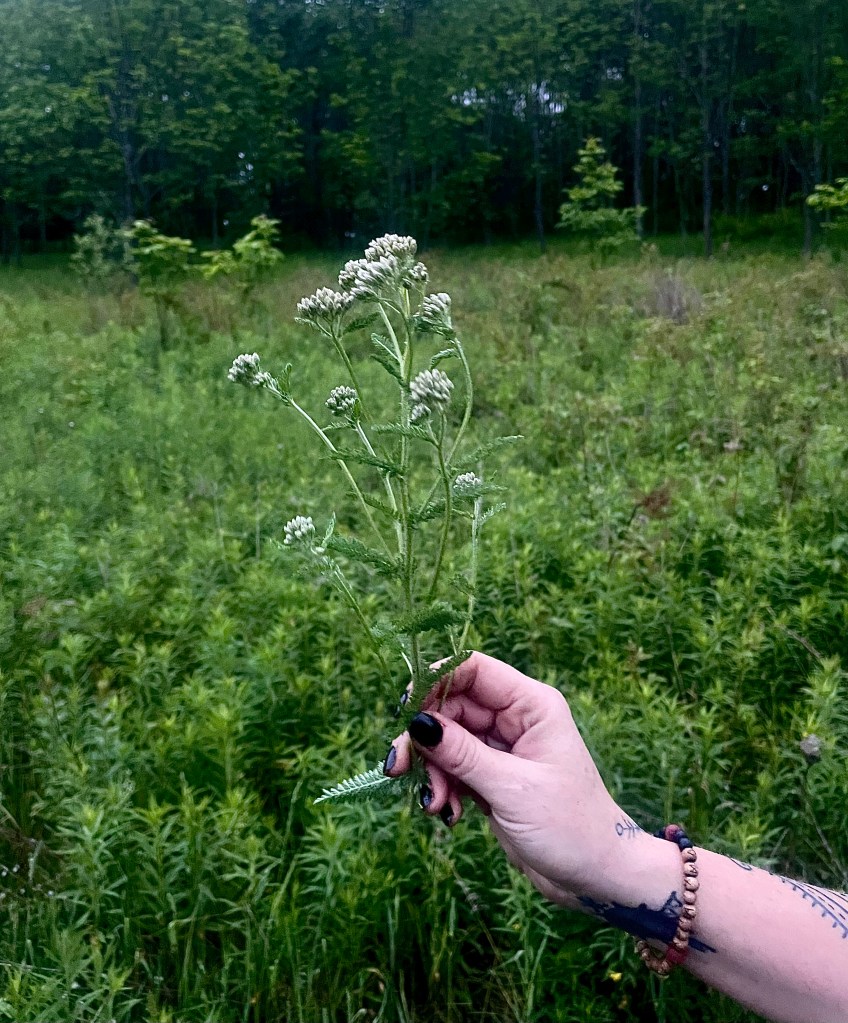
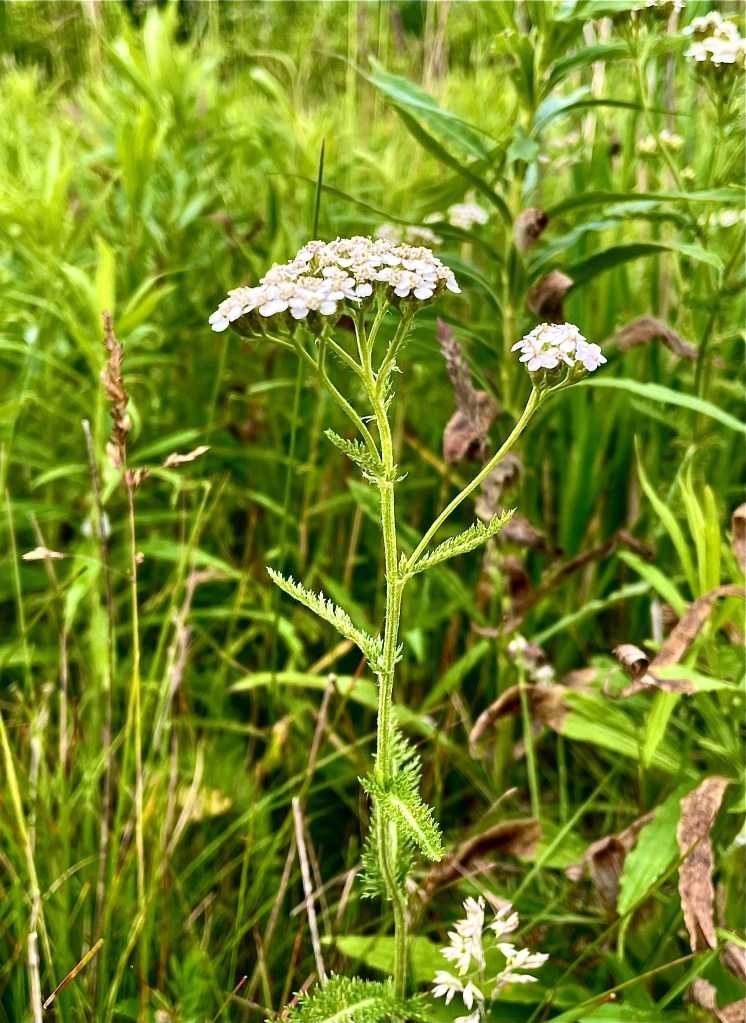
The scientific name for the common yarrow plant (Achillea millefolium) translates to ‘a thousand leaves’, in reference to the tiny, lacy, fern-like leaves. It is also called plumajillo (“little feather”) due to the shape and wispy characteristics of the leaves. Other names include chipmunk tail, milfoil, bloodwort, nosebleed plant, woundwort and field hops. The common name of yarrow may be derived from the Celtic word garw, which means “rough” and could be associated with yarrow’s ability to thrive in inhospitable conditions.
Yarrow was (scientifically) named after the Greek warrior Achilles, whose longevity in battle was credited to being dipped in a warm bath of yarrow shortly after birth. Later, it’s said that he used yarrow leaves to heal the wounds of his men. In keeping with this heroic legacy, yarrow is one of our strongest allies for heavy or hemorrhagic bleeding and first-aid herbalism.
Yarrow has long been associated with the occult and divination practice. It was considered an “herb of witches” due to its outstanding healing power. This could also have given rise to some of the common names for yarrow, such as bad man’s plaything, elf’s herb, devil’s plaything, devil’s herb and devil’s nettle. The Druids selected stems of yarrow to forecast weather for the season. The Irish included this as one of the herbs of St. John and hung it on houses as protection from sickness. In Celtic folklore, yarrow was used in handfasting and wedding rituals. It is said that yarrow keeps a newly married couple happy and at peace for seven years. I am not sure what happens after those seven years! Yarrow was also used by the Chinese as an oracle for foretelling the future.
Yarrow has been used in old European love charms for millennia. This plant is said to be a cure for heartache and has been used as a love charm. When the herb is pressed into a small sachet and placed under one’s pillow, it provokes dreams that can reveal the identity of one’s true love.
One Gaelic incantation that is recited when plucking yarrow goes like this: “I will pluck the smooth yarrow that my figure may be sweeter, that my lips may be warmer, that my voice may be gladder. May my voice be like a sunbeam, may my lips be like the juice of the strawberry…”
The Farmer’s Almanac published an article in 1986 that included an article titled “How to Find the Perfect Mate”. Several superstitious acts were listed, beginning with “Pluck a stalk of yarrow and stick it up your nose. If a drop of blood appears, your love is true.”
Yarrow was used by the Saxons as an amulet. These served as protection from all sorts of ailments and robbery. While it was used for security purposes, at the same time it could serve evil intents as well. Other legends state that when going on a journey, one should pull ten stalks of yarrow, keep nine, and throw the tenth away (as an offering to the spirits), place the nine under your right heel and evil spirits would have no power over you.
Amidst all the lore and practical uses, yarrow is also a ceremonial and mind-altering medicine. It is mildly psychotropic, and many herbalists have reported shifts in consciousness after taking high doses. When fermented in ale or mead, yarrow’s intoxicating effects seem to be enhanced. You won’t experience these effects if you’re taking yarrow in standard medicinal doses.

Yarrow is one of the most ancient herbs for practical medicine and ceremonial healing. Its pollen has been found in Neanderthal burial sites. Traces of yarrow leaf have been found in the teeth of a 50,000 year old Neanderthal man.
Yarrow is a joy to gather as it usually symbolizes the first days of Summer here in Western New York. For ceremonial and divinatory use, yarrow is traditionally gathered on Midsummer’s Day. Otherwise, it can be harvested soon after the flowers have opened and once the morning dew has dried.
Yarrow was named for the Greek warrior Achilles, whose longevity in battle was credited to being dipped in a warm bath of yarrow shortly after birth. Later in life, it’s said that he used yarrow leaves to heal the wounds of his men.
Yarrow is a strong ally for heavy bleeding and also works as an antiseptic. It finds its way into the medicine cabinet as a diaphoretic for colds and flu, made from yarrow’s flowers. It is also used as a bitter for improving digestion when taken before a meal as an aperitif and is effective for stomach and menstrual cramps and intestinal flus.
Yarrow’s roots have anodyne and anti-inflammatory qualities that can be used for tooth and teething pain. A frozen or cold cloth soaked in a decoction or diluted tincture will reduce inflammation when chewed.
It may also be used as a mild sedative to promote sleep or to calm anxiety. As a traditional divinatory and ritual herb, yarrow has been used in Native American sweat lodges, Chinese oracular ceremonies and European love charms for millennia.
A wash of the leaves or flowers will disinfect wounds and can be followed by a chew-and-spit poultice of fresh or dried leaves to stem bleeding and speed healing. Fresh yarrow leaves are preferred, as the dried leaves seem to lose their volatile oils very easily.
Astringent tannins in yarrow have made it a valued remedy for the reproductive system among midwives and herbalists.
Dried, powdered leaves are great for the medicine cabinet. A centuries-old Romani remedy is that it can be applied to cuts and wounds to prevent infection and stop bleeding. A pinch of the powder in the nose will also help quickly curb a nosebleed. Refrain from inserting fresh yarrow leaves into your nostrils.
Tincture ratios and dosage:
Leaf: Fresh (1:2 using 95% alcohol) or dry (1:5 using 50% alcohol); preparation 1–3 ml, three times a day.
Flower: Fresh (1:2 95% alcohol) or dry (1:5 50% alcohol); preparation 1–3 ml, three times a day.
Root: Fresh (1:2 95% alcohol) or dry (1:5 50% alcohol); preparation 1–3 ml, three times a day.
Infusion ratios and dosage:
Leaf: Infusion of 1 to 2 teaspoons (5–10 ml) of the dried leaves per 1 cup (240 ml) of boiling water, up to three times a day. Higher doses can be used acutely, as needed, for a short period.
Flower: Infusion of 1 to 2 teaspoons (5–10 ml) of the dried flowers per 1 cup (240 ml) of boiling water, up to three times a day.
Root: Decoction of 1 to 2 teaspoons (5–10 ml) of the dried roots per 1 cup (240 ml) of boiling water, up to three times a day.
Avoid ingesting during pregnancy. Both internally and externally, yarrow may cause side effects for those with Asteraceae sensitivity (contact dermatitis, photosensitivity, and allergic reactions) although reactions are very rare. Be sure of your yarrow identification, as there are poisonous look-alikes, including poison hemlock.
Be safe!
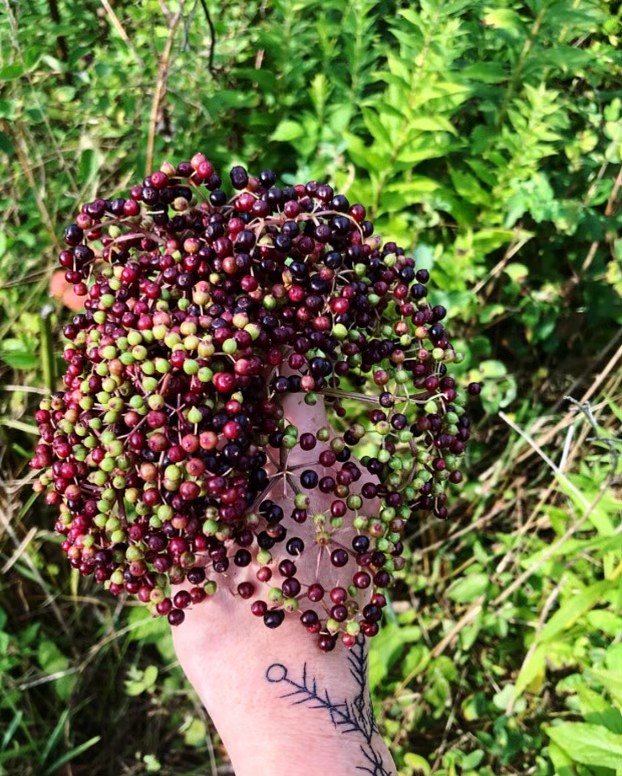
One could spend a lifetime soaking up Elderberry lore. Please, if we have missed something important, let us know!
Elder can be found most prominently in European history and mythos. Elderberry gets its name from the Old English aeld, which means “fire.” This association with fire comes from archeological evidence suggesting the use of its hollow branches to blow into fire to get it going.
In Celtic Ogham, the Ruis (ᚏ) symbol represents the Elder. In Old Irish, ruise means “red” or “redness”. This Ogham refers to blushing, intense emotions, shame, being red in the face and the glow of anger. It also refers to the practice of using Elderberries to redden one’s cheeks. Ruis shows sacrifice must be made in order to gain. We must face our failures and pain on our path to achievements.
Elder is sacred to many goddess-traditions and especially to the goddess Frau Holle. It is said that Frau Holle lived inside of the elder bush and she has been referred to as the Elder Mother. Frau Holle has been represented in various ways in several cultures and has gone by many names in Germanic mythology including Mother Earth, Perchta, Odin’s Wife, Frigg, Holda, and several more. She has many faces.
Frau Holle is alternately a hag and a nurturing mother, believed to be a bridge between life and death; communicating with and helping souls to pass over. She holds the power to unleash a variety of magicks on all beings and things in the world. Not one part of the Elderberry bush is to be cut or burnt without permission from her. If one does, you may experience her wrath.
In Danish, the Elder Mother is called Hyldemoer and is associated with Elves, commonly perceived as living within the roots of the Elder tree. Elder wood was considered dangerous to use when building cradles for fear that the Elder Mother could torment or steal the child away.
In an ancient Irish collection of stories known as “The Lays of Fionn Mac Cumhail”, there is a tale called “The Headless Phantoms”. In this tale, Fionn stays in a strange and otherworldly house where elder logs are burnt. He spends the evening being forced to face a myriad of horrible monsters.
The Romani were so fearful of the wrath of the Elder Mother that they would go through great lengths to inspect each bundle of firewood to be sure there was no Elder before casting it upon the fire. It is said that “should you doze off under an Elder bush, you may be taken away to the otherworld or you may never wake at all.
The Elder is known as a great protector and powerful ward against evil. Elderberries are still commonly planted in gardens to watch over the plants. Leaves of the bush were placed above doors to ward off witches. Elderberries on windowsills are supposed to keep vampires from entering. The vampire’s compulsive need to count all the berries would keep them occupied until dawn.
It has also been used in a variety of burial rituals. Green Elder branches were placed in fresh graves to protect the dead from evil spirits. Carrying or wearing any part of the Elder would protect you from harm. Elderberry oil (or water) has been used in blessing rituals. Among Christian traditions, the Elder was a fearful symbol of sorrow and death. In medieval times, some Europeans would tie Elderberry twig hoops to parts of the body that had rheumatism and believed that this would cure it. The Romans created hair color from the dark juice of the berries.
 Ansuz Society